

/images/ppid_a911dc6a-image-177063602905670713.webp)
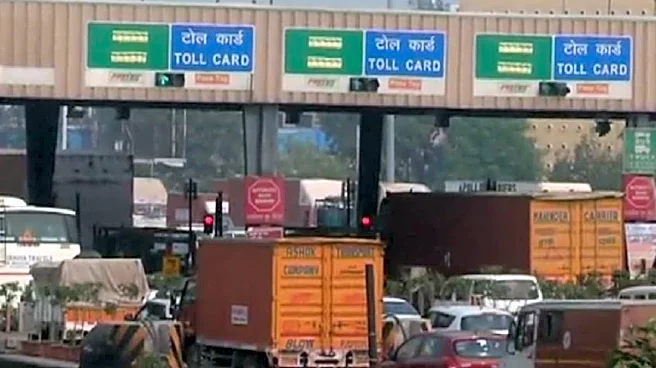
Taking a step further in improving the tolling system, the central government is rolling out barrier-less provisions across 21 fee plazas in India, including five from Delhi-NCR, Minister Nitin Gadkari informed Lok Sabha on Thursday.
He said a Request for Proposal (RFP) to implement a barrier-less tolling system has been invited or finalised across 21 fee plazas, “with the possibility of implementing it on other fee plazas in a phased manner depending upon the outcome and efficacy of the implementation on these projects”.
Of the 21 plazas, six are under the bidding stage, while work has been awarded on 15 of these.
Among those from NCR are the Kukrola, shifted Kherki Daula Fee Plaza, on NH-48 and Badarpur Faridabad Fee Plaza on NH-19, both from Haryana,
along with Bijwasan on the Dwarka Expressway in Delhi. These are under the bidding stage.
The RFP has been awarded for tolls at Mundaka on UER-II in Delhi and Gharaunda on NH-44 in Haryana. The Gharaunda toll falls between Delhi and Chandigarh.
The 21 plazas span nine states and UTs, with the highest concentration in Delhi-NCR at five. Andhra Pradesh, Tamil Nadu, Haryana, and Rajasthan have three tolls selected for the barrier-less tolling, while two each are from Delhi, Gujarat, Maharashtra, and Karnataka. One is from Assam.
A total of eight plazas fall on National Highway 48—connecting Delhi to Chennai. Four are on NH-44, connecting Srinagar and Kanyakumari. Two are on the Bengaluru-Mysuru Expressway.
The 15 fee plazas where the requests for proposals for barrier-less tolling rollout have been awarded are Gharaunda (NH-44) in Haryana, Chorayasi and Boriach on NH-48 in Gujarat, Daulatpura, Manoharpura and Shahjahanpur on NH-48 in Rajasthan, Mundaka on Delhi’s UER-II, Kaniminekhi–Sheshagirihalli and Gananguru on NH-275 in Karnataka, Nemili and Chennasamudram on NH-48, and Paranur on NH-45 in Tamil Nadu, and Kasepalli, Amakathadu and Marur on NH-44 in Andhra Pradesh.
The six plazas that are currently under bidding are Bijwasan on the Dwarka Expressway in Delhi, Kukrola (shifted Kherki Daula) on NH-48 and the Badarpur–Faridabad Plaza on NH-19 in Haryana, Chalakwadi and Hiwargaon Pavsa on NH-50 in Maharashtra, and Madanpur on NH-31 in Assam.
Last year, News18 reported that instead of the satellite-based user fee collection system, the ministry was proceeding with corridor- or stretch-based projects for the implementation of the Automatic Number Plate Recognition (ANPR) FASTag System (AFS)-based Barrier-Less Free Flow tolling.
The data will be captured through the front and rear licence plates and FASTag information. The system uses high-performance cameras to read vehicle number plates and RFID FASTags to deduct tolls automatically without stopping.
The ANPR technology will identify vehicles by reading their number plates, and the existing FASTag system that uses Radio-Frequency Identification (RFID) will deduct the toll.
With the free-flow tolling system, vehicles crossing the toll plazas need not stop there, and the toll can be collected from a moving vehicle.
To ensure smooth and efficient toll collection, the ministry plans to impose stricter penalties for violations, including doubling the toll amount if payment is delayed beyond seven days.
These measures aim to eliminate cash transactions at toll plazas, reduce congestion, and provide commuters with a seamless, barrier-free travel experience on India’s national highways.
/images/ppid_a911dc6a-image-177063642375377933.webp)

/images/ppid_a911dc6a-image-177063614887391562.webp)
/images/ppid_a911dc6a-image-177063607691813949.webp)
/images/ppid_a911dc6a-image-177063603910732315.webp)
/images/ppid_a911dc6a-image-177063617985511206.webp)
/images/ppid_a911dc6a-image-177063611524442751.webp)