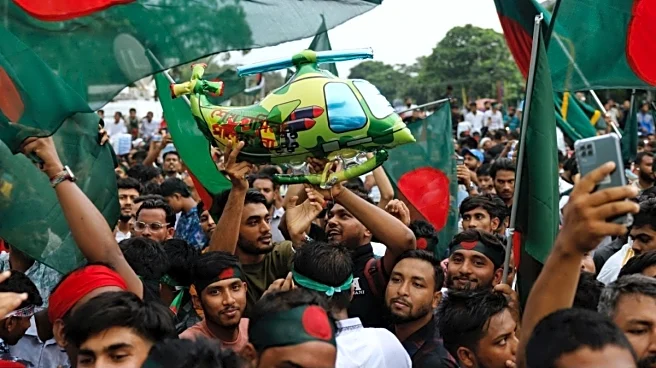


In December 2025, a protest in Dhaka did something unusual. It did not change a law, topple a government, or occupy a ministry. Yet within hours, India summoned Bangladesh’s envoy and visa operations were disrupted. The march itself never reached the Indian High Commission.
The narrative did.
This is the defining political shift underway in the Indian subcontinent. Protests are no longer primarily instruments of domestic bargaining. They are mechanisms for external signalling, designed to force diplomatic reaction, international visibility, and narrative dominance. What appears as disorder is, in fact, a system: a protest economy where outrage substitutes governance and attention becomes leverage.
To understand why this works, one must look beyond
individual incidents and examine incentives, data, and history.
For much of the last decade, Bangladesh was held up as an economic success story. Between 2010 and 2022, GDP growth averaged above 6 per cent. Poverty rates fell sharply. Export earnings crossed $50 billion. Yet institutional trust moved in the opposite direction. Election participation declined. Opposition space narrowed. Courts and regulatory bodies lost credibility in public perception. This divergence — economic growth without institutional consent — created a vacuum.
Political science has a name for this: institutional exhaustion. When formal channels cease to absorb dissent, protest becomes the only remaining site where power can be seen and felt. But protest itself has evolved. In an algorithmic media environment, its success is no longer measured by policy concessions but by reach.
That is why protest language escalates so quickly. Student leaders invoke geopolitics not because they control borders or armies, but because such language travels. A slogan framed in domestic terms mobilises thousands. A slogan framed in sovereignty terms mobilises millions across borders, screens, and newsrooms. The goal is not execution. It is circulation.
India enters this narrative not by accident but by historical design. Since 1971, India has occupied a dual position in Bangladesh’s political memory: indispensable to liberation, yet perpetually available as a symbol of dominance. This duality is empirically visible. Text analysis of Bangladeshi political discourse over decades shows that references to “interference” and “sovereignty” spike during periods of electoral stress and opposition fragmentation. Cooperation is reframed as control precisely when legitimacy is weakest at home.
This pattern is not unique to Bangladesh. The Indian subcontinent has seen it before — most clearly in Pakistan.
Pakistan offers the longest-running dataset of narrative substitution. From the late 1980s onwards, as civilian governance weakened and economic reform stalled, external antagonism filled the legitimacy gap. Anti-India rhetoric became a domestic adhesive. The results are measurable.
Over the same period, the divergence was clear in the data: between 2010 and 2024 Bangladesh’s per-capita GDP nearly tripled from about $882 to $2,625, while Pakistan’s per-capita GDP stood at roughly $1,643 in 2024, illustrating that despite similar starting positions in the early 2010s, Bangladesh’s per-person economic output grew substantially faster and now exceeds Pakistan’s by more than 60 per cent — a structural difference that helps explain why economic capacity has translated into differing political dynamics. Social-sector spending underperformed regional averages. Internal fractures deepened even as foreign policy posturing intensified.
The most revealing evidence lies not in what travels globally, but in what does not.
In recent years, Pakistan’s Hindu minority has repeatedly protested land seizures, forced conversions, and temple demolitions. In Sindh, families, including women and children, have blocked national highways demanding protection from local power brokers. By classical human rights standards, these episodes are severe, sustained, and well documented. Yet they rarely become international causes. They do not trend. They do not generate panels or statements.
This asymmetry exposes the true structure of the protest economy. Suffering is not amplified based on severity. It is amplified based on narrative compatibility. Victimhood must implicate the “right” antagonist, fit existing ideological frames, and offer moral clarity to distant audiences. When it does not, silence becomes policy.
This is what can be called the silence industry: a system that does not lie outright but manages attention so selectively that some realities never fully enter public consciousness.
Information controls during unrest intensify this distortion. Across the Indian subcontinent, governments increasingly restrict internet access during protests. The stated aim is stability. The observed effect is narrative acceleration. When verifiable information collapses, rumours gain authority. Diaspora actors — often well-intentioned, sometimes ideological — fill the vacuum. International media, deprived of local verification, relies more heavily on activist framing.
Empirical studies show that misinformation spreads faster in low-information environments, not slower. During Bangladesh’s unrest, claims travelled internationally within hours, while corrections lagged by days. Diplomatic reactions formed on perception rather than policy. Foreign ministries responded not to legislative change, but to narrative momentum.
This is how domestic protest becomes foreign policy without passing through institutions.
The choice of embassies as protest destinations follows the same logic. Historically, crowds gathered at parliaments because that is where decisions were made. Today, embassies are targeted because they are where narratives crystallise. A protest near a foreign mission compresses complexity into imagery. It forces reaction without negotiation. It internationalises grievance without resolving it.
Data across the region and beyond show that diplomatic-mission-adjacent protests are a structural feature of political stress, not isolated eruptions of extremism. Earlier in 2024, in Islamabad, police prevented a large pro-Palestinian sit-in from reaching the US Embassy’s high-security district; the rally, organised by a major Islamist party, was explicitly bound up with domestic reactions to geopolitical developments in Gaza and was only contained near the embassy perimeter after law-enforcement intervention.
These are not unique cases. Outside the Indian subcontinent, similar patterns recur: in March 2023, a pro-Khalistan mob in London scaled the Indian High Commission and tore down the national flag, prompting diplomatic protests from New Delhi to the United Kingdom and official demands for better protection of its diplomatic premises. In the Democratic Republic of Congo in January 2025, protesters angered by their government’s handling of conflict targeted multiple embassies, including those of France, Belgium, the United States, and the United Nations, by setting fires to gates and prompting formal condemnations and security responses.
Even diaspora politics reflect this pattern: large protest gatherings occurred outside Indian diplomatic missions in Europe during the Citizenship Amendment Act demonstrations in 2019-20, with hundreds assembling at Indian embassies in London, Paris, Berlin, and Munich to signal both domestic grievance and international solidarity.
What unites these divergent cases is not a common ideology, but a common political logic: when internal legitimacy is in question, protests migrate towards visible, high-attention targets like embassies and missions to amplify their cause and provoke reactions that domestic media, foreign governments, and global audiences cannot ignore. This pattern of embassy-proximate demonstrations spiking in moments of political stress reflects not radicalisation per se, but an adaptation to an attention economy in which symbolic proximity to state actors abroad amplifies a movement’s impact far beyond its original domestic footprint.
But adaptation has costs. When politics relies on external reaction rather than internal consent, sovereignty becomes performative. The street gains veto power without responsibility. The state appears assertive while losing coherence.
Bangladesh now stands at a familiar crossroads. With elections scheduled for early 2026, incentives favour visibility over restraint. The most likely short-term outcome is controlled volatility: periodic protest spikes, calibrated anti-India rhetoric, and manageable diplomatic friction. The risk lies in escalation, where a single symbolic incident produces sustained economic and diplomatic consequences. The least likely but only stabilising outcome is institutional repair: credible elections, disciplined student politics, and a media ecosystem that interrogates power rather than amplifying rage.
For India, history offers a clear lesson. States that personalise neighbours’ domestic crises become permanent antagonists regardless of intent. Procedural firmness combined with rhetorical restraint has consistently produced better long-term outcomes than narrative engagement.
The author is a practising advocate. She writes articles on women’s rights, politics and law. Views expressed in the above piece are personal and solely those of the author. They do not necessarily reflect News18’s views.




/images/ppid_59c68470-image-177069761118650612.webp)