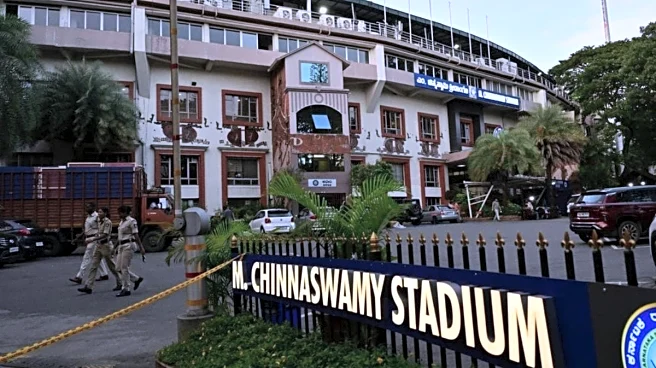

Months after a tragic stampede claimed lives outside Bengaluru’s iconic M. Chinnaswamy Stadium, the Karnataka State Cricket Association has taken a symbolic and procedural step before restarting cricket
matches at the venue. On December 22, KSCA organised a havana/havan, a traditional fire ritual, inside the stadium premises, seeking divine blessings and safety as preparations begin for the resumption of games.
The ritual was conducted in the backdrop of the June stampede that occurred during victory celebrations following Royal Challengers Bengaluru’s maiden IPL title win. What was meant to be a moment of sporting celebration turned into chaos, resulting in the deaths of 11 people and casting a long shadow over the stadium’s safety arrangements. In the aftermath, matches at Chinnaswamy Stadium were halted, pending investigations and corrective measures.
A Symbolic Reset Before Cricket Returns
Officials said the religious ceremony was intended as a prayer for the safety of spectators and players, and as a gesture to mark a fresh beginning before cricket returns to the venue. While such rituals are not uncommon in public institutions after major incidents, the timing of the havana is closely linked to the government’s recent decision to allow matches to resume under strict conditions.
The move comes after sustained efforts by the newly appointed KSCA president, Venkatesh Prasad, who has been engaging with the state government and police authorities to ensure compliance with safety norms laid down after the tragedy.
Government Clears Matches With Conditions
The Karnataka government has granted permission for matches to resume at Chinnaswamy Stadium, but only if a detailed set of safety requirements is followed. The Home Department has issued 17 mandatory conditions that must be implemented before spectators are allowed back in significant numbers.
These conditions were framed based on the findings of the Justice Michael D. Cunha Committee, which was constituted to examine the causes behind the stampede and recommend preventive measures. The committee’s mandate includes crowd management, entry and exit protocols, coordination between organisers and police, emergency response planning, and infrastructure-related safeguards.
Committee Review and Next Steps
The Justice Michael D. Cunha Committee shared details of its recommendations with the media and is scheduled to hold further discussions with government officials. Home Minister G. Parameshwara said that a final decision on which matches can be held, along with attendance limits and operational protocols, will be taken after the committee’s meeting.
Officials indicated that permissions may be granted on a case-by-case basis, depending on the scale of the event, expected crowd size, and the organiser’s preparedness to meet the prescribed conditions.
A Stadium Under Scrutiny
Chinnaswamy Stadium, one of India’s most recognisable cricket venues, sits in the heart of Bengaluru, surrounded by busy roads and commercial areas. While its central location has long been seen as an advantage, the stampede exposed serious gaps in crowd control during high-emotion events.
The tragedy has forced authorities to re-evaluate how large-scale celebrations and matches are handled, especially when spontaneous crowds gather beyond ticketed spectators.
Balancing Faith, Safety, and Sport
For KSCA, the religious rituals mark only one part of a larger reset. The real test lies in how effectively the 17 safety conditions are implemented on the ground. While prayers may offer emotional closure for some, officials acknowledge that strict enforcement, planning, and coordination will determine whether the stadium can safely host matches again.
As cricket prepares to return to Chinnaswamy Stadium, the focus remains firmly on ensuring that celebrations never again turn into tragedy.
/images/ppid_a911dc6a-image-177090209934057401.webp)

/images/ppid_a911dc6a-image-177090206860094611.webp)
/images/ppid_a911dc6a-image-177090203309067592.webp)
/images/ppid_a911dc6a-image-177090206584574622.webp)
/images/ppid_a911dc6a-image-177090203236054475.webp)