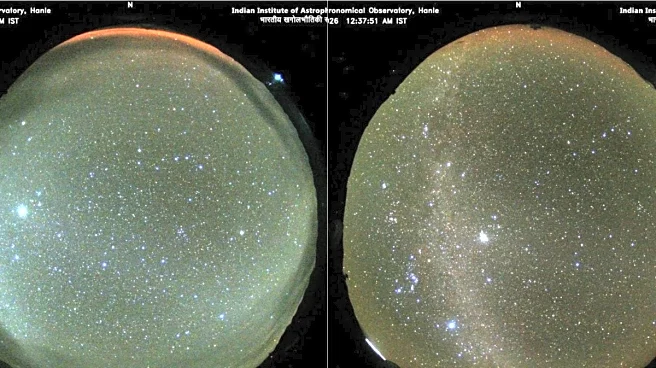

Ladakh skies lit up again this January. For the sixth time this solar cycle, scientists at India’s astronomical observatory at Hanle have captured deep red auroral activity on January 19 and 20 nights
using its all-sky cameras.
This auroral display is caused by coronal mass ejections (CME), which are large amounts of plasma and magnetic fields ejected from the sun’s atmosphere – the corona.
Some of this can hit Earth in a matter of a few hours or even days and produce geomagnetic storms. Scientists study them because when extreme, these storms can harm space technology, disrupt radio communication and GPS signals.
The Indian Institute of Astrophysics (IIA) in Bengaluru explained that the aurora recorded at Hanle was due to a strong geomagnetic storm, which began around 3.30 am on January 20. It reached its maximum intensity at 8.30 pm on January 20.
“During the ongoing 25th solar cycle, only six geomagnetic storms stronger than 200 nT have been recorded that were capable of producing auroras at low latitudes. In this case, a coronal hole surrounding the sun’s active region likely helped the CMEs to reach Earth within 24 hours,” said P Vemareddy, a solar astrophysicist at the IIA.
According to US space agency NASA’s remote-sensing observations, the storm resulted from the interaction of a CME, which was expelled from the sun around 11.30 pm on January 18 at a speed of at least 1,400 km/second. Scientists said in terms of space-weather severity, the event can be classified as a G4-level geomagnetic storm with an S4 radiation level.
The team at Hanle used a combination of ground-based and space-based observations, and investigated the processes behind these storms to better understand the sun’s influence on Earth.
“Aurora was previously imaged at Hanle on five occasions from 2023 to 2025. Though aurorae are usually seen at high altitudes, the current solar cycle is strong enough to have caused many aurorae to be seen at latitudes as low as Ladakh, and captured from the observatory in Hanle. This also showcases the importance of preserving the darkness of the night sky at the Hanle Dark Sky Reserve,” said Dorje Angchuk, engineer-in-charge at the observatory.
The IIA operates the Indian Astronomical Observatory with centres at Hanle, Leh and Merak in Ladakh.



/images/ppid_59c68470-image-177104254494215325.webp)

/images/ppid_a911dc6a-image-177104210287325129.webp)

/images/ppid_a911dc6a-image-177104202793221357.webp)
/images/ppid_a911dc6a-image-177104206710214315.webp)
/images/ppid_a911dc6a-image-177104202907093694.webp)
/images/ppid_59c68470-image-177104014803952296.webp)
/images/ppid_59c68470-image-177104006389961167.webp)
/images/ppid_a911dc6a-image-177103853218557950.webp)