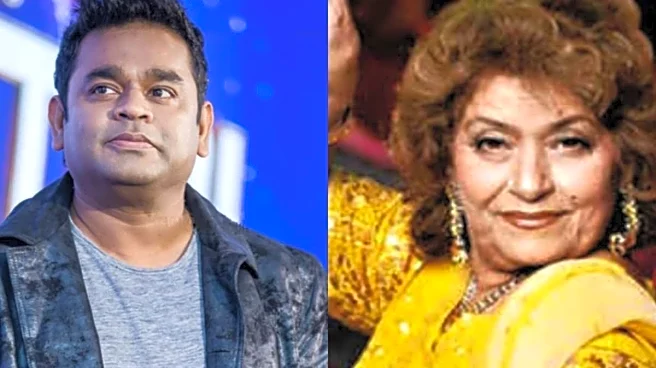

Ahmed Khan may be known today as a director, but the turning point of his career came three decades ago, when Ram Gopal Varma handed him the choreography of Rangeela — a film that didn’t just redefine
Hindi cinema’s grammar in the 1990s, but also launched an artistic trifecta: A.R. Rahman’s Hindi breakthrough, Manish Malhotra’s fashion revolution, and Ahmed’s own rise as one of Bollywood’s most inventive dance minds.
Looking back at that era for the inaugural edition of SCREEN Spotlight, Ahmed still sounds bewildered by how casually his life changed.
“To my surprise, I still don’t know why Ram Gopal Varma offered me that film,” he laughed. “I was a very young boy, and in 1994, it was almost impossible to just walk into a studio. And here he was, offering me a film. I couldn’t tell if it was real or if he was joking.”
At the time, Ahmed was an assistant to Saroj Khan — the busiest choreographer in the country. Whenever Saroj ji was double-booked or shooting abroad, her assistants had to step in. One of those days, Saroj Khan was out of India and the shoot for Rangeela came up. Ahmed reached the set to represent his guru, assuming it would be a routine fill-in.
“Ramu saw that I’d come in place of Saroj ji,” Ahmed recalled. “Within half an hour, I don’t know what caught his eye, but he asked me to come again the next day.”
After wrap-up that evening, Varma took Ahmed into the editing room and showed him the cut of “Tanha Tanha.” The young choreographer was stunned.
“There was no continuity,” Ahmed remembered. “Urmila was suddenly running, Jackie Shroff was sitting somewhere, a wide shot became a close-up, they were together in one frame and apart in the next. He broke every rule. But I used to do a lot of music videos back then, so that non-linear edit pattern felt exciting to me. I loved it.”
The next day, during the shoot for “Haye Rama,” Varma unexpectedly pulled him aside. Ahmed assumed he was about to be asked to step away so that Saroj Khan could take over the project. Instead, Varma bluntly revealed his real plan.
“He told me, ‘Let me cut the chase short — I want you to do Rangeela. I’m not taking Saroj Khan; her dates aren’t matching. I may go to a South choreographer like Prabhu Deva or Raju Sundaram. If you want to do it, do it. At least it will stay in the family.’”
Ahmed didn’t know how to respond. He told Varma he wasn’t sure whether he was ready for something this big. So he went back to his guru.
“Saroj ji was very happy,” he said. “She blessed me and said, ‘Go do it. The music is so different… even I’m not getting that vibe. You guys will enjoy it.’ It was Rahman’s first Hindi score — nobody had heard anything like that before.”
With Saroj Khan’s blessing, the responsibility of choreographing what would become a landmark soundtrack fell squarely on Ahmed’s shoulders. Varma’s brief was as unconventional as the film itself.
“Ramu told me, ‘Rahman has pushed himself for this Hindi film, so don’t stress about anything. You have nothing to lose. Go full-blown — I want the frenzy of a young boy in these songs.’”
That freedom shaped everything Ahmed created for Rangeela. The film’s explosive musical language, Rahman’s genre-bending compositions and Varma’s restless camera all pushed him to think beyond traditional Bollywood choreography.“That difference in Rahman’s composition enhanced my capability as a choreographer,” Ahmed said. “It made me come forward and give those kinds of steps. Otherwise, it wouldn’t have happened.”
Nearly 30 years later, Rangeela remains a benchmark in pop culture — and a reminder of how a single risk, taken by a director on a young assistant choreographer, rewrote the visual and musical vocabulary of an entire decade.




/images/ppid_a911dc6a-image-177088105837360575.webp)

/images/ppid_a911dc6a-image-177088102480749256.webp)
/images/ppid_a911dc6a-image-177088109440221446.webp)
/images/ppid_a911dc6a-image-177088108433540521.webp)
/images/ppid_a911dc6a-image-177088105408391550.webp)