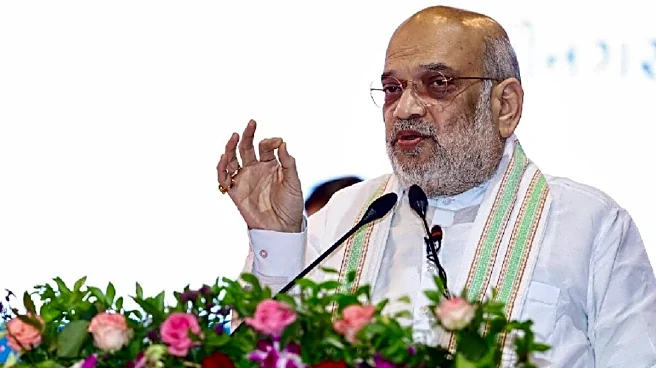


A day after the last local terrorist in Kashmir, Lateef Bhat, was eliminated, Union Home Minister Amit Shah called for a unified approach to strike at the “entire terror network”, ranging from financiers to harbourers.
Speaking at the Anti-Terror Conference, Shah congratulated the security forces for the breakthrough in Kashmir, which has, for the first time, rendered the Valley free of any local terrorist, according to police records.
“We must target the entire chain of terror financing, which requires better coordination with financial investigation agencies. We will not achieve success unless we strike at the entire terrorist network in a coordinated and comprehensive manner,” Shah said, according to a statement from the Ministry of Home Affairs
(MHA).
He added that state police and law enforcement agencies must work towards a model “to apprehend terrorists and put them behind bars even before they can execute a terrorist incident”.
Urging better coordination among states and within agencies, Amit Shah called for “shared and collective goals, along with clearly defined accountability”.
“Unless our goals are shared and accountability for achieving them is clearly established, success cannot be achieved,” he emphasised.
He also stressed that the concept of proactive action in India’s counter-terrorism policy must be strengthened, with greater emphasis on structural and operational capabilities.
Details have emerged showing how human intelligence, combined with seamless coordination across agencies, led to the elimination of Lateef without collateral damage. Highlighting the role of actionable intelligence in such operations, the Home Minister said the need of the hour is to “develop a mechanism through which police station-level intelligence is transmitted through multiple levels to the Director General of Police (DGP), enabling the extraction of actionable intelligence”.
Shah noted that an integrated system is being built so that police stations across the country operate under a unified strategy to combat terrorism.
New-Age Terrorism
Acknowledging the threat of new-age terror, the Home Minister called on the Anti-Terrorism Squads (ATS) of every state to strengthen their cyber expert units. ATS capabilities across states must be enhanced, and a Quadrangular Regional Security Grid in border states should be a key priority, he added.
Not only investigation and law enforcement, but intelligence gathering is also being upgraded in this regard, according to the Home Minister.
“By expanding the scope of the Multi Agency Centre (MAC) to include cyber security, narco-terrorism, and emerging radicalisation hotspots, and by establishing a National Memory Bank, we have laid a new foundation for strengthening our preparedness,” the Home Minister told the conference.
‘Fugitives Abroad Must Be Brought Back
Congratulating intelligence agencies and the Central Bureau of Investigation (CBI) for successfully bringing back more than 300 fugitives from 36 countries, the Home Minister said that to completely eliminate terrorism, organised crime, and drug-related threats, it is essential to bring offenders hiding abroad back to India. Since 2019, 303 fugitives have been brought back to India from 36 countries, according to an MHA statement.
The National Investigation Agency (NIA) has also now been empowered to protect the interests of Indians living abroad, Shah said.