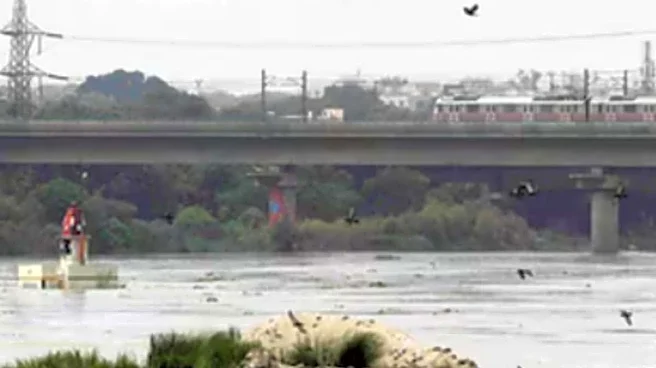

The Rekha Gupta-led Delhi Government on Wednesday announced its ambitious mission to clean the Yamuna by 2028, setting a fixed deadline to stop the discharge of untreated sewage into the river and restore
it as the city’s lifeline.
Chief Minister Rekha Gupta said the plan would be implemented in mission mode, combining fixed timelines, technological monitoring and coordination with neighbouring states.
“Yamuna is not merely a river, but the lifeline of Delhi. The government is continuously working to rejuvenate it through scientific planning and inter-state coordination,” she said.
A key component of the plan is doubling Delhi’s sewage treatment capacity from the current 814 million gallons per day (MGD) to 1,500 MGD by 2028. The city currently operates 37 sewage treatment plants (STPs), which are meeting present requirements. However, keeping future needs in mind, the government has set a higher capacity target, in line with directions given last year by Union Home Minister Amit Shah.
Doubling STP Capabilities
According to an official statement, existing machinery will be upgraded by December 2027 to add 56 MGD capacity. In addition, 35 new decentralised sewage treatment plants will add 170 MGD, while large new plants near major drains will contribute another 460 MGD by December 2028.
“In addition, 170 MGD additional capacity will be created through 35 new decentralised sewage treatment plants (DSTPs). Furthermore, by installing new large plants near drains, an additional 460 MGD capacity will be added by December 2028, ensuring a robust and future-ready sewage management system for Delhi,” the government said.
The aim is that untreated sewage will no longer flow into the Yamuna. As treatment capacity increases, more wastewater will be treated before being discharged into the river.
This will gradually improve water quality, reduce foul odour and pollution, and help restore life to the river.
In the long term, this will safeguard drinking water sources, improve public health, and provide Delhi with a sustainable sewage system for its growing population.
Sewer Connection In Unauthorised Colonies
The government also plans to connect all 1,799 unauthorised colonies in Delhi to the sewer network in a phased manner between December 2026 and December 2028. Work on sewer lines in JJ clusters is being expedited, with sewer infrastructure already completed in 574 of the city’s 675 JJ clusters. Arrangements for single-point sewage collection are being made in 65 clusters.
“Out of 675 JJ clusters, work has been completed in 574, while arrangements for single-point sewage collection are being made in 65 clusters,” the government added.
To curb industrial pollution, the government will carry out regular inspections of common effluent treatment plants in planned industrial areas and take strict action against polluting units in unplanned zones.
Drain Monitoring System
For the first time, Delhi will also introduce a comprehensive drain-monitoring system. Drone mapping of 22 major drains flowing into the Yamuna will be undertaken, with monthly water quality testing at 47 locations by teams from the Delhi Pollution Control Committee and the Central Pollution Control Board.
Drone surveys to identify and inspect all minor drains connected to the Najafgarh and Shahdara drains will be completed by January 2026, while surveys of the remaining drains will be completed by the Delhi Jal Board by June 2026.
The objective is to accurately identify the sources and volume of pollution entering the river so that it can be effectively prevented.
Role Of Neighbouring States
The Chief Minister stressed that cooperation with neighbouring states is essential to make the Yamuna clean.
Six drains from Haryana contribute around 33 per cent of the pollution entering the Najafgarh drain, while four major drains from Uttar Pradesh account for nearly 40 per cent of the pollution in the Shahdara drain.
Gupta said she would personally raise the issue with the Chief Ministers of Haryana and Uttar Pradesh to work out a solution.



/images/ppid_59c68470-image-177102753183257032.webp)


/images/ppid_a911dc6a-image-17710264327998831.webp)

/images/ppid_a911dc6a-image-177102646607765106.webp)