

The show must go on is an old theatrical maxim, but Vithabai Narayangaonkar appears to have taken it to an almost unfathomable extreme. Nine months pregnant, she was performing before a live audience when labour pains struck. What followed sounds like something a screenwriter might hesitate to put on paper for fear of being accused of creative excess.
Vithabai reportedly slipped away from the performance, delivered her baby backstage and, in a detail that makes the entire episode almost impossible to fathom, cut the umbilical cord with a stone. But even childbirth had seemingly failed to convince her that the night’s performance was over. She was preparing to return to the stage when news of what had transpired reached the audience.
This time,
however, the fans weren’t willing to let the show go on. It is a story that has since become inseparable from Vithabai’s legend, offering a glimpse into the extraordinary lengths to which she went to honour a profession that was both her inheritance and her livelihood.
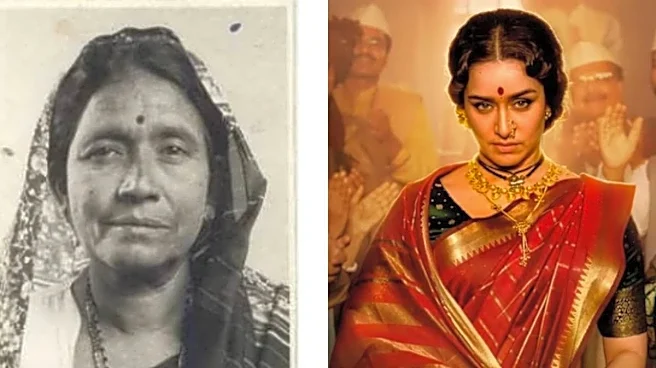
Born into a family of travelling Tamasha performers, Vithabai would eventually ascend to the throne of Maharashtra’s folk theatre, earning the formidable title of ‘Tamasha Samradni’ or Empress of Tamasha. But the crown came with its share of thorns. Now, with Shraddha Kapoor stepping into her shoes in ‘Eetha’, Vithabai’s extraordinary journey is receiving renewed attention. But before the silver screen takes over, there is a remarkable real-life story worth revisiting.
Born Into Tamasha: The Family Legacy That Shaped Vithabai
For Vithabai, the performing arts were never a distant ambition or a career she stumbled upon. They were the family inheritance. Born on July 1, 1935, in Pandharpur, Maharashtra, Vithabai Bhau Mang Narayangaonkar grew up in a household where the stage was both a workplace and a way of life. Her grandfather, Narayan Khude, had established a travelling Tamasha troupe, a legacy subsequently carried forward by her father, Bhau Bapu Narayangaonkar, and other family members under the name Bhau-Bapu Mang. The family travelled across Maharashtra, taking their performances from one village to another.
Vithabai’s education in the performing arts happened on the road. Her classroom was the travelling troupe, and her lessons came from watching seasoned performers command the stage. She grew up absorbing the rhythms of Lavani, Gavlan and other folk performance traditions, gradually finding her own footing within the demanding world of Tamasha.
Financial difficulties within the family brought her into the profession at a young age, initially to help support the household. But Vithabai was not destined to remain another face in the troupe. Her expressive dancing, formidable stage presence and instinct for entertaining a live audience soon began setting her apart. The young girl who had stepped onto the stage to help her family would eventually become its undisputed star.
From Village Stages To The Crown Of Tamasha Samradni
To understand the stature Vithabai eventually commanded, one must first appreciate the world of Tamasha. One of Maharashtra’s most distinctive folk theatre traditions, it is a richly layered performance form that brings together music, dance, satire, humour and dramatic storytelling. Lavani, with its vigorous footwork, rhythmic precision and expressive gestures, remains one of its most recognisable components.
But Tamasha is hardly just about the spectacle of dance and elaborate costumes. It calls for an artiste who can sing, perform, improvise, entertain and hold the attention of an audience through an entire show. The stage is unforgiving, and the audience is an immediate critic.
Vithabai had an instinctive command of this theatrical grammar. A significant turning point came when celebrated Marathi playwright Mama Varerkar watched her perform and was sufficiently impressed to invite her to join his troupe.
The association gave her an opportunity to broaden her theatrical repertoire and refine her understanding of performance. Her reputation soon travelled beyond the villages and travelling circuits where Tamasha thrived. She eventually acquired the title ‘Tamasha Samradni’, the Empress of Tamasha.
Nine Months Pregnant, One Performance And An Extraordinary Return To The Stage
Of all the stories associated with Vithabai, the childbirth episode remains perhaps the most astonishing. According to widely reported accounts, she was nine months pregnant when labour pains began during a Tamasha performance. She reportedly retreated backstage, delivered her child without medical assistance and cut the umbilical cord with a stone. What makes the episode even more extraordinary is that she was said to have prepared to return to the stage. The audience, upon discovering what had happened, reportedly intervened and insisted that she rest.
When Bollywood Came Calling, Vithabai Chose Her Troupe
For an artiste whose reputation had travelled well beyond Maharashtra’s Tamasha circuit, opportunities outside folk theatre were perhaps inevitable. One of the most intriguing accounts of Vithabai’s career involves an offer from legendary filmmaker Raj Kapoor. Impressed by her performance, he reportedly offered her a role in one of his films. For someone working in the world of travelling folk entertainment, mainstream cinema could have opened an entirely different avenue of recognition, visibility and financial opportunity. Vithabai, however, is said to have declined.
The reason was rooted in her commitment to the troupe. Speaking to The Indian Express, Shantanu Ghule, who created the Marathi stage production Vitha based on her life, said Vithabai believed that leaving Tamasha for films would put at risk the livelihoods of the many artistes and their families who depended on the travelling company.
Behind The Applause: A Troubled Marriage And Personal Hardships
The woman who commanded audiences with such authority had considerably less control over the circumstances of her personal life. Vithabai’s marriage to Maruti Sawant was reportedly troubled, with accounts of domestic abuse and financial exploitation.
Reportedly Sawant took the money she earned from performances and subjected her to physical abuse. It is a disturbing contrast to the formidable public persona she had cultivated over decades.
Her circumstances also reflected a larger vulnerability within the folk entertainment economy. Tamasha artistes could enjoy enormous popularity, draw packed audiences and become household names within their communities without necessarily accumulating financial security.
Presidential Honours And A Legacy That Outlived The Stage
Vithabai’s contribution to Maharashtra’s folk theatre eventually earned recognition at the highest level. She received Presidential medals for her work in Tamasha in 1957 and again in 1990, an extraordinary distinction that acknowledged her contribution to India’s folk performing arts. During the 1962 Sino-Indian War, she reportedly performed for Indian soldiers near the North-East Frontier Agency region.
Vithabai actively worked towards the welfare of fellow Tamasha artistes and advocated for better support systems for performers whose livelihoods remained precarious. Reports credit her with helping secure pensions for folk artistes from the Maharashtra government. It was a cause close to her heart, given the economic uncertainties that had shadowed the profession she had spent her life championing.
Yet, for all the honours and acclaim, her final years were marked by a particularly cruel irony. Vithabai died on January 15, 2002, following a paralytic attack. Reports from the time revealed that her family struggled to arrange money to settle her hospital bills and transport her body home for the last rites.
The expense was eventually met with assistance from admirers, cultural organisations and well-wishers. The woman who had spent decades entertaining audiences and received recognition from the President had, in her final hours, little financial security to fall back on.
In 2006, the Maharashtra government instituted the Vithabai Narayangaonkar Lifetime Achievement Award in her memory. The honour recognises senior Tamasha artistes for their contribution to preserving and promoting the traditional folk art form.
More than two decades after her death, Vithabai’s life is finding a new audience through Eetha, with Shraddha Kapoor portraying the legendary performer. The film takes its title from Eetha, a local pronunciation of Vitha, the nickname associated with Vithabai. Directed by Laxman Utekar, the project ventures into the world of Maharashtra’s folk theatre and the personal circumstances that shaped the artiste’s life.