
/images/ppid_59c68470-image-178837003119596857.webp)
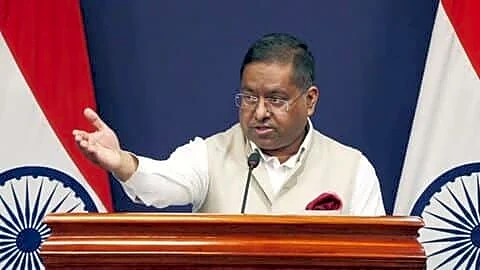
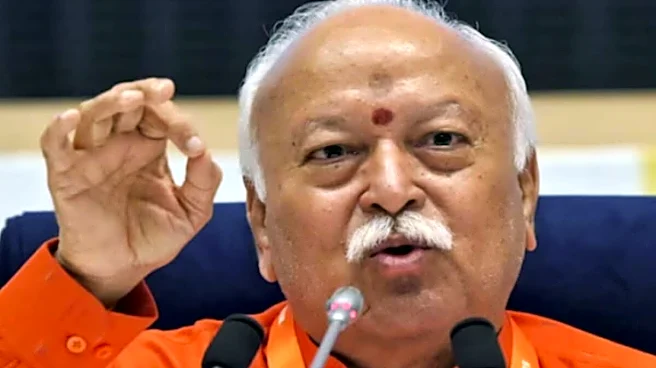
Mohan Bhagwat’s diaspora outreach as part of the RSS’s centenary celebrations, which began with a packed house at Madison Square Garden, has exposed an uncomfortable truth that the global far left compounded with Islamists, Khalistani militants and sections of the Hindu fringe find equally difficult to accept.
His central message is plain: Muslims are part of India’s civilisational and national reality, and a Hindu who wants a Muslim-free India has misunderstood Hindutva in its entirety.
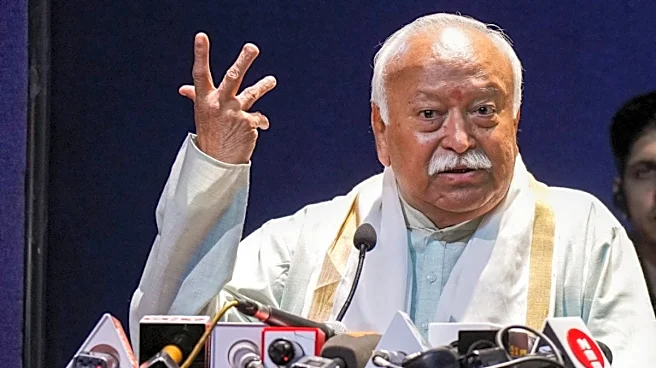
On 29 August 2026, more than 5,000 people filled the Infosys Theater at Madison Square Garden for an event organised by American Hindus for Engagement and Dialogue. Halfway into his speech, Bhagwat preempted a question many in the room likely carried about the RSS
view on Muslims within the framework of a Hindu Rashtra. He said, “If any Hindu thinks that there should be no Muslims in Bharat, he is not a Hindu.”
He went further, placing the statement within a broader proposition – humanity is one, that different faiths represent different paths, that every human being possesses dignity and that diversity is not something to be merely tolerated but protected. In other words, Bhagwat was not making a tactical concession to Muslims. He was presenting what he believes to be the civilisational logic of Hindutva itself.
The controversy surrounding Bhagwat’s visit is therefore not simply about one speech. It is about whether India can discuss nationalism, religious identity, historical trauma and the uncomfortable reality of Muslim politics without collapsing into abuse and censorship.
The coalition against him
The coalition against him did not treat the sentence as evidence. New York Mayor Zohran Mamdani, prior to the visit, already said he did not support the convention and called the RSS vision exclusionary while also conceding he lacked jurisdiction to kill a private event. Indian National Congress-backed and affiliated Hindus for Human Rights announced that Bhagwat does not represent Hindus. Jamaat-e-Islami Hind-backed IAMC and allied platforms joined the City Hall pressers. Pieter Friedrich, an anti-RSS activist, published a video framing the booking as a Nazi-inspired occupation of the Garden and demanding Mamdani stop it. USCIRF asked for the visa to be pulled. Sixty-plus groups issued joint denunciations. The method was not rebuttal. It was preemption born out of the worry that Mr Bhagwat should not be heard because hearing him might change the file and provide him legitimacy by Western policy think tanks, policymakers and polity.
That is intolerance of those who masquerade around as free speech absolutists for a contrarian viewpoint, and politics stood starkly exposed.
Khalistani-aligned activists, caste campaign networks, Islamist lobbies and progressive electives shared a single anxiety. Bhagwat in a Western hall speaking English to think tanks and diaspora donors might force a rewrite of the RSS equals fascism template. The fear has been his legitimacy.
There is, of course, nothing illegitimate about criticising Bhagwat, the RSS or Hindutva. An organisation with a century-long political and social history should be scrutinised. Its ideology, organisational culture, political relationships and record should all be open to examination. But criticism and cancellation are not synonyms. If the argument is that Bhagwat is wrong, then the most powerful response is to let him speak and demonstrate why he is wrong.
A pluralist society cannot operate on the principle that an individual should be denied a platform because his words might complicate a narrative that activists have spent years constructing around him. If the RSS is as irredeemably fascist as its critics insist, surely the argument should survive a speech.
The founding context they skip
The founding context most of these people skip is not trivia.
Keshav Baliram Hedgewar built the RSS in Nagpur in 1925 after the Khilafat years, the 1921 Moplah violence in Malabar and the 1923 Nagpur riots. He had been a Congressman. He concluded that Hindu society was unorganised while pan-Islamic mobilisation and street communalism were not.
The chronology matters, but so does precision. It would be too simplistic to claim that the RSS was founded solely as a reaction to the Khilafat movement or the Moplah rebellion. Hedgewar’s project was broader.
He believed Hindu society was socially fragmented and required organisation, discipline and consolidation. Yet the communal and pan-Islamic mobilisation of the preceding years undeniably formed part of the political environment in which those conclusions were reached.
A century later, Mr. Bhagwat cited 130,000 service projects and non-discriminatory relief.
Sardar Patel, in 1947, who banned the RSS, did so with the aim of ensuring the Hindu allegiance and consolidation remained rooted towards the Congress rather than splinter. However, he still wrote that RSS men did service to Hindu society and protected women and children where the state was thin. That mixed ledger is history. The protest script uses only one column.
That is an important distinction. Service does not erase controversy, just as controversy does not erase service. An organisation should be judged on the totality of its record rather than through either hagiography or caricature.
The rise of Muslim separatism in India, starting with the likes of Shah Waliullah providing a structure to Muslim politics, compounded with the Mappilla riots of 1921, is one example of why many Hindus developed a deep historical distrust of pan-Islamic politics. Yet the episode must be studied carefully rather than converted into a one-line morality tale. Accounts document mass and barbaric violence against Hindus, forced conversions and attacks.
The correct lesson is neither that all Muslims were responsible nor that communal atrocities should be dissolved into an abstract class narrative. Historical honesty requires both propositions to be held together.
Muslim communities cannot collectively be indicted for crimes committed by their ancestors or in the name of Islamic mobilisation. There are many in India who continue to sanitise those brutalities and excesses while whitewashing the criminalities.
But this distinction cuts both ways. A contemporary Muslim citizen cannot reasonably be held responsible for the actions of the Muslim League, the perpetrators of the Moplah violence or Islamist movements. Equally, a contemporary Hindu cannot be held collectively responsible for every act of violence committed by someone claiming to act in the name of Hindutva. Collective guilt is a terrible foundation for a modern republic.
The politics of the 1940s
The same principle applies to the politics of the 1940s.
Muhammad Ali Jinnah and the Muslim League’s call for Direct Action Day on 16 August 1946 led to the mass mobilisation of Muslim separatists in Calcutta, which facilitated brutal anti-Hindu riots in which thousands were killed. The violence was followed by reprisals and helped accelerate the political crisis that culminated in Partition.
Remembering Direct Action Day is not an argument against Indian Muslims. It is an argument against the romanticisation of Islamic politics.
And this is where historical memory becomes politically inconvenient. On 28 May 1937, Muhammad Iqbal wrote to Jinnah that the enforcement and development of Shariat in India was impossible without a free Muslim state or states, and described a single Indian federation as effectively hopeless. Whatever one’s contemporary political vocabulary, these were arguments for Muslim political distinctiveness, not for an uncomplicated secular nationalism.
Likewise, Direct Action Day cannot be removed from the historical record simply because it complicates contemporary narratives. The Muslim League’s call for direct action over the Pakistan question was followed by the Great Calcutta Killing, in which thousands of Hindus and Muslims were killed. The subsequent retaliatory violence only deepened the communal catastrophe.
None of this makes every Muslim responsible for Direct Action Day. It establishes something much simpler: communal politics did not have a single protagonist, and history cannot honestly be written as though only one community ever mobilised religious identity for political ends.
The other flank
The other flank is less televised and just as useful to name.
A Hindu Right fringe heard Bhagwat’s New York line as betrayal. If a Hindu who denies Muslims a place in India will not remain Hindu, then demographic panic dressed as theology is out of the creed.
That fringe is reacting to real scars: Partition, excesses against Pakistan’s minorities, Kashmiri Pandits, periodic riot cycles and the memory of League politics.
Trauma is not an argument for ethnic cleansing.
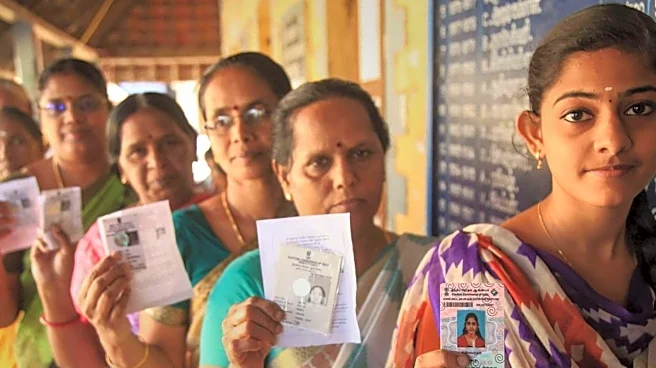
India has around 200 million Muslims, not 20 million, citizens by birth, vote and passport. Pretending they can be wished away is not Hindutva. It is a fantasy that would shatter the republic the Sangh claims to defend. Bhagwat said so in 2018 in Delhi and again in 2026 in New York.
The correction here is important: Census 2011 recorded 17.22 crore Muslims, or 14.2% of India’s population. Government projections subsequently put the Muslim population at approximately 19.75 crore in 2023 if the 2011 proportion is applied. So the argument is not about 20 million Muslims but roughly 200 million Indians.
The hardliners who reject that sentence are not defending Savarkar’s civilisational nation. They are defending a grudge.
Bhagwat’s formulation was direct. He has said that Islam will remain in India and that Hindus and Muslims are already one people whose forms of worship differ.
This is a pragmatic political and civilisational argument.
India’s Muslims are not a temporary presence awaiting historical correction but are citizens, neighbours, voters, soldiers, professionals and communities rooted in the country.
The 2011 Census recorded 17.22 crore Muslims, 14.2 per cent of India’s population, making Islam the country’s second-largest religion.
Any politics that imagines India without its Muslims is not merely unrealistic but entirely incompatible with the constitutional and demographic facts of the republic.
And there is a deeper philosophical point here. If Hindutva is to be understood as a civilisational rather than exclusionary idea, then the existence of Indian Muslims is not a problem to be solved. It is a reality to be incorporated into the national story. A confident civilisation does not require demographic purification to establish its legitimacy.
The workable distinction
The workable distinction is simple and routinely sabotaged.
Indian Muslims as people are not the same object as exclusionary Muslim politics.
All India Muslim Personal Law Board still organises as a clerical veto on civil equality. Waqf administration still sits on hundreds of thousands of properties under a parallel property regime that Parliament has tried messily to audit through the 2025 amendment and the UMEED portal. Those institutions can be criticised with statutes, land records and court files.
Conflating every Muslim neighbour with AIMPLB or a Waqf claim is sloppy. While for Muslims, refusing to criticise the Board because the word “Muslim” appears in its name is the mirror sloppiness.
Our objective should be to debate the institutions that engineer exclusionary politics in a liberal democracy, in the garb of minority rights.
A serious national debate must distinguish between Muslims and Muslim political institutions.
Now put the 1937 letters back on the table
Now put the 1937 letters back on the table because the “who is the fascist?” question was answered in writing long before Madison Square Garden.
On 28 May 1937, Iqbal told Jinnah that the enforcement and development of the Shariat of Islam was impossible in India without a free Muslim state or states and that a single Indian federation was, in his view, hopeless.
That correspondence deserves to be read in its own historical context rather than retrospectively forced into today’s political categories. Iqbal was not making an argument for liberal secularism as the term is ordinarily understood today. He was articulating a theory of Muslim political nationhood.
The League then won the 1945-46 Muslim seats in landslide numbers, about 87 per cent of reserved Muslim constituencies, treated at the time as a powerful demonstration of Muslim League political dominance.
Direct Action Day in Calcutta in August 1946 produced the Great Calcutta Killing, thousands dead in a few days after a League call and a provincial holiday that emptied the streets.
That is the archive of a nationalism driven by Islamic othering that actually partitioned the land.
RSS did not.
Muslim League leaders like Khaliquzzaman and Raghib Ahsan then sat in India’s Constituent Assembly, and after contributing to the formation of laws for the Indian Muslims, they left for Pakistan.
This fact cannot be ignored. Muslim separatism played a decisive role in Partition. It, however, does not mean that contemporary Indian Muslims are collectively heirs to separatism. The Republic of India was subsequently built on universal citizenship, and millions of Muslims remained in India. Their citizenship is not conditional.
The liberal caricature
The term “fascist” is frequently deployed as a substitute for analysis.
Some critics treat the RSS as inherently illegitimate because of its Hindu civilisational vocabulary while ignoring the organisation’s long history of mobilisation, social work and relief activity. The RSS has publicly highlighted assistance during disasters, including the Gujarat earthquake and Kerala floods, although its record and ideology remain subjects of legitimate scholarly and political criticism.
Service unfortunately does not erase controversy, and controversy does not erase service.
An organisation should be assessed through its doctrine, internal culture, political relationships, conduct and treatment of minorities and not through slogans and dishonest narratives alone.
This should also be a lesson for those who try to make it intellectually defensible to describe every Hindu nationalist as a fascist while excusing or minimising the authoritarian and separatist impulses that existed within other political movements, especially the ones driven by religious othering, be it Islamists or the Sikh militants.
Direct Action Day, Partition violence and the history of communal mobilisation demonstrate that no community possesses a monopoly on either victimhood or culpability.
The real fascistic tendency is the refusal to tolerate pluralism within one’s own camp, the demand that dissenters be silenced, cancelled or morally expelled.
That tendency appears far more with the Left of today, among religious hardliners, in separatist movements and within sections of the fringe Hindu Right.
And this is where the word “fascist” should be rescued from becoming a political swear word. Fascism is not simply anything one finds objectionable. If every conservative is a fascist, the term means nothing.
Why the diaspora message matters
The RSS has rarely presented itself internationally through such an overtly conciliatory programme.
Bhagwat’s “One World, One Humanity” messaging seeks to reassure global audiences that the Sangh’s nationalism is not a doctrine of demographic cleansing but a theory of civilisational unity. His appeal to the diaspora also places obligations on Indians abroad to represent India’s diversity, respect the country’s civilisational inheritance and avoid importing foreign culture-war categories into Indian debates.
The event itself brought together people from multiple faiths and national backgrounds under the theme of universal oneness, with organisers describing it explicitly in terms of Vasudhaiva Kutumbakam (the world as one family).
The Left should ask whether the RSS’s changing language reflects genuine evolution and test it against conduct. The Right should ask whether its own rhetoric is compatible with the inclusive civilisational proposition Bhagwat has articulated. Neither side benefits from freezing the other into a caricature.
The test for everyone
Bhagwat’s statement should be treated as a test, not a truce.
For the Hindu Right, the test is whether it can defend Hindu interests without denying Muslim citizenship, dignity or belonging.
For Muslim political leadership, the test is whether it can reject separatism, communal vetoes and regressive authority in the form of Islamic Othering while embracing equal citizenship and constitutional reform.
For the liberal Left, the test is whether it can criticise the RSS without pretending that Hindu civilisational identity is itself fascism.
India does not need a politics that chooses between historical amnesia and communal contempt.
It needs a harder synthesis: to remember the Khilafat era violence, Mappilla atrocities, Direct Action Day and Partition without blaming contemporary Muslims and acknowledging RSS service and Hindu anxieties without romanticising every Sangh position, and to defend constitutional equality without surrendering to institutional obscurantism.
The most consequential line from Bhagwat’s outreach is therefore also the simplest.
Muslims are part of India, and any nationalism that cannot accept that reality has already failed the country it claims to defend.
The irony, however, is that the loudest opponents of Bhagwat may have done him a favour. By trying to silence him, they have ensured that his most inconvenient sentence, that Muslims belong in Bharat, is now the sentence everyone is discussing.
Adit Kothari is a Calcuttan residing in London as a Pravasi Bharatiya, working to dismantle the plethora of false narratives and misinformation against India and Hindutva. Views expressed in the above piece are personal and solely those of the author. They do not necessarily reflect News18’s views.