
/images/ppid_a911dc6a-image-177103642565816962.webp)
/images/ppid_a911dc6a-image-177103504309993710.webp)
/images/ppid_a911dc6a-image-177103508492594205.webp)
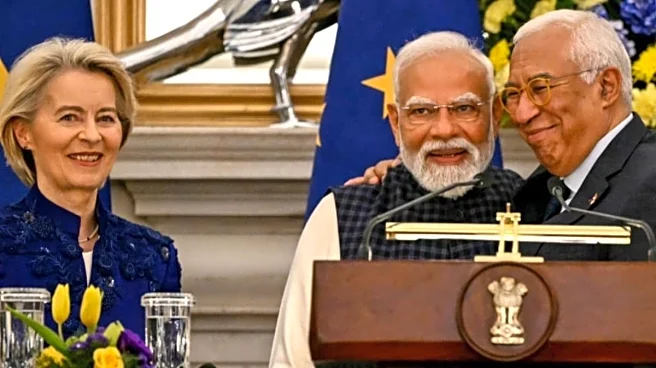
The India-EU free trade agreement (FTA), concluded on January 27, 2026, during the 16th India-EU Summit, marks a historic milestone after negotiations relaunched in 2022 (originally launched in 2007 and suspended in 2013). Often called the “mother of all deals,” it creates a free trade zone encompassing nearly 2 billion people and about 25 per cent of global GDP, positioning India and the 27-member EU bloc for transformative economic integration. Current bilateral trade stands at approximately anywhere between USD 136.5-140 billion in goods (India’s exports to EU at USD 75.85 billion and imports at USD 60.68 billion in 2024-25) plus substantial services trade (USD 83 billion). The FTA delivers unprecedented market access; over 99 per cent of Indian
exports by trade value gain preferential entry into the EU, with immediate zero-duty access on 70.4 per cent of tariff lines covering 90.7 per cent of India’s exports (primarily labour-intensive sectors).
This deal opens immense positive possibilities for India, driving export-led growth, job creation, FDI inflows, MSME empowerment, supply chain integration, technological advancement and strategic diversification amidst global uncertainties. Projections suggest Indian exports to the EU could rise by up to 41 per cent, significantly boosting bilateral trade (one estimate says, up to 65 per cent overall increase). It aligns with PM Modi’s idea of “Viksit Bharat” enhancing competitiveness, inclusive growth and resilience.
Tariff liberalisation and immediate market access will remove long-standing barriers. The EU will eliminate or phase down duties on critical Indian categories–textiles, apparel, footwear, leather, marine products, fisheries, gems & jewellery, chemicals, pharmaceuticals and engineering goods. Self-certification under modern Rules of Origin (aligned with recent EU FTAs) simplifies compliance for exporters, especially SMEs, via uploaded origin statements and customs portals. This reduces costs, speeds clearance and enables cumulation benefits for regional value chains.
Customs facilitation, advance rulings, simplified procedures, sanitary and phytosanitary Measures (SPS) and technical barriers to trade (TBT), both World Trade Organization (WTO) agreements regulating product standards and safety to prevent unnecessary trade barriers, will further cut red tape and non-tariff barriers (NTBs), making EU entry predictable and efficient, while upholding high standards. A bilateral safeguard mechanism protects against surges and dispute settlement ensures enforceability. Labour-intensive export sectors stand to gain massively, empowering millions in MSMEs, artisans, women and rural workers.
The EU accounts for roughly 38 per cent of India’s textile exports. Immediate zero duties will unlock premium EU markets for India, with Indian exports benefitting from reduced 8-12% tariffs, thereby improving our price competitiveness against the likes of Vietnam and Bangladesh. It will further help us via higher volumes, better margins, diversification into high-value garments, technical textiles and sustainable fashion. States like Tamil Nadu (Tirupur knitwear), Gujarat, Maharashtra, Rajasthan, and Uttar Pradesh (handlooms and powerlooms) will see huge surges; textile clusters will gain global value chain (GVC) integration. Job creation in spinning, weaving, dyeing and garmenting (millions of women workers), will be added benefits. It is interesting to see that the Congress Party and its acolytes who could not make decisions because they had no connection with the people on the ground, are today making a virtue of not doing anything. Our people have paid immense costs for this lost opportunity. Thank God, Narendra Modi at the helm of affairs has done what his predecessors failed to do–he has put India on the global map, ably and decisively.
What puzzles one is that when the whole world is calling it the “mother of all deals”, the likes of Jairam Ramesh think this FTA is hugely hyped. Is the combined GDP of $25 trillion, combined global trade of over $11 trillion and a common market of 2 billion people, hype? Is $33 billion of India’s labour-intensive exports getting zero duty access to the EU, right on day one, a hype? What is also unfortunate is that the likes of Ramesh miss a basic fact that we are both largely complementary economies. It is not a zero-sum deal but a win-win deal for both India and the European Union, which will power our economic growth and create a plethora of opportunities for businesses and people of both these stakeholders.
The Modi government has also taken up the issue of carbon border adjustment mechanism (CBAM), interests of our exporters in steel, aluminium and all other sectors like no one ever has and identified pathways to find solutions. We have found creative ways of handling these complex and sensitive subjects through dialogue, trust and support with our partners rather than “my way or highway only” kind of immature, illogical and rigid positions, that the erstwhile Congress regimes in India adhered to. All countries, including India, reserve their right to regulate for health and safety reasons. No one cedes them in a trade agreement. They are disciplined in a manner that they do not become unnecessary and unjustified impediments to trade. The India-EU FTA is no different in those aspects and rightfully so.
As for IPR obligations, they are similar to what we have in the agreement on trade-related aspects of intellectual property rights (TRIPS), at the WTO. They emphasise flexibilities for public health, need for transfer of technology, recognise India’s traditional digital knowledge library project and preserve our policy on data exclusivity. The commitments in Services are as per India’s domestic regime and we hope that some of these capital-intensive sectors such as maritime and financial services will attract EU’s investment, technology and innovation and grow these critical infrastructure services, bringing more efficient, innovative services to our businesses and people.
Again, speaking of the premium auto sector, our quota-based focused and phased auto offer (with a time lag of 5 years for EVs) is with an intent to boost Make in India. Liberalising completely knocked down (CKD) imports will encourage EU’s original equipment manufacturers (OEMs) to set up local assembly lines. This serves as a stepping stone, moving foreign OEMs from “importing” to “assembling” and eventually to “full localisation” as they build local supply chains. This brings high-end manufacturing processes, quality standards, and advanced R&D practices into the Indian ecosystem. It will also create new demand, benefit consumers by expanding choice with faster access to premium global models. It also enhances safety and tech standards.
Similarly, the point on refined fuel is linked to extraneous reasons. Our Trade agreement with the EU is a long-term strategic engagement based on trust and mutual respect which will strengthen our trade routes.
Pharmaceuticals and medtech gain access to the EU’s massive USD 572 billion market. Reduced tariffs (previously up to 11 per cent on some categories) plus streamlined approvals via SPS/TBT cooperation, will accelerate generics, APIs, biosimilars, vaccines and medical devices’ exports. Indian firms (Sun Pharma, Dr Reddy’s, Cipla, etc.) will leverage cost advantages. World Health Organisation–Good Manufacturing Practices (WHO-GMP) standards and traditional knowledge digital library (TKDL) recognition for faster EU registrations will open up many opportunities. Contract manufacturing, R&D collaboration, biologics expansion and reverse engineering efficiencies will accrue to Indian companies. Big boost to units in Gujarat (Ahmedabad and Vapi hubs), Himachal, Andhra, Maharashtra, is a given. Job growth in manufacturing, giant strides in quality control and regulatory affairs, are all in sync with India’s positioning as “Pharmacy of the World” and the move to be Atmanirbhar in APIs, as envisioned by PM Modi.
IT, ITeS, professional services and digitally delivered services will receive ambitious, general agreement on trade in services (GATS) plus commitments. The EU will open 144 sub-sectors meaningfully, while India will open 102 reciprocally. This means enhanced market access in computer-related services, R&D, professional services, business services and education. Short-term business visitors, dependents’ rights, framework for social security coordination within 5 years, will all be gamechangers. Recognition of traditional medicine practitioners in unregulated States, will help us too. The digital trade chapter will ensure source code protection, e-payments and consumer safeguards. Possibilities pertaining to BPO/KPO expansion, software exports’ surge, consulting and engineering, services’ growth, e-commerce and AI/data analytics partnerships, will all grow manifold. Hubs in Bangalore, Hyderabad, Pune, Chennai, Gurugram will thrive; skilled youth/professionals will gain high-value jobs, leading to higher remittances and upskilling related benefits. Services’ exports will scale further with predictability.
Exports from India of gems & jewellery, leather and footwear, handicrafts will see zero duties on significant shares. Surat, Delhi and Jaipur will benefit from EU’s luxury demand; Chennai, Kanpur and Agra will see leather and footwear clusters expand; artisan clusters (e.g., Varanasi silks, Kashmir shawls via GI cooperation) will access premium pricing. Export value growth, employment for artisans and youth, cultural preservation via GI protections, will all gain momentum. Auto components, engineering goods, chemicals, iron & steel, plastics, will gain from tariff cuts (EU duties previously 4-10%+). Components (e.g., from hubs in Pune, Chennai, Gurgaon) will integrate into EU automakers’ chains; engineering (pumps, machinery) will compete better. Chemicals and plastics’ exports will benefit India’s hubs in Gujarat and Maharashtra. Quota-based calibrated liberalisation for finished autos reciprocally, will support Make in India. Indian OEMs will export more, attract FDI for EVs and hybrids, while consumers will get access to advanced models.
India will benefit from capital, tech transfer, joint ventures and more. “Make in India” will get amplified via greater local production for the EU market and synergy with PLI schemes. Concomitant, expected FDI inflows in manufacturing and services will boost infrastructure and skills, especially for MSMEs. NTB reduction and trade facilitation via SPS/TBT working groups, transparency (60-day consultations), conformity assessment cooperation, customs data exchange accelerate clearances, will reduce compliance costs (time and money savings for exporters). Sustainable development chapter will promote low-carbon goods and services liberalisation and green tech cooperation (renewables, EVs, CBAM mitigation with MFN, tech and financial support). This India-EU FTA is in sync with the Paris Agreement on many counts, positioning India strategically, in green GVCs. Other geopolitical and long-term positives include market diversification (reducing reliance on US and China amidst tariffs and geopolitics), supply chain resilience (friend-shoring with trusted EU partners) and tech cooperation in AI, semiconductors and clean energy. CBAM forward-looking provisions aid compliance and funding. Importantly, the India-EU trade deal supports Modi’s Viksit Bharat goals of self-reliance with global integration and India’s status as an innovation hub. In conclusion, the India-EU FTA unleashes exponential opportunities via export multiplication in traditional areas, services’ leap, manufacturing renaissance in newer areas and of course, inclusive jobs. With political commitment evident, this partnership fortifies India’s global rise, delivering prosperity, resilience and shared prosperity for decades. Full realisation could add tens of billions in annual trade value, millions of opportunities, and cement India as a pivotal global economic powerhouse.
The India-EU FTA is ultimately a tale of “two giants” who chose partnership “in a true win-win fashion.” This trade deal sends a strong message that cooperation is the best answer to global challenges.
The deal is expected to further integrate supply chains and strengthen joint manufacturing power between India and the European Union, cutting up to 4 billion euros ($4.7 billion) in annual tariffs for exporters and creating jobs for millions of workers in India and in Europe. As always, PM Modi’s “Nation First” ideology was the biggest deal maker.
The author is an economist, national spokesperson for BJP and bestselling author of “The Modi Gambit”. Views expressed in the above piece are personal and solely those of the writer. They do not necessarily reflect News18’s views.

/images/ppid_59c68470-image-177104254494215325.webp)

/images/ppid_a911dc6a-image-177104210287325129.webp)

/images/ppid_a911dc6a-image-177104202793221357.webp)
/images/ppid_a911dc6a-image-177104206710214315.webp)
/images/ppid_a911dc6a-image-177104202907093694.webp)
/images/ppid_59c68470-image-177104014803952296.webp)
/images/ppid_59c68470-image-177104006389961167.webp)
/images/ppid_a911dc6a-image-177103853218557950.webp)