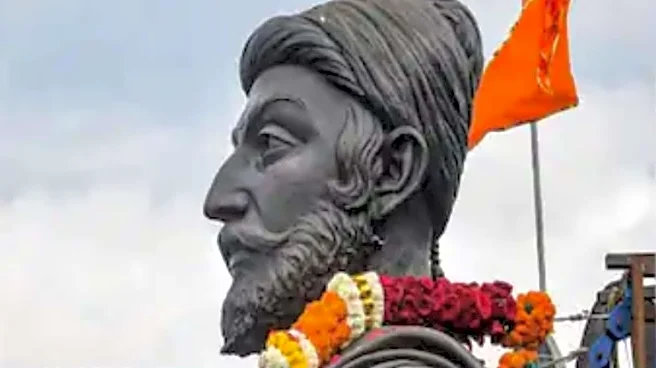

More than two decades after a controversial book on Chhatrapati Shivaji Maharaj triggered legal action, public outrage and a nationwide debate on academic freedom, Oxford University Press (OUP) India has
issued a public apology, admitting that certain statements in the publication were not properly verified.
The apology, published in newspapers on Tuesday, January 6, was addressed to Udayanraje Bhosale, the 13th descendant of the Maratha warrior king and BJP MP from Satara. It came in compliance with directions from the Kolhapur bench of the Bombay High Court, following a long-running criminal defamation case dating back to 2005.
In the public notice, OUP India acknowledged that some statements appearing on pages 31, 33, 34 and 93 of the book Shivaji: Hindu King in Islamic India were “unverified”. The publisher expressed regret for having carried these statements and apologised to Bhosale and the public “for any distress and anguish caused”.
The book, written by American historian James Laine and published in 2003, attempted a critical historical reading of the life of the 17th-century Maratha ruler. However, certain references to Shivaji Maharaj’s lineage and personal life were widely perceived as offensive by his followers and members of the Maratha community, leading to intense backlash.
The controversy reached a flashpoint in January 2004, when more than 150 activists of the Sambhaji Brigade vandalised the Bhandarkar Oriental Research Institute (BORI) in Pune, accusing the institute of assisting the author in producing objectionable material. The attack shocked the academic community and sparked a wider national conversation on the limits of scholarly interpretation and the responsibilities of publishers.
In 2005, Bhosale filed a private complaint in a court in Maharashtra’s Satara district against OUP India’s then managing director Sayeed Manzar Khan, along with academics Dr Shrikant Bahulikar and Sucheta Paranjape of Tilak Maharashtra Vidyapeeth, and VL Manjul, librarian at BORI. The court ordered a case to be registered under Section 500 (punishment for defamation) of the now-repealed Indian Penal Code.
The accused later moved the Bombay High Court. In a written submission to the Kolhapur bench on December 17, 2025, Khan expressed willingness to issue a public apology to Bhosale and to publish it in major English and Marathi newspapers, paving the way for the latest notice.
An OUP India spokesperson said the book had been available in India only briefly over 20 years ago and was withdrawn as soon as the controversy erupted. The publisher reiterated that it releases material representing a range of viewpoints, but strives to respect cultural sensitivities and historical contexts so its publications remain acceptable to a global readership.
The author, James Laine, had earlier apologised as well, stating that he loved India and had devoted his life to studying its culture, and that he never intended to defame “the great Maharashtrian hero”.
Welcoming the apology, Maharashtra Education Minister Dada Bhuse said the state government would nevertheless keep a close watch on the corrective steps taken by the publisher.
The episode is not without precedent for OUP. In 2011, OUP India faced criticism over alleged self-censorship after it decided not to reprint AK Ramanujan’s essay on the multiple tellings of the Ramayana, following objections from right-wing groups.
/images/ppid_59c68470-image-177077512106794299.webp)

/images/ppid_59c68470-image-177077504615982639.webp)
/images/ppid_59c68470-image-177077515851590090.webp)
/images/ppid_59c68470-image-177077508321758455.webp)
/images/ppid_a911dc6a-image-177077322976413782.webp)

/images/ppid_59c68470-image-177077258165510745.webp)
/images/ppid_59c68470-image-177077272281824806.webp)
/images/ppid_59c68470-image-177077276056749159.webp)
/images/ppid_59c68470-image-177077261155977594.webp)
/images/ppid_59c68470-image-177077268877789072.webp)