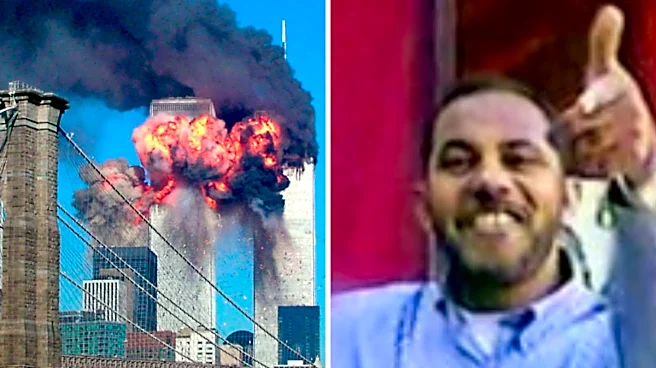




Newly surfaced footage has shed fresh light on Omar al-Bayoumi, a central figure in a $1 trillion lawsuit brought by families of the September 11 victims, showing his extensive links to Saudi officials and his association with Anwar al-Awlaki, who later became a leader of al-Qaeda in the Arabian Peninsula, according to a report by the BBC.
The videos, obtained by the BBC, were in the FBI’s possession within days of the 2001 attacks but were not fully pursued as part of the investigation into Bayoumi.
Paintballing Sessions
One clip from 1997 or early 1998 shows Bayoumi and Awlaki taking part in paintball sessions near San Diego, BBC reported.
The group is seen engaging in combat-style exercises and target practice, with several participants wearing military fatigues.
At one point, participants charge into battle shouting “Allahu Akbar”. A Saudi sheikh was also present.
The FBI’s post-9/11 investigations examined paintball activities, with agents being told that some participants were using the sessions to train for jihad. Bayoumi and Awlaki were involved in such sessions for at least three years in the late 1990s and early 2000s, according to the BBC.
Another video shows Bayoumi embracing Awlaki in January 1998.
Also Read: ‘Bastardization Of History’: FBI Slams Canadian Broadcaster For Not Calling 9/11 A ‘Terrorist Attack’
Saudi Links
Further footage records Bayoumi meeting officials and preachers linked to Saudi Arabia’s Ministry of Islamic Affairs.
Bayoumi had arrived in San Diego from Saudi Arabia in 1994, claiming to be an English student. However, court records indicate that he had effectively abandoned his studies within a few years, BBC reported.
After the 9/11 attacks, he became an early FBI suspect after his name appeared on an apartment rental agreement signed by hijackers Nawaf al-Hazmi and Khalid al-Mihdhar.
The Plane Sketch
When British police arrested Bayoumi in Birmingham on September 21, 2001, they seized thousands of documents, hundreds of photographs and at least 80 videotapes. Among the evidence was a notebook page containing a plane sketch and mathematical calculations related to flight, the BBC reported.
“It’s the mathematical calculation of the crash,” Jodi Westbrook Flowers, a member of the 9/11 families’ legal team, told the BBC. “When we figured out what it was, we knew that it was the smoking gun that we’d been looking for,” he added.
Bayoumi Released Despite Evidence
Despite the evidence, Bayoumi was released on September 28, 2001, after US officials decided there was insufficient evidence to extradite him.
The FBI later analysed some of the seized material, but key evidence did not reach agents in San Diego. Rick Lambert, who led the FBI’s investigation there, said his office repeatedly sought the evidence, the BBC reported.
Also Read: ‘He Was Very Friendly, Bubbly’:US Woman Recalls Saudi NeighbourLinked To 9/11 Hijackers
“Their position was, we’re in charge of the case; we’ll send it to you when we’re finished analysing,” he said to the BBC.
Lambert further stated, “I believe there is the potential that had we received that evidence and analysed it, that we would have been able to put the pieces of the puzzle together much more quickly.”
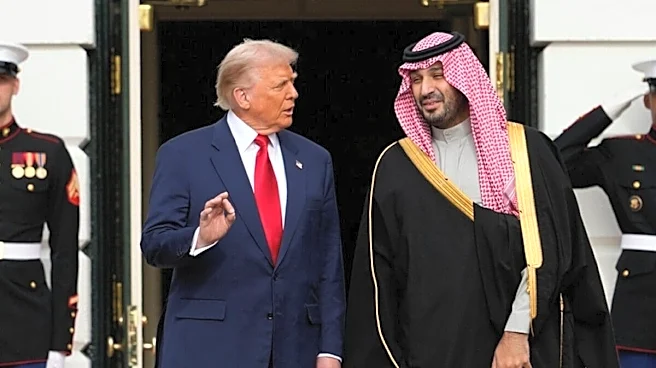
Bayoumi was never prosecuted. The 9/11 families’ lawsuit alleges that Saudi Arabia was complicit in the attacks and that Bayoumi assisted two of the hijackers.
9/11
On September 11, 2001, 19 al-Qaeda terrorists hijacked four commercial aircraft in the United States. Two planes were flown into the World Trade Center’s Twin Towers in New York, while a third crashed into the Pentagon in Arlington, Virginia.
The fourth aircraft, United Airlines Flight 93, crashed into a field in Pennsylvania after passengers and crew members fought back against the hijackers. A total of 2,977 people were killed in the attacks, making 9/11 the deadliest terrorist attack in US history.
/images/ppid_59c68470-image-178877753056164960.webp)





/images/ppid_59c68470-image-17885800282859120.webp)

/images/ppid_59c68470-image-178879261407960337.webp)