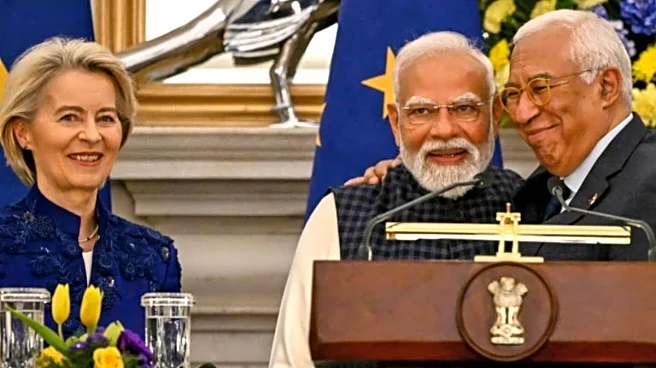

The presence of the Presidents of the European Council and the European Commission as chief guests at India’s 77th Republic Day goes beyond mere ceremonial tradition. It signifies a deliberate effort by
both India and the European Union to reinforce a partnership that is increasingly vital in today’s unpredictable and rapidly evolving world.
Amid a churning in global politics, this gesture underscores the value of trust, stability, and long-term cooperation. It shows that India and the EU view each other not simply as partners of convenience, but as reliable allies dedicated to shared values, mutual respect, and collective progress for the future.
This event holds both symbolic and strategic importance. Republic Day embodies India’s democratic identity, constitutional values, and sovereign aspirations. By inviting the highest representatives of the EU, India signals that Europe is central to its foreign policy priorities.
Europe’s acceptance of this invitation, meanwhile, acknowledges India’s rising global stature and its significance as a strategic partner in a multipolar world. These actions together highlight a mutual desire to deepen engagement at a time when stable and trustworthy partnerships are rare but urgently needed.
STRATEGIC CONTEXT
The global political landscape is fraught with profound uncertainty. Fragile supply chains, economic volatility, technological competition, climate challenges, and escalating geopolitical rivalries are disrupting long-standing partnerships and reshaping international relations.
Traditional power structures are shifting, and nations are seeking partners who offer predictability, resilience, and a long-term strategic outlook. In such an environment, Europe is under pressure to diversify its partnerships and bolster ties with countries committed to democratic governance, multilateralism, and international stability.
India naturally fits this role. As the world’s largest democracy, India merges political stability with a rapidly growing economy, advanced technological capabilities, and a prominent diplomatic presence. Its consistent support for multilateral institutions and dialogue-based solutions makes it an appealing partner for Europe, which has long advocated for a rules-based international order. The increasing alignment between India and the EU on issues such as climate action, digital governance, maritime security, and sustainable development further strengthens the strategic rationale for closer cooperation.
Inviting both António Costa and Ursula von der Leyen to India’s Republic Day celebrations carries significant political weight. It is more than just protocol; it is a clear indication that Europe views India as a strategic priority. Their joint presence signifies unity within the EU and illustrates that engagement with India is a collective European commitment rather than a series of individual bilateral relationships with member states.
It reinforces the concept that India-EU ties are built on a shared vision and mutual confidence. Through deeper political dialogue, stronger economic links, enhanced security cooperation, and expanded people-to-people connections, both sides aim to build resilience, stability, and a more balanced global order. This partnership transcends narrow strategic interests and seeks to address global challenges impacting the wider international community, from climate change and public health to digital transformation and sustainable growth.
TRUST AS THE CORNERSTONE
Trust is fundamental to the growing India-EU partnership. Instead of being driven solely by short-term gains or transactional interests, the relationship is increasingly shaped by reliability, transparency, and shared principles.
In a world where alliances shift swiftly and strategic interests often change, having dependable partners is invaluable. India and the EU share a commitment to democracy, the rule of law, human rights, and a rules-based international system, providing a strong foundation for cooperation.
This trust is especially crucial in sensitive and strategic areas such as supply chains, digital technology, energy security, and critical infrastructure. Reliance on unreliable partners can create serious vulnerabilities, as recent global disruptions have demonstrated. High-level diplomatic engagements reinforce this trust by fostering personal rapport between leaders, aligning strategic priorities, and translating shared intentions into practical cooperation.
Trust also facilitates constructive dialogue on differences. While India and the EU may not always agree on every international issue, the strength of their relationship lies in their ability to engage openly and respectfully. This maturity adds depth to the partnership and sets it apart from purely interest-driven alliances.
ECONOMIC AND TECHNOLOGICAL COOPERATION
Economic engagement is a central pillar of India-EU relations. The European Union is one of India’s largest trading partners, while India offers a vast and dynamic market for European businesses.
Renewed efforts to advance trade and investment agreements reflect a shared recognition of the economic potential of closer integration. Such cooperation can enhance supply chain resilience, promote innovation, and support sustainable development on both sides.
Technological collaboration is equally significant. Europe’s strengths in advanced manufacturing, green technologies, and regulatory frameworks complement India’s capabilities in information technology, digital services, and innovation-driven entrepreneurship. Joint initiatives in digital governance, artificial intelligence, and cybersecurity show how both sides can shape global standards while upholding democratic values and individual rights.
In the field of energy, India and the EU share strong commitments to climate action and sustainability. Cooperation on renewable energy, green hydrogen, and climate finance advances environmental goals while also strengthening strategic autonomy by reducing dependence on unstable energy sources. These shared efforts underline how the partnership contributes to global public goods.
THE SYMBOLISM OF REPUBLIC DAY
Republic Day holds special significance for India, representing the adoption of its Constitution and its dedication to democratic governance. The selection of chief guests is always deliberate and symbolic, reflecting India’s diplomatic priorities and its vision for global partnerships.
Inviting Costa and von der Leyen sends a powerful message about the importance India places on its relationship with Europe. It indicates that Europe is seen as a trusted and long-term partner, while Europe’s acceptance highlights India’s growing global influence and strategic importance.
The symbolism extends beyond ceremony. Such high-level participation provides opportunities to advance practical cooperation in trade, investment, climate action, scientific research, education, and regional security.
It offers a platform for focused dialogue and reinforces political momentum behind shared initiatives. The occasion also communicates to the international community that India and the EU are committed to working together in shaping a more stable and cooperative global order.
A PARTNERSHIP FOR A CHANGING WORLD
The India-EU partnership is entering a defining phase, characterised by shared responsibility and growing mutual confidence. By prioritising trust, reliability, and democratic values, both sides are moving beyond limited cooperation toward a deeper strategic relationship.
Their engagement reflects a recognition that global challenges cannot be addressed in isolation and that stable partnerships are essential for lasting peace and prosperity. In a world marked by uncertainty, this partnership stands as an example of how relationships built on trust and shared principles remain vital.
Ultimately, India-EU relations offer a hopeful model of cooperation in an era of fragmentation. By combining political trust, economic engagement, technological collaboration, and shared democratic values, the partnership contributes not only to the interests of both sides but also to the broader goal of a more stable, inclusive, and cooperative international order.
(Sheikh Khalid Jehangir is a policy analyst specialising in South Asian affairs and regional security, serving as a fellow and executive member of ICPS Europe. Views expressed in the above piece are personal and solely those of the author. They do not necessarily reflect News18’s views)
/images/ppid_a911dc6a-image-177103853218557950.webp)



/images/ppid_a911dc6a-image-17710364781122582.webp)
/images/ppid_a911dc6a-image-177103642565816962.webp)
/images/ppid_a911dc6a-image-177103504309993710.webp)
/images/ppid_a911dc6a-image-177103508492594205.webp)