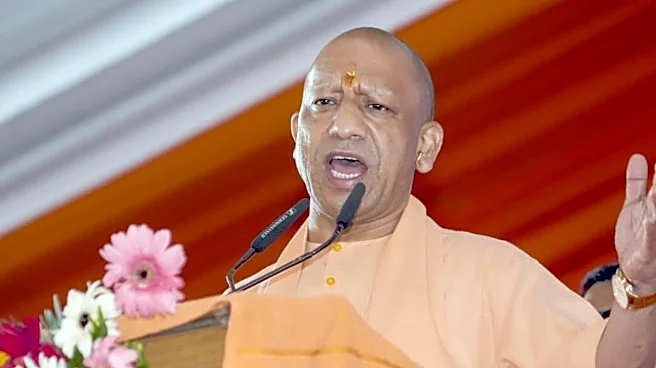






Under the leadership of Chief Minister Yogi Adityanath, the Uttar Pradesh government remains committed to equipping the state’s youth with employment-oriented skills aligned with future industry requirements.
In line with this vision, the Uttar Pradesh Skill Development Mission has released the target allocation for the second phase of short-term skill training under the State Skill Development Fund (SSDF) Scheme for the financial year 2026-27.
Minister of State (Independent Charge) for Vocational Education, Skill Development and Entrepreneurship, Kapil Dev Agarwal, said, “Uttar Pradesh is emerging as the country’s leading state in skill development while realising Prime Minister Narendra Modi’s vision of Skill India. In accordance with CM Yogi
Adityanath’s vision of making youth tech-savvy, a mandatory four-hour ‘AI for All’ and soft skills module has been introduced in every training batch. The maximum duration of courses has been fixed at 900 hours, while residential training centres will be required to conduct a minimum of eight hours of classes every day.”
To ensure transparency, installation of CCTV cameras across all training centres as per prescribed standards has been made mandatory, enabling direct monitoring from the Mission headquarters.
Additionally, every centre will be required to keep one Hindi and one English newspaper daily to enhance the general awareness of trainees.
The inauguration of new training centres will mandatorily be conducted by the local MLA. Institutions will be allowed to select only those job roles listed on the NCVET/NQR portal, and batches will receive approval only after thorough verification by the DPMU.
To make skill training fully transparent and outcome-oriented, the Yogi government has, for the first time, used the ‘Kaushal Darpan’ AI Dashboard for target allocation. Targets have been assigned to all 936 training providers solely on the basis of centre capacity verification reports submitted by the DPMUs.
The Minister said, “All providers must achieve their allotted targets and obtain approval for every batch in accordance with the Mission’s guidelines. Considering the growing demand from modern industries, special priority has been given to new-age sectors such as healthcare, electronics, AI, IT-ITeS, food processing, apparel, and handicrafts. New-age training providers will be permitted to conduct training programmes only in futuristic job roles.”
The Minister clarified that allocation of targets does not mean training can begin immediately. DPMUs will not allow batch formation until the training providers sign a formal agreement with the Mission and it is duly verified. The Mission reserves the right to revise targets upward or downward depending on budgetary provisions or requirements. If any institution fails to commence classes on time or complaints are received from the ground, strict legal and administrative action will be taken without delay under the Yogi government’s zero-tolerance policy.
Mission Director Pulkit Khare said, “A total of 936 training providers have been entrusted with training over 100,000 youth. Of these, 831 private, government and start-up training providers have been assigned a target of training 91,425 youth, while 105 industrial and new-age training providers have been given a target of training 14,650 youth. Earlier, in April, during the first phase, 957 training providers were allocated targets to train more than 99,000 youth, and those training programmes are currently being conducted smoothly.”
The primary objective of the SSDF Scheme is to provide employment-oriented training to the youth of Uttar Pradesh in line with local needs and industry demand. By making the ‘Kaushal Darpan’ AI Dashboard and new-age modules such as ‘AI for All’ mandatory, the government is preparing the state’s youth for future global job markets.
He added, “All selected institutions must commence classes from August 1, 2026, without fail. A stringent 17-stage implementation schedule has been issued, covering timelines from centre selection, verification, awareness camps and batch approvals to placements. After completion of the course, only students with 70% or higher attendance will be eligible to participate in job fairs, and placements must be ensured within 90 days of the declaration of results. Even after employment, candidates will be tracked for 365 days to monitor placement outcomes.”









/images/ppid_59c68470-image-178291510848041830.webp)
