
/images/ppid_a911dc6a-image-177070952852720132.webp)
/images/ppid_a911dc6a-image-177070952776072175.webp)
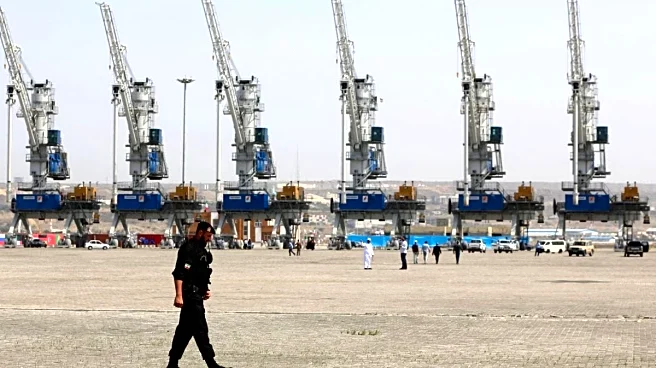
As the six-month US sanctions waiver on India’s operations at Iran’s Chabahar Port edges towards expiry on April 26, New Delhi is navigating one of the most intricate geopolitical tests it has faced in recent years. This is not a crisis of India’s making, nor one that can be resolved through rhetorical bravado or quiet capitulation. It is, instead, a measure of strategic patience, diplomatic dexterity, and the true meaning of “strategic autonomy” in a fractured world.
India has been categorical on one point: walking away from Chabahar is not an option. The port is not a vanity project or a transient commercial bet. It is a carefully cultivated strategic asset, and deadlines alone do not negate decade-long calculations.
Why Chabahar matters—in name and in strategy
Chabahar, fittingly, means
“four offspring”—a reference to the four natural inlets or bays along Iran’s southeastern coast. The name is poetic, but its relevance to India is profoundly strategic.
For New Delhi, Chabahar represents four critical outcomes. First, it offers direct access to Afghanistan and Central Asia without transiting Pakistan—a geopolitical workaround India has sought for decades. Second, it anchors the International North–South Transport Corridor (INSTC), linking India to Iran, Russia, and Europe through a multimodal trade route. Third, it functions as a humanitarian lifeline, enabling aid shipments to Afghanistan when other routes are blocked. And fourth, it serves as a strategic counterweight to China’s deep-water presence at Gwadar under the China–Pakistan Economic Corridor (CPEC).
Abandoning Chabahar would not merely stall a port project; it would mean relinquishing strategic space in a region where geography is destiny. India has said it continues to engage with both the United States and Iran to sustain operations at the strategically important facility.
Washington’s waiver and the price of time
The current US waiver shielding India from secondary sanctions is temporary by design. Washington’s Iran policy remains uncompromising, shaped by domestic politics, Israel’s security calculus, and renewed hostility following US strikes on Iranian nuclear facilities and Iran’s internal unrest.
Extensions, therefore, are transactional—not ideological. India must assume that any further reprieve will come with expectations.
The most likely bargaining arena is economic. The United States could press India to sweeten broader trade negotiations, soften positions on market access, or offer concessions in technology transfers or defence procurement. Such linkage diplomacy is neither new nor subtle.
Energy is another lever. While forcing India into specific US or Venezuelan oil purchases is speculative, Washington may seek clearer alignment on limiting residual economic engagement with Iran beyond the narrow Chabahar framework.
The more delicate pressure point, however, is geopolitical signalling. India’s calibrated stance on Russia–Ukraine, its refusal to embrace sanctions as a default tool, and its insistence on maintaining ties with Iran sit uneasily with Washington’s preference for sharper alignments. Even without explicit demands, pressure can be exerted through diplomatic tone, pace of cooperation elsewhere, or strategic ambiguity.
Tehran’s turmoil: Opportunity or risk?
Iran today is beset by internal unrest and external coercion. Economic collapse, widespread protests, and military confrontation with the United States have placed the regime under extraordinary strain.
For India, this instability cuts both ways. On one hand, Tehran has strong incentives to retain India as a credible economic and diplomatic partner at Chabahar—one of the few projects that still signals regional legitimacy and connectivity. On the other hand, prolonged unrest or escalation could complicate operations, raise security concerns, and expose Indian interests to unpredictable shocks.
India’s posture towards Iran has therefore remained cautious but engaged: neither endorsing regime behaviour nor severing ties that serve long-term regional stability.
Pakistan, China, and the Gwadar contrast
No assessment of Chabahar is complete without its mirror image across the border. Pakistan’s Gwadar port, developed under CPEC with Chinese financing, has struggled to fulfil its promise. Debt burdens, local resistance in Balochistan, security challenges, and delayed projects have dulled its strategic shine.
From India’s perspective, this contrast matters. Chabahar’s persistence underscores an alternative regional model—slower, more cautious, but less extractive and more multilateral. It also complicates China’s ambition to dominate regional trade corridors through Pakistan.
That said, the idea that the United States seeks to militarise this imbalance—by using Pakistani territory or Indian-linked infrastructure to attack Iran—does not withstand scrutiny. Islamabad has officially denied any such cooperation, and New Delhi has neither the inclination nor the incentive to become a military node in a US–Iran conflict. India’s interest lies in stability, not escalation.
Interlude: The money on the table
It is worth pausing to assess the monetary footprint of India’s Chabahar engagement. New Delhi’s long-term commitment has not been symbolic—it has been anchored in substantial capital and contractual obligations. Under the 2024 bilateral agreement, India agreed to invest roughly $120 million directly to develop and operate the Shahid Beheshti terminal, along with a $250 million credit window for associated infrastructure—cumulatively placing India’s direct investment and financing commitments in the vicinity of $370 million to $500 million over the life of the project. These figures reflect both hardware (cranes, connectivity, and cargo handling) and support for ancillary links to Afghanistan and beyond.
If India were ultimately arm-twisted into abandoning the project, this would not be a mere loss of face but a tangible cost. Beyond the sunk capital already spent (equipment, upgrades, and financing pipelines), India would forfeit future operating revenue, logistical advantages, and the hard-won trade access that Chabahar is supposed to secure. Conversely, Iran stands to lose expected inflows from both India’s investment and the associated economic activity that arises from cargo throughput, transit tariffs, and jobs tied to expanded port operations—not to mention a key leverage point vis-à-vis its regional rivals. In contrast to China’s $62 billion focus on Gwadar, India’s investment may be smaller in scale but is strategically targeted; losing it now would undercut the narrative that New Delhi’s regional connectivity strategy can outlast resource-rich competitors.
Strategic autonomy under stress
The real test before India is not whether it can extend a waiver, but how it does so. Conceding too much risks setting a precedent where long-term strategic investments become hostages to short-term geopolitical pressure. Conceding too little risks the waiver lapsing, freezing operations, and exposing Indian entities to sanctions.
New Delhi’s best option lies in disciplined negotiation: isolating Chabahar as a stabilising, humanitarian, and regional connectivity project while resisting attempts to bundle it into unrelated strategic demands. At the same time, India must quietly prepare contingencies—legal, financial, and diplomatic—to sustain engagement even under tighter constraints.
A port, a mirror, a measure
Chabahar was never meant to be easy. Its value lies precisely in its location at the intersection of rivalries—the US versus Iran, India versus Pakistan, and China versus the rest. Extending the waiver will not be a triumph, nor will its expiry amount to immediate defeat.
What will matter is whether India emerges from this episode having protected its core interests without trading away its broader strategic balance. In that sense, Chabahar is not just a port on Iran’s coast. It is a mirror reflecting how far India has come—and how carefully it must now tread—in an unforgiving geopolitical landscape.
/images/ppid_59c68470-image-177071004258558281.webp)

/images/ppid_59c68470-image-177071011457677600.webp)
/images/ppid_59c68470-image-177071015030845145.webp)
/images/ppid_59c68470-image-177071008324940804.webp)
/images/ppid_59c68470-image-177071007375437723.webp)
/images/ppid_59c68470-image-177071003213418150.webp)
/images/ppid_59c68470-image-177071011165153667.webp)
/images/ppid_59c68470-image-177071003473193707.webp)
/images/ppid_59c68470-image-177071002745745499.webp)
/images/ppid_a911dc6a-image-177070970111222524.webp)
