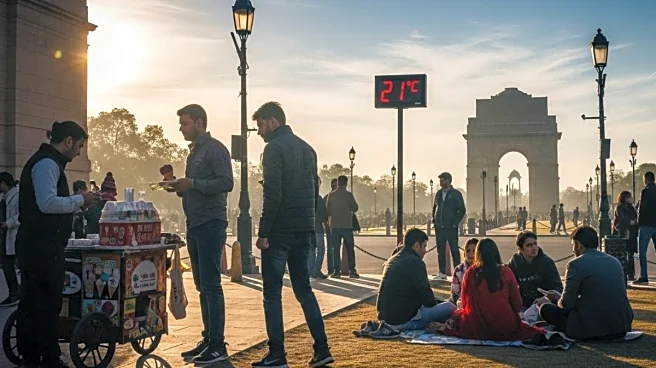




Delhi experienced its warmest January day in seven years on Thursday, with daytime temperatures rising well above normal, even as mornings and nights remained cold. The Safdarjung observatory, which is considered the city’s main weather station, recorded a maximum temperature of 27.1 degrees Celsius.
The temperature was 6.8 degrees above the normal January average and nearly three degrees higher than Wednesday’s reading, according to the India Meteorological Department (IMD).
The last time Delhi saw a hotter January day was in 2019, when the maximum temperature touched 28.7 degrees Celsius on January 21.
Other parts of the city also reported warmer conditions. Ayanagar recorded a maximum temperature of 25.4 degrees Celsius, which was 5.4 degrees above
normal.
Despite the warm afternoon, the city continued to witness chilly hours. Safdarjung also recorded the lowest temperature of the day, with the minimum settling at 6.3 degrees Celsius, which was 1.2 degrees below normal.
The IMD has forecast thunderstorms accompanied by rain in the national capital on Friday, which could bring temporary relief from the rising daytime heat.
Meanwhile, air quality conditions in Delhi-NCR improved on Thursday, prompting the Commission for Air Quality Improvement (CAQM) to revoke Stage 3 pollution curbs under the Graded Response Action Plan (GRAP).
According to the commission, the improvement in air quality is due to favourable weather conditions. The CAQM cited IMD’s forecast, which suggests that the Air Quality Index (AQI) in the region is likely to remain in the “moderate” to “poor” category in the coming days.
“The Sub-Committee, accordingly, decides to revoke its orders dated 16.01.2026, for invoking actions under Stage-III (‘Severe’ Air Quality) of Schedule of GRAP (modified on 21.11.2025), with immediate effect,” the order stated.
However, the commission urged residents to remain cautious and follow pollution-control measures already in place. It said citizens must “strictly adhere to the citizen charter under GRAP Stage 1 & 2” as winter weather conditions are still “not so favourable” and air quality could worsen again.
/images/ppid_a911dc6a-image-177089362548548250.webp)


/images/ppid_a911dc6a-image-17708908284999862.webp)



/images/ppid_a911dc6a-image-177064303810559815.webp)
/images/ppid_59c68470-image-177064503543751185.webp)