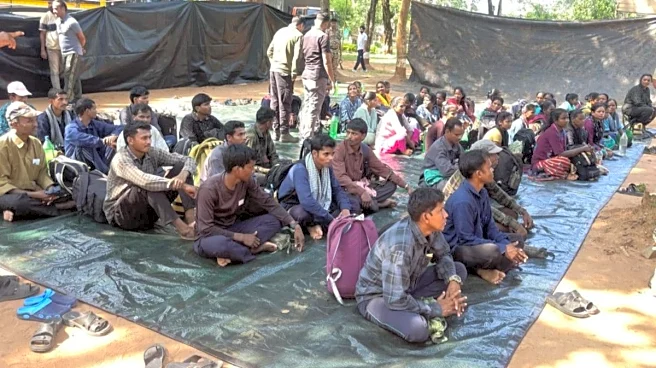

On January 9, 2026, 63 cadres of the Communist Party of India-Maoist (CPI-Maoist), 36 of whom carried cumulative rewards worth Rs 11.9 million, surrendered in Dantewada District in the Bastar division
of Chhattisgarh. Superintendent of Police (SP) Gaurav Rai declared, “Today, on 09/01/2026, a total of 63 Maoist cadres joined the mainstream of society in District South Bastar Dantewada under the Poona Margem: Rehabilitation to Revival initiative.” Among the surrendered Maoists were 18 women, a Police statement said. “They were active in the Darbha Division, South Bastar, West Bastar, the Maad area, and Odisha State,” Rai added.
The surrendered Maoists included seven cadres carrying rewards of Rs 800,000 each, seven with rewards of Rs 500,000 each, eight with rewards of Rs 200,000 each, 11 with rewards of Rs 100,000 each, and three with rewards of Rs 50,000 each, bringing the total reward amount for their capture to Rs 11.95 million.
Senior Maoist leaders among those who surrendered included Paklu alias Pradip Oyam (45), the ‘secretary’ of the Maoist Kalahandi Area Committee; Mohan Kadti alias Azad (32), a Divisional Committee Member (DVCM) involved in ambushes and killings since 2005; as well as his wife, Sumitra Kadti alias Draupadi Chapa (30), also a DVCM and Bhairamarh Area Committee ‘secretary’, who was linked to multiple encounters and arson incidents. Other surrendered cadres included Hungi alias Ankita alias Radhika Lekam (28), a Platoon Party Committee Member (PPCM) associated with propaganda activities and violent acts; Sukhram Tati (20), a member of Company No. 1; Pandu Madkam (19), a member of Company No. 7; and Somdu Kadti (21), also a member of the same wing. The remaining cadres were involved in improvised explosive device (IED) blasts, vehicle burnings, road blockades, and propaganda campaigns.
On January 7, 2026, 26 CPI-Maoist cadres, 13 of them carrying a cumulative bounty of Rs 6.4 million, surrendered in Sukma District. The surrendered Maoists had been involved in several major incidents in Sukma District, Marwar region and border Odisha.
Among them was 35-year-old Lali alias Muchaki Ayate, a ‘Deputy Commander’ who was carrying a reward of Rs 1 million, allegedly involved in a 2017 incident in which an IED exploded on a Security Forces (SFs) vehicle on the Sonabeda village to Koraput Road in Odisha, killing 14 soldiers. Another surrendered Maoist, Hemla Lakhma (41), a resident of Sukma District, carried a reward of Rs 800,000 and had been working with the Maoists since 2011. The Police statement disclosed that he was involved in an encounter in which 17 Police personnel were killed in the forest of Minpa village in the year 2020.
On January 5, 2026, a woman CPI-Maoist cadre, identified as Role alias Gita alias Lata alias Somari (37), carrying a reward of Rs 500,000, surrendered before the Police in Dhamtari District, Chhattisgarh, citing disillusionment with the banned outfit’s ideology. Gita, who was active as a member of the Nagri Area Committee and ‘commander’ of the Gobra Local Organisation Squad (LOS), surrendered before Dhamtari SP Suraj Singh Parihar.
Gita, a native of Pusnar village under Gangaloor Police Station in Bijapur District, had been associated with the Maoist organisation since 2005. During her long stint with the outfit, she said she was deprived of family life and faced discriminatory treatment, which led to growing resentment and eventual disenchantment with the group’s ideology.
At least 90 Maoist surrenders have been recorded in the State since the beginning of the current year, thus far (data till January 11, 2026). According to partial data collated by the South Asia Terrorism Portal (SATP), 1,425 Maoists surrendered in Chhattisgarh in 2025, in addition to 332 such surrenders in 2024. 201 Maoists surrendered in 2023.
The total number of Maoist surrenders since March 6, 2000, when SATP began documenting Left Wing Extremism (LWE)-related violence across the country, stands at 5,924.
The dramatic increase in surrenders in 2025 compared to 2024 illustrates growing depletion of Maoist cadres’ resolve and operational cohesion, partly due to intensified security pressure and the State’s “Surrender and Rehabilitation Policy 2025”.
Significantly, on January 8, 2026, welcoming all the surrendered Maoists, Chief Minister Vishnu Deo Sai observed, “This is not merely an achievement on the security front, but a victory of human trust and dialogue. The doors of the government are always open for those who renounce violence. They will be provided a dignified life, security and opportunities for a better future. A permanent solution to the Naxal problem lies in the triad of security, development and trust.”
Further, appealing to the remaining Maoist cadres to return to the mainstream, he urged them to choose the path of peace, family and progress, assuring them that the State Government would extend full support in their rehabilitation and reintegration.
Meanwhile, no Maoists have been arrested in the current year, thus far (data till January 11, 2026). Security Forces (SFs) arrested a total of 250 Maoists in 2025 and 265 in 2024. 134 Maoists were arrested in 2023. The cumulative number of such arrests since March 6, 2000, stands at 4,072.
At least 14 Maoists have been killed in the State since the beginning of the current year (data till January 11, 2026). According to partial SATP data, 299 Maoists were killed in Chhattisgarh in 2025, compared to 235 in 2024 and 23 in 2023. Overall, a total of 1,949 Maoists have been killed in the State since March 6, 2000.
Though the State has yet to record any fatality in the SF category in the current year, fatalities in this category recorded a spike from 18 in 2024 to 21 in 2025. A similar trend was observed earlier, when SF fatalities rose sharply from 10 in 2022 to 26 in 2023. The highest number of SF fatalities, 198, was recorded in 2007.
Nevertheless, the SF:Maoist kill ratio remained overwhelmingly in favour of SFs in 2025, at 1:14.23, recording an improvement compared to 2024, when it stood at 1:13.05. The best annual ratio recorded since 2000 was in 2004, at 1:20, while the worst kill ratio was recorded in 2007, at 2.67:1. Significantly, the overall kill ratio since March 6, 2000, also remains in favour of SFs, at 1:1.55.
The dominance of SFs on the ground has contributed to some improvement in civilian security. The last civilian fatality in the State was recorded on December 7, 2025, when a contractor from Uttar Pradesh, Imtiyaz Ali, was killed by CPI-Maoist cadres in Irpalli village, under Pamed Police Station limits in Bijapur District.
Ali was engaged in road construction work despite prior warnings from the Maoists to halt the project. He and one of his staff members were abducted near the project site and taken into the forests near the Errapalli security camp. Ali’s associate escaped and reported the incident to the authorities. Ali was found dead the following day. A total of 43 civilian fatalities were recorded in the State in 2025, compared to 57 in 2024 and 37 in 2023. The lowest number of civilian fatalities, seven, was recorded in 2004.
In 2025, Maoist-linked fatalities were reported from eight districts: 223 in Bijapur, 48 in Narayanpur, 40 in Sukma, 28 in Gariabandh, 11 in Kanker, nine in Dantewada, and two each in Kondagaon and Mohla Manpur-Ambagarh Chowki. Six of these eight districts (excluding Gariabandh and Mohla-Manpur Ambagarh Chowki) fall in the perilous Bastar Division. By comparison, in 2024, fatalities were reported from nine districts: Bijapur (102), Narayanpur (101), Sukma (39), Kanker (37), Dantewada (26), Dhamtari (two), Kondagaon (one), Mohla-Manpur-Ambagarh Chowki (one), and Raipur (one).
At the peak in 2012 (out of a total of 27 in the State), Maoist-linked fatalities were reported from 11 districts: 43 in Bijapur, 17 in Sukma, 15 each in Dantewada and Kanker, four each in Dhamtari and Kondagaon, three in Narayanpur, two in Rajnandgaon, and one each in Gariabandh, Raipur and Raigarh.
The contraction of Maoist-influenced areas, especially beyond the core Bastar region, highlights the diminishing geographic scope of the insurgency, compared to earlier years.
An analysis of overground and underground Maoist activities in Chhattisgarh reinforces an assessment of weakening influence.
According to the SATP database, Maoist activities were reported from eight districts in 2025 (out of 33 districts in the State). Only Bijapur fell in the ‘highly affected’ category, Narayanpur, Sukma, Gariabandh, Kanker, and Dantewada were ‘moderately affected,’ while Kondagaon and Mohla Manpur-Ambagarh Chowki were ‘marginally affected.’
By comparison, in 2024, two districts (Bijapur and Narayanpur) were ‘highly affected,’ three districts (Dantewada, Kanker, and Sukma) were ‘moderately affected,’ and nine districts (Dhamtari, Kondagaon, Mohla-Manpur-Ambagarh Chowki, Raipur, Bastar, Gariabandh, Kabirdham, Jashpur, and Rajnandgaon) were ‘marginally affected.’ At the peak in 2009, three districts (Bijapur, Dantewada, and Rajnandgaon) were ‘highly affected,’ four districts (Bastar, Dhamtari, Kanker and Narayanpur) were ‘moderately affected,’ and six districts (Balrampur, Durg, Jashpur, Raipur, Raigarh and Surguja) were ‘marginally affected.’
2025 saw an expansion of security infrastructure and a continuation of aggressive operations. A total of 52 new Forward Operating Bases (FOBs) were established across Narayanpur, Bijapur, and Sukma, improving reach into core insurgent territories. This operational shift curtailed Maoist mobility, disrupted supply and communication lines, and reduced their ability to regroup after encounters. A report dated December 29, 2025, also suggested that weapons and IED recoveries surged sharply during the year, with 645 firearms and 875 IEDs seized, indicating improved intelligence penetration and attrition of Maoist combat resources, resulting in significant disruption of Maoist logistics.
Arrest figures remained high, with hundreds of Maoists detained through sustained operations. The expansion of FOBs, improved intelligence operations, and enhanced coordination with Central Armed Police Forces further strengthened the State’s operational footprint, even in remote areas.
In a January 4, 2026, report, an official release described 2025 as a historic year for the Bastar Range, citing major breakthroughs against Maoist leadership, large-scale recovery of arms, and the surrender of senior cadres. These developments, the release said, had laid a strong foundation for long-term peace and stability in the region. Sundarraj P, Inspector General of Police (IGP), Bastar Range, noted, “Significant achievements on the fronts of security, peace, justice, and development have marked the year 2025. Precise and timely intelligence-based operations and strong coordination among security forces have established decisive control over Naxalite activities.”
The National Investigation Agency (NIA) also took positive action on 16 occasions against the Maoist rebels. Most recently, on December 30, 2025, the NIA chargesheeted five accused, including four absconders, in a 2024 case relating to the supply of explosives to the CPI-Maoist in Chhattisgarh, before a Special Court at Jagdalpur. The arrested accused were identified as Manish Sodhi and absconders Sodhi Kesa, Manila, Madkam Kesa and Sodhi Lakhma, all residents of Sukma District. They were booked under the Indian Penal Code (IPC), the Explosive Substances Act and the Unlawful Activities Prevention Act (UAPA). Investigations revealed the procurement and supply of materials intended for IEDs targeting SFs. Seized items included tiffin bombs, detonators, potassium nitrate and aluminium powder, along with Naxalite literature and mobile phones.
The materials were meant for the CPI-Maoist’s People’s Liberation Guerrilla Army (PLGA) Battalion No. 01, active in the Jagargunda area. The case originated with State Police arrests on September 25, 2024; NIA took over in December 2024 and continues to probe a wider conspiracy and terrorist-funding trail.
Earlier, on November 8, 2025, the NIA conducted searches at 12 locations in CPI-Maoist-affected Dantewada and Sukma Districts, in connection with the Aranpur IED blast and ambush of April 26, 2023, which had claimed 11 lives. The operation, carried out under case number RC-07/2024/NIA/RPR, targeted premises of several suspects linked to the CPI-Maoist. Incriminating materials, including cash, handwritten notes, digital devices, and receipt books used for “levy” collection, were seized. The April 2023 attack, executed by the CPI-Maoist’s Darbha Division Committee, remains one of Bastar’s deadliest incidents. NIA has, so far, filed two charge sheets against 27 arrested persons, while further investigations continue to trace absconding operatives and financiers.
Regrettably, even as the battle against Maoists in Chhattisgarh continues, the State Police Force, the first line of defence against internal threats, faces significant shortfalls. According to the latest Bureau of Police Research and Development (BPR&D) report, as of January 1, 2024, the State had 64,980 Policemen, against a sanctioned strength of 82,052, leaving 17,072 posts vacant (20.80 per cent). In this highly Maoist affected State, the Police/Area Ratio (number of Policemen per 100 square kilometres) is 48.06, compared to the sanctioned strength of 60.69.
By comparison, the all-India Police/Area Ratio stands at 65.78, against a sanctioned strength of 83.81. Of a sanctioned strength of 142 Indian Police Service (IPS) officers in the State, 13 posts (9.15 per cent) remain vacant, weakening the executive direction of the Force. Additionally, 23 of 498 Police Stations in the State are without telephone connections. To bolster the State Police, 290 companies of Central Armed Police Forces [Border Security Force (BSF), Central Reserve Police Force (CRPF), Central Industrial Security Force (CISF), Indo-Tibetan Border Police (ITBP), etc.] have been deployed in Chhattisgarh.
Chhattisgarh’s security landscape in 2025 reflects an intensive, multi-pronged counter-insurgency effort, coupled with rehabilitation incentives. Compared to 2024, Maoist losses, both in terms of lives and cadre loyalty, have accelerated, and the geographical spread of violence has contracted.
While the insurgency persists, weakened influence, record surrenders, and expanding security reach point toward a narrowing of extremist capabilities as the State moves toward the government’s March 2026 deadline for eradicating Naxalism.
The Maoist ‘movement’ in Chhattisgarh has been gravely weakened, but it is not yet extinguished. Sustained pressure, political resolve and development-led governance will remain essential to ensure that the remaining vestiges of Left-Wing Extremism are finally dismantled.
The author is a Research Associate at the Institute for Conflict Management. Views expressed in the above piece are personal and solely those of the author. They do not necessarily reflect News18’s views.