



Intercity travel across the National Capital Region (NCR) is set to become faster and more seamless, with multiple infrastructure projects underway. Key cities such as Noida, Greater Noida, Ghaziabad, Gurugram, and Faridabad are already being linked through elevated roads, Metro corridors, and tunnels. In addition, rapid rail networks are being developed to connect cities located farther away.
Following the rollout of the rapid rail service between Delhi and Meerut, the next phase is now extending into Haryana. Construction has officially begun on the Rapid Rail Transit System (RRTS) corridor connecting Delhi with Karnal. The project had received prior approval under the Delhi-Panipat-Karnal corridor plan, and work on the ground is now underway.
At present, commuting from Delhi to Karnal takes around four hours by road. Once the RRTS corridor is operational, this duration is expected to shrink significantly to nearly 90 minutes, less than half the current travel time.
High-Speed Namo Bharat Trains Planned
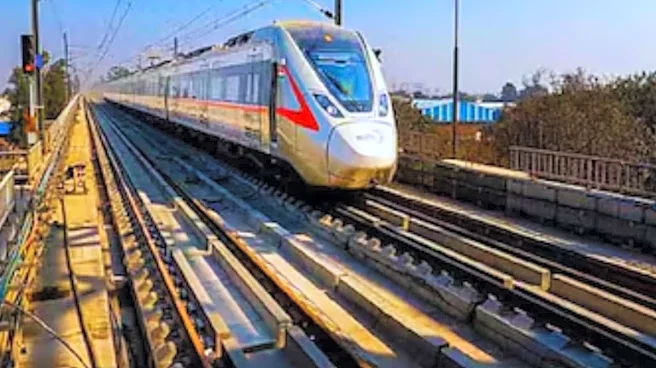
The corridor will be served by Namo Bharat trains, which will operate at speeds of up to 160 km/h. While the system is designed to support speeds of up to 180 km/h, operational speeds will remain slightly lower for efficiency and safety.
This makes the rapid rail considerably faster than conventional metro services.
Project Cost And Implementing Agency
The ambitious infrastructure project is estimated to cost around Rs 35,000 crore. It is being executed by the National Capital Region Transport Corporation (NCRTC), the nodal agency responsible for developing rapid rail networks in the NCR.
Out of the total cost, the Haryana government is expected to contribute approximately Rs 7,472 crore.
Route And Key Cities Covered
The corridor will originate from Sarai Kale Khan in Delhi and extend to Karnal in Haryana. Along the way, it will pass through major urban centres including Sonipat and Panipat, significantly improving connectivity between these cities.
The total length of the corridor is projected to be around 136 km, with approximately 36 km falling within Delhi and the remaining 100 km in Haryana.
Stations And Infrastructure Details
The project is expected to feature between 17 and 22 stations, with the majority located in Haryana. Initial estimates suggest around 17 stations, including six in Delhi and eleven in Haryana.
Proposed stations in Delhi include Sarai Kale Khan, Indraprastha, Kashmiri Gate, Burari-Mubarka Chowk, Alipur, and Narela. In Haryana, key stops may include Kundli, the KMP Expressway Interchange, Murthal, Ganaur, Samalkha, Panipat, Gharaunda, Karnal Bypass, Sector-7, and Karnal ISBT.
Elevated Corridors And Depots
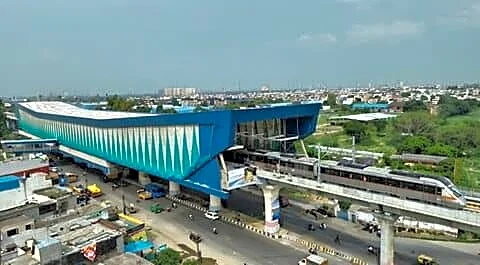
A large portion of the corridor will be constructed as an elevated track, with certain stretches running underground where necessary. Two depots are planned along the route, one in Murthal and another in Ganaur, to support operations and maintenance.
The alignment will largely run parallel to National Highway 44, with the final station located near the Karnal bus stand.
The corridor is being designed for seamless integration with existing transport networks. It will connect with the Delhi Metro, inter-state bus terminals (ISBTs), and other public transport systems, ensuring smooth last-mile connectivity for passengers.
Timeline And Future Impact
The first phase of the corridor is expected to be completed within five years. Once operational, it is likely to significantly ease road congestion.
Currently, nearly 2 lakh vehicles travel daily between Delhi and Karnal. The introduction of rapid rail is expected to reduce this burden, contributing to lower traffic congestion and improved air quality.
Beyond improving mobility, the project is also expected to drive economic activity and boost real estate development along the corridor. Enhanced connectivity often leads to increased investment and urban expansion in surrounding regions.