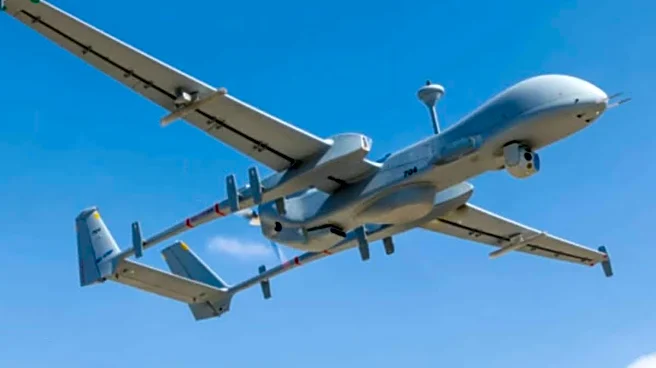

The satellite-linked Heron Mk II drones, already in service with the Indian Army and Air Force and recently deployed during Operation Sindoor, are now set to join the Indian Navy, making it a tri-service
platform.
The induction comes under emergency procurement, with all three branches of the Indian Armed Forces acquiring additional units from Israel Aerospace Industries (IAI). The company is also planning future local production in India to meet long-term operational needs.
Sources at IAI confirmed the development, describing India as a “major customer for more than three decades” and noting that the Heron MkII will now equip all three services.
They added that IAI is working closely with Indian partners, including Hindustan Aeronautics Limited (HAL), on plans for manufacturing and technology transfer, in line with India’s expanding domestic defence-production goals.
All About MkII Drones
The Heron MkII is a Medium Altitude Long Endurance (MALE) UAV with a maximum takeoff weight of 1,430 kg and an endurance of up to 45 hours.
It can carry payloads of up to 490 kg, supporting a wide variety of sensors such as EO/IR, SAR and SIGINT suites.
The platform is designed to operate in adverse weather and is equipped with Automatic Takeoff and Landing (ATOL) capability.
With the MkII, India has now operated three generations of IAI’s UAVs, starting with the Searcher, progressing to the Heron-1, and now fielding the MkII variant.
The system is built for contested electromagnetic environments and features encrypted satellite communications, autonomous mission control and the capability to reposition or recover from alternate locations when required.
The MkII is one of IAI’s most advanced operational platforms, though not the company’s first or only UAV.
Israel’s UAV ecosystem traces its roots to the Scout, the first unmanned aircraft developed by IAI.
The system emerged from lessons learned during the 1973 war, when Israeli intelligence struggled to monitor Syrian troop movements in real time.
Manned aircraft often arrived too late, by which point enemy air-defence units had relocated.
The Scout was developed to fill this operational gap and, after its introduction in the late 1970s, delivered strong performance during the 1982 Lebanon conflict, serving primarily in intelligence and reconnaissance roles.