
The Ministry of Culture’s tableau for this year’s Republic Day parade at Kartavya Path celebrated 150 years of the national song, Vande Mataram, tracing its journey from Bankim Chandra Chatterjee’s original
composition to a colonial-era recording by a renowned Marathi singer, and finally to a contemporary rendition performed by a group representing the ‘Gen Z’.
Titled “Vande Mataram: The Soul-Cry of a Nation”, the tableau’s foreground featured an artistic depiction of the song being composed, with a panel below showcasing an image of Chatterjee himself. The central section brought together performers in traditional attire, highlighting India’s rich folk diversity, alongside younger performers in modern dress, symbolising the song’s resonance across generations.
“The Ministry of Culture presented a tableau on the theme ‘150 Years of Vande Mataram’ at the Republic Day Parade 2026, foregrounding the National Song as a living expression of India’s civilisational memory, collective consciousness, and cultural continuity,” the Ministry of Culture tweeted.
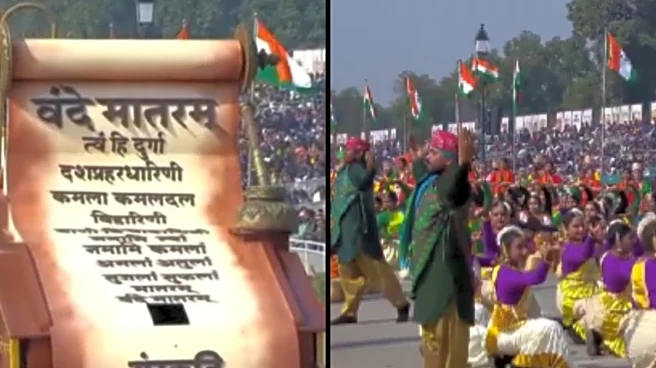
The sesquicentenary of ‘Vande Mataram’ was the dominant theme of the 77th Republic Day Parade, with enclosure backdrops along the Kartavya Path displaying prints of old paintings (published in a volume in 1923) by artist Tejendra Kumar Mitra, illustrating the opening stanzas of the national song, and floral artworks at the main stage paying homage to Chatterjee, who composed it in 1875.
2,500 Artists Perform On Vande Mataram Song
The Culture Ministry also showcased a dance performance on the Vande Mataram theme. Curated by the Sangeet Natak Akademi, the choreography came alive with the participation of 2,500 artists from every state and union territory, celebrating the nation’s unity, rich cultural heritage, and patriotic spirit through a mesmerising perfomance.
‘Vande Mataram’, a rallying cry during the freedom movement, was adopted as India’s national song by the Constituent Assembly in 1950. India turned a Republic on January 26, 1950, when the Constitution, adopted on November 26, 1949, came into effect.
‘Vande Mataram’ was initially composed independently and later included in Chatterjee’s novel ‘Anandamath’. It was first sung by Rabindranath Tagore at the 1896 Congress Session in Calcutta (now Kolkata). The chant ‘Vande Mataram’ as a political slogan was first used on August 7, 1905, according to a note ‘150 Years of Vande Mataram: A Melody That Became a Movement’, shared by the government on November 6 last year.
‘Vande Mataram’ was first published in the literary journal ‘Bangadarshan’ on November 7, 1875. Later, Chatterjee incorporated the hymn in his novel ‘Anandamath’, which was published in 1882. It was set to music by Tagore, it said.
It has become an integral part of the nation’s civilisational, political and cultural consciousness. Commemorating this milestone presents an occasion to reaffirm the timeless message of unity, sacrifice, and devotion that ‘Vande Mataram’ embodies for all Indians, the note said. Videos on ‘Vande Mataram’ were played on a screen at Kartavya Path.
(With inputs from PTI)






/images/ppid_a911dc6a-image-177097782622344643.webp)

/images/ppid_59c68470-image-177097760620817211.webp)

/images/ppid_59c68470-image-177097756960286546.webp)
/images/ppid_59c68470-image-177097753298733631.webp)
/images/ppid_59c68470-image-177097752876693648.webp)