
/images/ppid_a911dc6a-image-177103642565816962.webp)
/images/ppid_a911dc6a-image-177103504309993710.webp)
/images/ppid_a911dc6a-image-177103508492594205.webp)
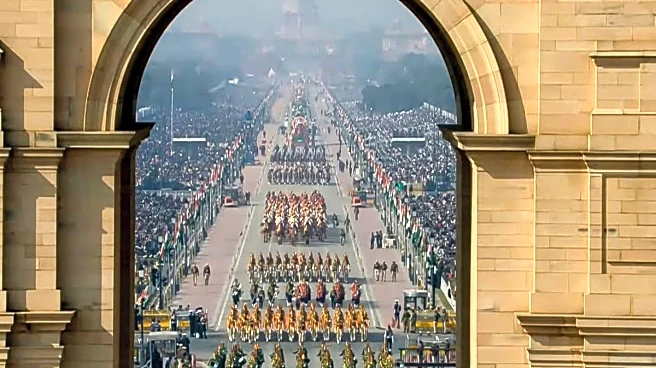
In a grand celebration of democratic ideals and national pride, India marked its 77th Republic Day with a spectacular parade at Kartavya Path that brought together rich cultural expressions, cutting-edge defence technology, and a powerful tribute to the nation’s heritage. As President Droupadi Murmu presided over the ceremony, distinguished international dignitaries, including European Commission President Ursula von der Leyen and European Council President Antonio Costa, were in attendance as chief guests.
A Theme Rooted in History and Unity
This year’s parade honoured the 150th anniversary of Vande Mataram, celebrating the enduring legacy of the national song that became a rallying cry during India’s freedom struggle. Kartavya Path was adorned
with artistic interpretations of its stanzas, evoking both cultural pride and historical memory as thousands gathered to witness the ceremony.
The theme of “unity in diversity” was reflected across performances by around 2,500 cultural artists, classical dancers, bands, and tableaux representing India’s cultural and developmental achievements.
Showcase of Military Modernisation and Readiness
One of the defining features of the parade was the emphasis on India’s defence capabilities. A phased Battle Array Format debuted on Kartavya Path, bringing a battlefield-like realism to the marchpast, with assets ranging from cavalry and reconnaissance units to modern artillery, unmanned systems, and air defence platforms.
A central highlight was the Tri-Services tableau titled “Operation Sindoor: Victory Through Jointness”, spotlighting India’s coordinated military operation against terror infrastructures. This feature included representations of strategic weapon systems such as BrahMos missiles, S-400 air defence systems, and combat aircraft that were instrumental during the mission.
Modeled as an Operational Integrated Display, the tableau visualised how the Army, Navy, and Air Force coordinated intelligence, precision strikes, and support systems to neutralise enemy infrastructure and threats. It integrated representations of long-range assets and advanced weapon systems, underscoring how joint synergy played a decisive role in modern warfare.
An aerial spectacle featured Mi-17 helicopters flying in a “Dhwaj Formation”, scattering flower petals over Kartavya Path as a tribute to the Tricolour. Alongside state and ministry tableaux, a Naval contingent showcased India’s maritime legacy with historic stitched vessels and representations of modern indigenous ships like INS Vikrant and INS Udaygiri.
The aerial segment culminated in a breath-taking flypast featuring 29 aircraft, including Rafale, Su-30, MiG-29 and Jaguar fighters, flying in formations that underscored the Air Force’s precision and readiness.
Honouring Valour and Participation
Veterans and gallantry awardees held an honoured place in the procession, with decorated heroes like Subedar Major (Honorary Captain) Yogendra Singh Yadav and Subedar Major Sanjay Kumar marching alongside other distinguished personnel.
The parade also featured contingents from the Indian Army, Navy, Air Force, and Central Armed Police Forces, along with vibrant tableaux from 17 states and Union Territories and 13 governmental ministries, each highlighting facets of national progress and community spirit.
As tradition dictates, recipients of India’s highest gallantry awards led parts of the march-past. This year, among those honoured was Group Captain Shubhanshu Shukla, awarded the Ashoka Chakra for his historic achievement as the first Indian to serve on the International Space Station. Alongside him, 70 other heroes were recognised for exceptional valour and service.
From the heartfelt resonance of Vande Mataram to the disciplined precision of modern military formations, the Republic Day 2026 parade captured both India’s storied past and its aspirations for the future.

/images/ppid_59c68470-image-177104254494215325.webp)

/images/ppid_a911dc6a-image-177104210287325129.webp)

/images/ppid_a911dc6a-image-177104202793221357.webp)
/images/ppid_a911dc6a-image-177104206710214315.webp)
/images/ppid_a911dc6a-image-177104202907093694.webp)
/images/ppid_59c68470-image-177104014803952296.webp)
/images/ppid_59c68470-image-177104006389961167.webp)
/images/ppid_a911dc6a-image-177103853218557950.webp)