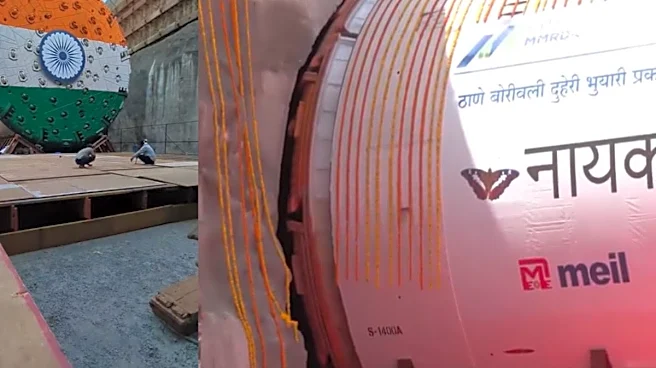



Maharashtra Chief Minister Devendra Fadnavis, along with Deputy CMs Eknath Shinde and Sunetra Pawar, officially launched the Tunnel Boring Machine (TBM) for the ambitious Thane-Borivali Twin Tunnel project.
Speaking at the event on Tuesday, Fadnavis called it an engineering marvel, noting that the tunnel will cut the current 23-kilometre Thane-Borivali route down to just 11.84 kilometres, bringing travel time from as long as two hours down to just 15 minutes. The project is being executed by MMRDA at an estimated cost of Rs 16,600 crore.
What Exactly Is A TBM — And What Does It Do?
Think of a Tunnel Boring Machine as a giant underground drill — only far more sophisticated. The TBM ‘Nayak’ measures 86 metres in length with a cutter head diameter of 13.34 metres and is the country’s largest
single-shield hard rock tunnel boring machine.
It is capable of precision cutting at 4.5 rotations per minute and weighs approximately 2,500 tonnes. As it rotates and bores through rock, it simultaneously lines the tunnel walls with precast concrete segments, moving forward metre by metre through the earth.
It features a customised hard-rock cutter head, real-time guidance, dust suppression, and low-noise systems to protect the park environment, while automated spoil removal and safety modules reduce manual work and enhance safety.
Why Are These Machines Named Nayak And Arjun?
This is where it gets poetic. The tunnel passes deep beneath the Sanjay Gandhi National Park (SGNP) — one of Mumbai’s most precious green lungs. Rather than treating this as just a construction challenge, the project planners chose to honour the park’s biodiversity through the machines doing the digging.
The TBM Nayak is named after a rare butterfly species found in SGNP. The second TBM, Arjun, takes its name from the Arjun tree — a species native to the park.
Both TBMs have been procured from the German manufacturer Herrenknecht’s facility in Chennai. The choice of names is deliberate — a nod to the very ecosystem the machines will burrow beneath, and a public commitment to disturbing it as little as possible.
Deputy CM Eknath Shinde captured the spirit of this at the launch event, saying the tunnelling must be done with such care that “even a butterfly should not be disturbed.”
How Big Is This Project Really?
The 11.84-km-long corridor will include 10.25 km of twin tunnels and 1.59 km of roads, providing a direct underground link between Ghodbunder Road in Thane and the Western Express Highway in Borivali.
A total of four TBMs will eventually be deployed — two boring from the Borivali end and two from the Thane end.
According to Times of India, each tunnel will have two traffic lanes and one emergency lane in each direction. Cross-passages will be built every 300 metres for safety and evacuation.
With a projected average daily traffic of around 80,000 vehicles by 2029, the corridor will shorten travel distance by 11 to 15 kilometres, delivering long-term economic and environmental benefits.
What About The Forest Above — Will It Be Harmed?
This has been the biggest concern around the project, given that SGNP is a protected zone home to leopards, migratory birds, rare butterflies, and over 1,000 plant species.
CM Fadnavis said new technology has been used to ensure the national park and its biodiversity will not be harmed.
According to TOI, the construction is being carried out deep underground using zero-vibration technology.
Officials say safety protocols inspired by international benchmarks — including those used in Singapore’s metro systems, which tunnel through water-bearing strata — will be followed to address the risk of water seepage from undiscovered underground reservoirs beneath the forest. All environmental and wildlife clearances have been secured.
११.८४ किमी लांबी, ३ लेनचे दुहेरी बोगदे आणि अत्याधुनिक सुरक्षा यंत्रणा!
ठाणे-बोरीवली दुहेरी बोगदा हा केवळ प्रकल्प नाही, तर मुंबईला वेगवान बनवणारे एमएमआरडीएचे वचन आहे. 'मुंबई इन मिनिट्स' आता स्वप्न उरलं नाही!#MumbaiInMinutes is now a dream being realised and the Thane-Borivali… pic.twitter.com/VVfdNjuKn7— MMRDA (@MMRDAOfficial) April 7, 2026
When Will It Be Ready?
The project, which began on May 19, 2023, is expected to be completed by May 2028. Once complete, it will be India’s longest urban road tunnel — and for the lakhs of commuters stuck on Ghodbunder Road every single day, it cannot come soon enough.
/images/ppid_59c68470-image-177555003938539345.webp)


/images/ppid_a911dc6a-image-17755781221043081.webp)

/images/ppid_a911dc6a-image-177555842909062190.webp)
/images/ppid_a911dc6a-image-177564243427517713.webp)