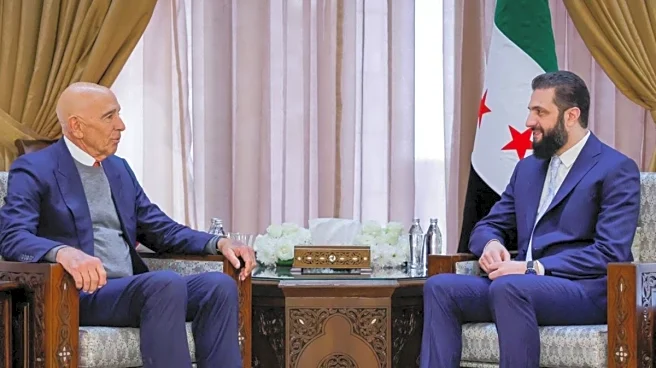

The Syrian government and the US-backed Syrian Democratic Forces (SDF) on Sunday agreed to an immediate and comprehensive ceasefire on all fronts, following days of fighting in the country’s north and east.
The agreement comes after Syrian government forces advanced into areas previously held by Kurdish-led forces in the northeast. The ceasefire was announced after talks involving Syrian President Ahmed al-Sharaa and SDF leader Mazloum Abdi.
US envoy Tom Barrack welcomed the deal, calling it a major step forward. “This agreement and ceasefire represent a pivotal inflection point, where former adversaries embrace partnership over division,” Barrack said in a post on X.
The United States commends the Syrian government and the Syrian Democratic Forces (SDF) for their constructive efforts in reaching today’s ceasefire agreement, paving the way for renewed dialogue and cooperation toward a unified Syria.
Two great Syrian leaders, driven by the…
— Ambassador Tom Barrack (@USAMBTurkiye) January 18, 2026
He met President Sharaa in Damascus on Sunday and held talks with Abdi in Erbil, Iraq, a day earlier.
According to a document published by the Syrian Presidency, the ceasefire will take place alongside the withdrawal of all SDF-affiliated forces to the east of the Euphrates River. The agreement also includes plans to integrate SDF fighters into Syria’s defence and interior ministries after required security checks.
Under the deal, the Syrian government will immediately take full military and administrative control of the provinces of Deir al-Zor and Raqqa, which were previously under Kurdish control. All border crossings, as well as oil and gas fields in the region, will also be handed over to the state.
President Sharaa said the decision was taken to calm the situation. He told reporters that a planned meeting with Abdi was delayed due to poor weather, but both sides agreed to move forward with the ceasefire.
The presidency released the text of a 14-point agreement, which also places responsibility for Islamic State prisoners and their families, currently held in Kurdish-run prisons and camps, under the control of the Syrian government.
(With inputs from agencies)




/images/ppid_a911dc6a-image-177104554006886045.webp)





/images/ppid_59c68470-image-177104502841632289.webp)

/images/ppid_a911dc6a-image-17710448296527978.webp)
/images/ppid_a911dc6a-image-177104482828655023.webp)