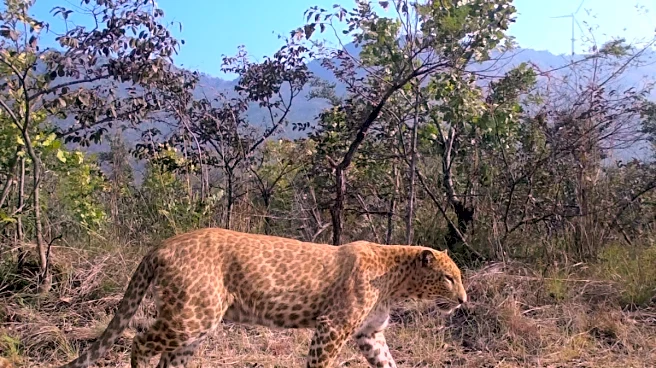

In a remarkable wildlife discovery, researchers in Karnataka have documented an ultra-rare leopard colour morph in the Vijayanagara district, marking only the second confirmed sighting of such a big cat
in India and the first in the state. The elusive animal, named the “Sandalwood Leopard” by conservationists, is distinguished by a pale reddish-pink coat with light-brown rosettes, a striking deviation from the typical tawny coat of Indian leopards. The discovery has drawn fresh attention to Karnataka’s rich biodiversity and the diversity of its leopard population.
The sighting was made by Sanjay Gubbi and his team from the Holematthi Nature Foundation (HNF), who captured images of the female leopard, estimated to be 6–7 years old, through camera traps as part of ongoing research on leopard diversity in the state. In later images, the leopard was photographed with a cub exhibiting the usual tawny coat with black rosettes, highlighting the uniqueness of the adult female’s coat.
Typically, Indian leopards have tawny coats marked with black rosettes, but this exceptionally rare morph, believed to be linked to hypomelanism or erythrism, shows a pale reddish-pink hue that resembles the colour of sandalwood. While the striking appearance has been visually documented, the team cautioned that confirming the exact genetic basis of this morph would require molecular analysis through non-invasive DNA samples such as hair or scat.
The camera trapping was part of efforts to estimate leopard populations and identify key landscapes for large mammal conservation in the Kalyana-Karnataka region, conducted in collaboration with CHINA’s wildlife research initiatives. According to HNF, Karnataka supports an estimated 2,500 leopards, including one of the country’s highest concentrations of melanistic leopards, commonly known as black panthers.
Globally, this rare colour morph has been recorded only five times: twice in South Africa, once in Tanzania, and twice in India. The research team documenting this discovery also includes Sandesh Appu Naik, Shravan Suthar, Poornesha HC, Ruma Kundarkar, Ravichandra Velip, Dayanand Mirashi, Sumit Velip, Aishwarya Karanth, and Mayur Mirashi.
The Sandalwood Leopard’s documentation highlights Karnataka’s wildlife diversity and the importance of continued conservation efforts. As researchers continue monitoring leopards across the state, this rare sighting adds a new dimension to understanding the genetic and ecological diversity of big cats in India, capturing the imagination of wildlife enthusiasts worldwide.










/images/ppid_a911dc6a-image-177088522728382126.webp)

/images/ppid_59c68470-image-177088509203227042.webp)
