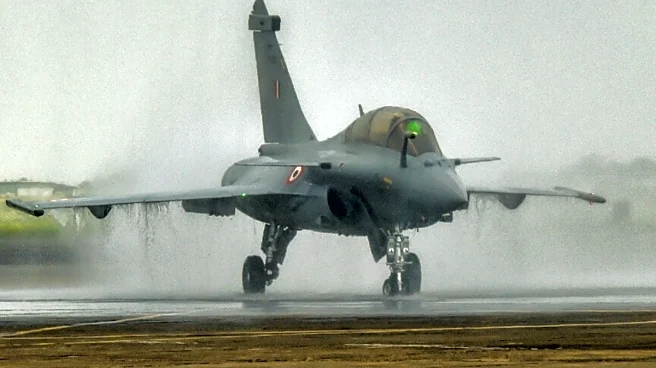

India’s quest for unchallenged air superiority, amid escalating tensions on its borders, has once again thrust the Rafale fighter jet into the spotlight. On 16 January, the Defence Procurement Board, under
Defence Secretary Rajesh Kumar Singh, cleared the proposal for 114 additional Rafales from France’s Dassault Aviation, paving the way for what could be the Republic’s most substantial defence outlay at Rs 3.25 lakh crore. This follows the Indian Air Force’s (IAF) operational integration of 36 jets procured in 2016 and the Navy’s April 2025 contract for 26 marine variants, elevating the total fleet to 176 aircraft.
Yet, as with previous deals, this initiative has ignited partisan controversies, with detractors alleging undue haste, inflated costs and a dilution of self-reliance. In truth, such acquisitions represent pragmatic realism in a volatile geopolitical landscape. Let’s draw on the latest developments, including the Board’s nod and impending reviews by the Defence Acquisition Council and Cabinet Committee on Security, to dissect the deal’s intricacies, dispelling entrenched myths with empirical clarity.
The Rafale, a versatile 4.5-generation platform — remarkably more sophisticated than the base model the UPA government had begun bargaining for — has already demonstrated its prowess in IAF exercises, where its SPECTRA electronic warfare system effectively neutralised simulated threats from advanced adversaries. Far from mere procurement, this tranche is a strategic bridge between immediate vulnerabilities and the need to nurture indigenous capabilities. With negotiations intensifying ahead of a possible February summit between Prime Minister Narendra Modi and French President Emmanuel Macron, the emphasis remains on technological sovereignty and economic multipliers.
It is high time this nation moved beyond polemics and appreciated the deal’s role in fortifying national security. Indeed, as border standoffs with China persist and Pakistan modernises its arsenal, delaying such enhancements would be folly. The deal’s timing, coinciding with India’s push for defence exports under Aatmanirbhar Bharat, underscores a broader vision: transforming the nation from a buyer to a builder in global aerospace.
Scale, timeline, necessities
The proposal addresses a glaring deficit in the IAF’s force structure. Authorised for 42 squadrons, the service limps along with barely 30-32, as venerable MiG-21s and Jaguars approach obsolescence. The 114 Rafales would reconstitute several squadrons, providing a robust deterrent against the dual threats from China and Pakistan, whose air arms boast stealthy J-20s and aspiring J-35s, respectively. This is no capricious splurge but the fruition of the Multi-Role Fighter Aircraft (MRFA) tender, where the Rafale prevailed over rivals like the Eurofighter Typhoon and Boeing F/A-18, owing to its seamless compatibility with IAF logistics and battle-tested efficacy. The selection was influenced by the jet’s superior beyond-visual-range capabilities and low radar cross-section, which have proven invaluable in high-altitude operations along the Line of Actual Control.
A pervasive myth posits this as an exorbitant redux of the 2016 controversy. In fact, the Rs 3.25 lakh crore encompasses more than mere aircraft. It’s a comprehensive package, with armaments, simulators, training, spares and lifecycle sustainment over decades — plus upgrades to the cutting-edge F4 standard with AI-enhanced sensor fusion — on offer. Comparative analysis reveals parity with international norms; Egypt’s 2024 Rafale batch, for instance, mirrored per-unit costs when adjusted for similar inclusions, hovering around Rs 1,000-1,200 crore per fully equipped jet.
Detractors often invoke the 2007 MMRCA baseline of Rs 500-525 crore per jet, but that calculation did not take into account inflation, bespoke India-specific enhancements — cold-weather engine starts for Himalayan ops, for instance — and enduring maintenance commitments. Spread across 30-40 years, the investment yields enduring value, far outweighing short-term fiscal optics. Moreover, offsets mandated under the deal could redirect up to 50 per cent of the value back into the Indian industry, exceeding Rs 1.6 lakh crore in economic inflows.
The procedural trajectory lends further credence. Following the Board’s approval on 16 January, the file advances to Defence Minister Rajnath Singh’s Acquisition Council, thence to Modi’s Cabinet Committee for Security for final sanction. Deliveries of the initial 12-18 fly-away units could commence by 2030, ensuring operational continuity amid localisation ramps. Concurrently, the Navy’s Rs 63,000 crore pact for 26 Rafale Marines, inked on 28 April 2025, fortifies carrier-based aviation on vessels like INS Vikrant, with inflows slated for 2028-2030. This multifaceted approach exemplifies the Modi administration’s layered doctrine: foreign tech for present dominance, dovetailed with homegrown endeavours like the Tejas Mk2 and AMCA. Such synergy is indispensable, lest delays in domestic production should expose strategic flanks. The deal could expand to include 24 more jets for training, pushing the total closer to 140, further amplifying squadron rebuilds.
Source code realities: Autonomy without recklessness
No facet of the Rafale discourse has been more mangled than the source code conundrum. Critics lambast France for withholding full access, evoking spectres of remote control or embedded vulnerabilities. This narrative, however, betrays a fundamental misapprehension of aerospace norms.
India has prudently eschewed demands for the complete flight control software, RBE2 AESA radar algorithms or SPECTRA electronic warfare fundamentals — proprietary kernels that no Western exporter, be it France or the United States with its F-35, divulges to any client. Such transfers would imperil intellectual assets and invite proliferation risks, even among NATO confederates. Instead, New Delhi’s imperatives centre on operational latitude: interface layers for indigenous weapon grafting, mission software and validation protocols. This facilitates autonomous integration of systems like the Astra Mk1/Mk2 missiles, Rudram anti-radiation ordnance and BrahMos-NG, obviating wartime reliance on foreign clearances. Defence ministry sources confirm that these layers will allow India to update threat libraries independently, adapting to evolving electronic signatures from Chinese or Pakistani systems.
Debunking the second myth — that France wields veto power over Indian assets — the accord stipulates encrypted data links meshing Rafales with domestic radars, satellites and command grids, rendering them integral to India’s sovereign combat ecosystem. No ‘kill switch’ exists in export configurations, as attested by independent audits; allegations to the contrary stem from conflations with other platforms. India further governs threat databases and adaptive responses, engendering adversary ambiguity, a potent asymmetric advantage. Unfettered flight control access, conversely, would court catastrophe, jeopardising pilots via untested alterations. Genuine autonomy inheres in mission mastery rather than quixotic code possession.
Bolstering this, the package incorporates F4 retrofits for the extant 36 jets, augmenting capabilities against hypersonic flights, alongside provisions for nascent F5 iterations. The deal may encompass at least 24 F5 variants, heralding quantum leaps in stealth and networking. This progressive escalation underscores the partnership’s depth, transcending transactional bounds. Additionally, joint ventures in engine technology, including possible co-production of the M88 turbofan, could reduce India’s import dependency from 70 per cent to under 40 per cent in power plants over the next decade.
Manufacturing in India: Beyond screwdriver jobs
Scepticism abounds that the deal undermines ‘Make in India’, consigning the nation to perpetual import servitude. On the contrary, it heralds a manufacturing renaissance, eclipsing previous benchmarks.
Of the 114 airframes, 96-102 will emerge from Indian soil, commencing at 30 per cent indigenous content and ascending to 60 per cent via structured indigenisation — with some reports ambitiously floating 80 per cent localisation, though negotiations continue. The epicentre will be Dassault Reliance Aerospace’s Nagpur facility, orchestrating airframe fabrication, harness assembly, structural integration and sustainment. Collaborators include Tata, Mahindra and Larsen & Toubro, fostering a vibrant supply chain of over 100 vendors. A Hyderabad MRO hub for Safran M88 engines will cultivate expertise, likely generating export avenues to Southeast Asia. This localisation quantum outstrips the Su-30MKI’s 50 per cent threshold, achieved only after protracted efforts. Moreover, it is consistent with the global trends where even Boeing localises 30-40 per cent in offset deals.
The third myth — of indigenous sabotage — crumbles under scrutiny. Rafale serves as a sentinel, while the Tejas Mk2, powered by co-produced GE F414, and the stealthy AMCA gestate. Offsets from the deal could infuse billions into R&D, catalysing breakthroughs in composites and avionics. As IAF leadership avers, procurement lacunae demand bridging; this infusion secures the interim without stymying progress. Economically, it promises thousands of skilled employments — estimates peg 10,000-15,000 direct jobs, plus 50,000 indirect — invigorating ancillary sectors like precision engineering and software testing. In a post-pandemic era, such multipliers are vital for industrial resurgence, adding 0.2-0.3 per cent to annual GDP growth through defence manufacturing.
Strategic maturity: Dominance today, independence tomorrow
This endeavour epitomises strategic sagacity, privileging territorial integrity over ideological posturing. Confronted by China’s J-20 deployments and Pakistan’s modernisation, India cannot abide complacency. Rafale’s SPECTRA has, in simulations, thwarted PL-15 incursions, validating its edge against numerically superior foes. At the same time, Pakistan’s Chinese missile defence systems, LY-80, HQ-9 and HQ-16, failed miserably to intercept Indian BrahMos and SCALP cruise missiles during Operation Sindoor.
Dispelling the fourth myth — of geopolitical capitulation — the selection eschews entanglements like US data-sharing mandates or Russian reliability woes. Opting for Rafale preserves non-alignment, enabling diversified sourcing amid global supply chain disruptions. Whispers of expansion to 200 jets, including further tranches, reflect calibrated ambition to realise 50 squadrons against two-front exigencies. The deal also dovetails with Indo-French collaborations in space and cyber defence, strengthening Quad alliances without overt commitments.
The Rafale deal positions India as an aerospace confluence, with DRDO’s Rs 26,000 crore missile initiatives and Rs 5,000 crore unmanned procurements complementing it. Taxpayer funds thus procure not mere hardware but deterrence, prosperity and autonomy. The Rafale saga illuminates a mature polity, one that harnesses global alliances to forge unassailable self-sufficiency. As Macron’s February visit approaches, sealing this pact would affirm India’s ascent in the Indo-Pacific theatre, a development worthy of bipartisan acclaim. Ultimately, it is through such measured steps that nations secure their sovereignty in an uncertain world.
The author is a senior journalist and writer. Views expressed in the above piece are personal and solely those of the author. They do not necessarily reflect News18’s views.



/images/ppid_a911dc6a-image-177097782622344643.webp)

/images/ppid_59c68470-image-177097760620817211.webp)

/images/ppid_59c68470-image-177097756960286546.webp)
/images/ppid_59c68470-image-177097753298733631.webp)
/images/ppid_59c68470-image-177097752876693648.webp)