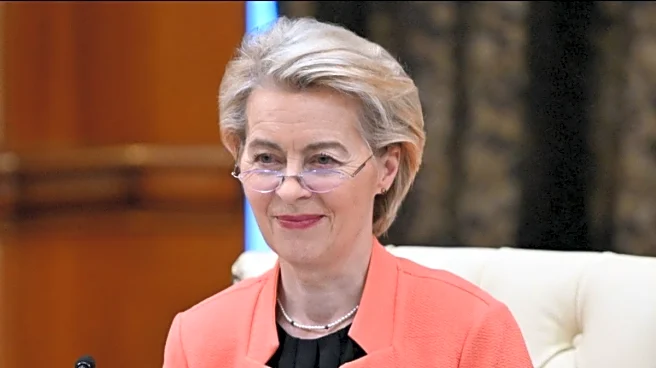

European Commission President Ursula von der Leyen and European Council President António Costa will be the chief guests at India’s Republic Day celebrations on January 26. Their visit is expected to coincide
with the India–EU Summit, where discussions are likely to centre on the proposed Free Trade Agreement (FTA), with both sides aiming to push the long-pending deal toward conclusion.
The twin events signal a renewed strategic and economic push between India and the EU at the highest levels.
Inviting top EU leadership as Republic Day chief guests carries strong symbolic weight, pointing New Delhi’s intent to deepen its diplomatic and economic engagement with the bloc.
The move comes at a time when India–EU relations have accelerated, particularly following the visit by EU Commissioners to India in February 2025, which helped set the stage for expanded cooperation in trade, defence, technology, and people-to-people exchanges.
India and the European Union (EU) resumed negotiations on December 8 in New Delhi on the long-pending free trade agreement (FTA), with both sides aiming to conclude the decade-long talks by the end of this year. The meeting comes at a crucial time as India and the EU attempt to close remaining gaps in the ambitious pact.
The discussions, as per a report by Moneycontrol, are expected to focus on resolving outstanding issues related to trade in goods and services, investment rules, government procurement and regulatory standards, including sanitary and technical requirements.
Key sticking points remain, including the EU’s proposed carbon tax, market access for automobiles and steel, rules of origin and barriers in services.
Commerce Minister Piyush Goyal is leading the Indian delegation, while the EU side is headed by Sabine Weyand, Director-General for Trade at the European Commission, who is back in Delhi within a month for the talks.
India has also raised concerns over the EU’s Carbon Border Adjustment Mechanism (CBAM), which takes effect on January 1 and could impact exports of steel, aluminium and other carbon-intensive goods by imposing additional levies tied to their carbon footprint.
/images/ppid_59c68470-image-177104014803952296.webp)

/images/ppid_59c68470-image-177104006389961167.webp)
/images/ppid_a911dc6a-image-177103853218557950.webp)




/images/ppid_a911dc6a-image-17710364781122582.webp)
/images/ppid_a911dc6a-image-177103642565816962.webp)
/images/ppid_a911dc6a-image-177103504309993710.webp)
/images/ppid_a911dc6a-image-177103508492594205.webp)