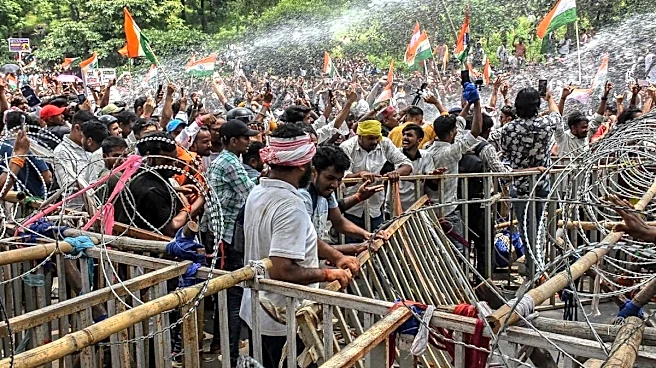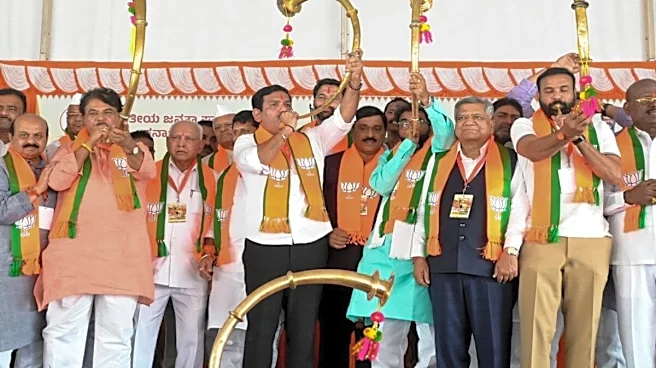


The Karnataka BJP’s 10-day Ballari Chalo padayatra has turned into a larger political contest, with the Opposition claiming that sustained protests have forced the Congress government to act, while Chief Minister D K Shivakumar has sought to turn the BJP’s street campaign into an opportunity for the ruling party to mount its own counter and expose the BJP as well.
The padayatra, which began in Lingasugur on September 1 and will culminate in Ballari on September 10, was originally planned around the demand for the removal of B Nagendra from the Cabinet over the alleged irregularities in the Maharshi Valmiki Scheduled Tribes Development Corporation.
Nagendra’s resignation last week, however, did not end the BJP’s campaign.
Later, the BJP expanded
the march into a wider attack on the Congress government over corruption, drought, farmers’ issues, vacant government posts and other alleged failures, while also seeking answers and assessing the party’s reach ahead of the 2028 Assembly polls.
For BJP state president B Y Vijayendra, the continuation of the padayatra is part of a larger strategy that he says is already yielding results.
Vijayendra said that the BJP had achieved four “successes” in the last 25 days through its campaign against what he called the “anti-people policies” of the Congress government.
He cited Nagendra’s resignation following BJP protests in both Houses of the legislature as the first. The second, he said, was the BJP’s campaign on drought, which forced the Chief Minister and ministers to visit drought-hit districts.
Vijayendra described the withdrawal of the Park Bill as the BJP’s third success, while the fourth, he said, was the government’s decision to convene a special session of the legislature to discuss drought and other pressing issues.
“This is what the powerful people’s movement means. BJP has been successful in building a strong movement. We are buoyed by this series of success. Nothing succeeds like success,” Vijayendra said to this reporter.
He said that the consistent effort and exposé by the BJP had “brought the high-flying government to its knees” and said the developments would encourage the party to intensify its campaign against the Congress.
The Congress, however, has a comeback to the BJP’s attempt to claim exclusive credit for the government’s decisions. Chief Minister D K Shivakumar has his own counter.
Responding to the BJP’s padayatra, he said it was a way for the BJP to provide the Congress with a platter to expose the party, and that the Congress would launch a massive counterattack. “Our party will plan a counter strategy. Our party is no less,” he said.
The Chief Minister has also sought to turn the BJP’s protest into a broader argument about the functioning of the legislature. His position is that the Opposition cannot claim to be fighting for drought-affected farmers while simultaneously disrupting the Assembly.
The recent monsoon session of the legislature was repeatedly disrupted by BJP and JD(S) protests over the Valmiki Corporation issue and the demand for Nagendra’s removal. The session was eventually adjourned sine die amid the continuing protests.
That has now become part of the Congress’s counter to Ballari Chalo: if the BJP wanted drought and farmers’ problems discussed, the government argues, it had an opportunity to do so in the legislature, which it did not.
The government has now decided to convene a three-day special session on September 21, 22 and 23 to discuss the drought situation, problems faced by farmers and the Kasturirangan report on the Western Ghats.
Shivakumar has directly linked the decision to the inability of legislators to adequately discuss the drought during the previous session. “You have seen the BJP and JD(S)’ politics. There was no discussion on farmers and the drought situation during the recent legislature session. That’s the reason the special session has been called,” he said.
He said legislators from across parties had raised concerns about the situation in their constituencies.
“BJP MLAs, JD(S) MLAs, and our MLAs were all telling me about the situation in their respective constituencies. So, I should understand the sentiments and situation in each constituency and extend all possible support to them,” Shivakumar said.
He also challenged the BJP to join the government in seeking financial assistance from the Centre.
The BJP has been demanding a farm-loan waiver for drought-hit farmers, and Vijayendra has urged the government to announce a waiver of up to Rs 5 lakh for farmers in affected regions. Shivakumar turned that demand back on the BJP, asking its leaders to accompany him to Delhi.
“Vijayendra has said that there should be a loan waiver. Certainly, the Central Government should take responsibility for a loan waiver. The Prime Minister himself has said that this is a drought situation. So, Vijayendra, R Ashoka, and all the other BJP leaders should come with me to Delhi and demand that the Central Government waive the farmers’ loans,” he said.
On the one hand, the BJP wants to establish that the Congress government responds only after sustained pressure, while the Congress is seeking to demonstrate that it is already acting on issues raised by legislators and the people, and that the BJP’s protests are preventing the government and the legislature from functioning.
The Park Bill saw a similar contest over political credit.
The government withdrew the controversial legislation after widespread protests over the provision allowing up to five per cent of park land to be used for public infrastructure and utility projects. Vijayendra has counted the withdrawal among the BJP’s four recent successes.
Shivakumar, however, has rejected the BJP’s description of the move as a U-turn and said the withdrawal was intended to allow a wider discussion. He said “they heard the people’s voices” and that this is how democracy works.
“Why should I do a U-turn? I would have explained the Bill to them in the Assembly, but they did not participate in the discussion during its passage,” the CM said.
He has also challenged the BJP to debate what previous governments did with park and civic amenity land.
“Let there be a discussion. I don’t have anything that Lalbagh land should be used for the tunnel road. We have thought about other places as well. But what else can be done? Give us an alternative,” Shivakumar said.
The Valmiki issue remains the central political trigger for the BJP’s campaign, even though Nagendra has resigned. Shivakumar has said Nagendra resigned voluntarily and questioned the need for the BJP to continue with the padayatra.
“But the BJP is doing a padayatra. Let them do it. You will see my yatra too,” he said.
The BJP, meanwhile, sees the march as an opportunity to keep the pressure on the government and build a broader anti-incumbency narrative.
The route through Raichur, Koppal and Ballari also gives the BJP a political opening in north Karnataka, where drought, farmer distress and issues concerning Dalit and tribal communities carry considerable electoral weight.
There is a larger electoral calculation as well. With GBA elections expected and the 2028 Assembly election less than two years away, the padayatra gives the BJP an opportunity to mobilise its cadre, project unity among its senior leadership and establish a set of issues around which it can build an anti-Congress campaign.
For the Congress, the challenge is to prevent the BJP from converting individual controversies into a single narrative of government failure. The party can point to the special session, its drought assessment and the withdrawal of the Park Bill as evidence of responsiveness. But if the BJP succeeds in convincing voters that these decisions were made only because of Opposition pressure, it can claim the political credit.