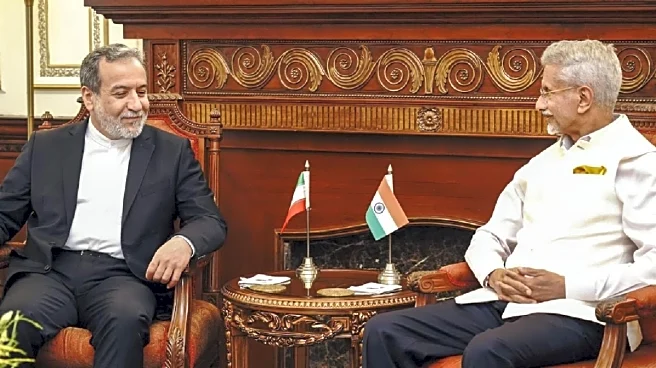

On January 24, India quietly did something that would seem bewildering. It voted on the same side as China and Pakistan at the UN Human Rights Council (UNHRC).
The resolution was to censure the Islamist
Ali Khamenei regime in Iran for its reported brutal excesses and mass murder of protesters. While the motion won 25-7 with 14 abstentions, India voted no with China, Cuba, Indonesia, Iraq, Vietnam, and Pakistan.
Iran’s unfolding tragedy stares us in the face. So far, about 30,000 innocent protesters have reportedly been massacred and thousands more tortured since protests sparked by the rial’s collapse on December 28, 2025. It should have been an open-and-shut case for India to take a stand against the regime.
But from India’s point of view, the issue has nuances and complications it can only gloss over at its peril.
Let us first look at the reasons India should overtly oppose the Iranian regime.
The first one is simple: as the world’s biggest democracy, supporting the resolution would reinforce India’s image as a champion of human rights and freedom of expression, in line with western allies like the US and EU. It strengthens ties in forums like the Quad and boosts India’s bid for a permanent UN Security Council seat.
It also would be a public display of support for one of India’s closest allies, Israel.
Censuring Iran would also undermine groups like Hezbollah, which have links to anti-India elements, besides strengthening ties with Sunni-majority Gulf states which are India’s key economic partners.
Back home, supporting Iranian protesters would resonate with India’s young population and democracy-loving civil society.
The Narendra Modi government can also play to its right-leaning, nationalist, anti-Islamist core vote bank.
But thereon begins the complications and kicks in equal, if not greater, self-interest.
First, India has old and deep strategic ties with Iran. It is crucial for India’s access to Afghanistan and Central Asia via the Chabahar port (which India helped build) and International North-South Transport Corridor, bypassing Pakistan.
Voting against western allies saves this partnership, which is essential for countering China’s Belt and Road Initiative and securing alternative trade routes amid tensions with Pakistan and China.
Second, India’s foreign policy underscores non-interference in internal affairs, according to Panchsheel principles. Opposing the resolution avoids hypocrisy, given India’s thick red line on UN scrutiny in issues like Kashmir. It also does not alienate non-western powers like Russia and China in a multipolar world.
Third, a vote against censuring the Khamenei regime protects India’s delicate balancing act between Shia Iran and Sunni Gulf states. The fall of Iran would deal a body blow to the Shia world, and would tip the balance in favour of a Sunni monopoly in the Islamic world.
Fourth, every time India contemplates changing the status quo in the Middle East, it has to take into account the safety of the 8-9 million Indian expatriates there, whose remittances also happen to be vital.
Fifth, Iran feeds into India’s energy needs with an enormous amount of oil and helps it keep control over prices and inflation.
Sixth, the BJP traditionally enjoys goodwill among Indian Shias in spite of the narrative of it being “anti-Muslim”. On the Iran issue, even a large part of India’s Sunni population sees the US-Israel block as a force against Islam rather than just one sect.
Seventh and last is India’s own experience with constant regime-change attempts from the West. While Iran may strongly deserve a different government, participating in toppling it paves the way for Deep State agents to invent an excuse to undermine India’s thrice-elected, democratically chosen government.
Unpopular and seemingly confounding and amoral decisions are often the only way a nation preserves the interests of its people. India’s choices on Iran should be seen in that light.
As American political scientist Joseph Nye says: “National interest is predetermined by geopolitics or the history of a country. Important political leaders never just followed their interests; they were concerned about the interests of their people.”
Abhijit Majumder is the author of the book, ‘India’s New Right’. Views expressed in the above piece are personal and solely those of the author. They do not necessarily reflect News18’s views.


/images/ppid_a911dc6a-image-177098224616495837.webp)

/images/ppid_59c68470-image-177087756975063071.webp)

/images/ppid_59c68470-image-177074753723033180.webp)
/images/ppid_59c68470-image-177099004901435587.webp)