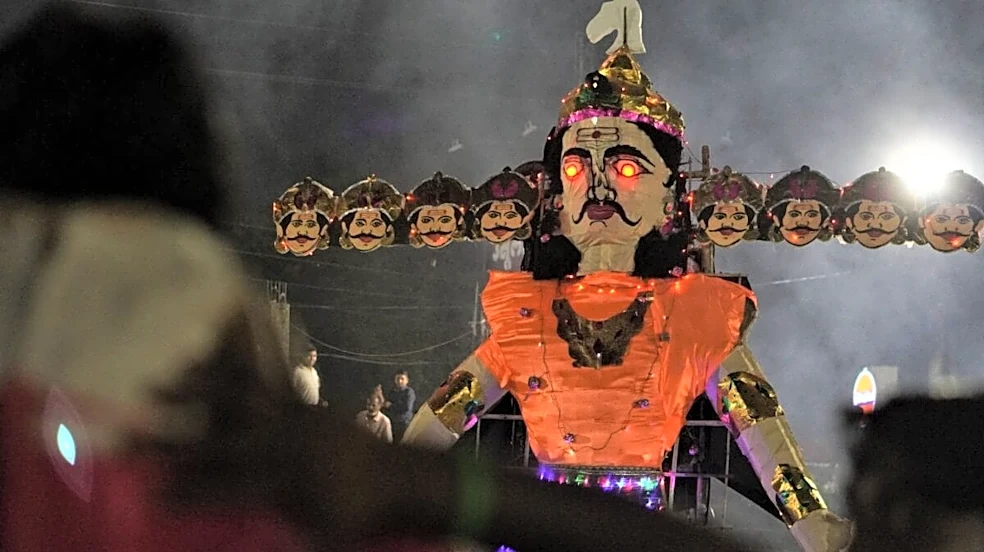


In some Indian towns and villages, Ravan is not remembered solely as the villain of the Ramayana. Local traditions honour him as a learned scholar, a devout follower of Lord Shiva, a revered ancestor and, in one particularly distinctive belief, a son-in-law worthy of respect. Some communities avoid burning his effigy, while others organise special prayers or maintain temples dedicated to him.
From Uttar Pradesh and Madhya Pradesh to Andhra Pradesh, here are five places where Dussehra offers a different perspective on the king of Lanka.
Bisrakh, Uttar Pradesh: The Village That Believes Ravan Was Born Here
Located near Greater Noida, Bisrakh is associated with one of the most unusual Dussehra traditions in India. According to local belief, the village was Ravan’s birthplace, and residents regard him not simply as the antagonist
of the Ramayana but as a learned Brahmin worthy of remembrance.
The belief shapes the village’s relationship with Dussehra. Instead of celebrating the festival with the customary burning of Ravan’s effigy, locals observe rituals and perform yajnas during Navratri. Ravan is revered in the tradition as a Maha Brahman, reflecting his Brahmin lineage and reputation for scholarship. Some residents also believe that burning his effigy would amount to Brahmahatya, the killing of a Brahmin, and could bring misfortune upon the village.
Kanpur, Uttar Pradesh: The Temple That Opens Only Dussehra
In Kanpur’s Shivala locality, the Dashanan Temple follows a ritual calendar that makes Dussehra particularly significant. While effigies of Ravan are set alight across much of the country, devotees gather here to offer prayers to him, hailing him with chants such as “Jai Lankesh”.
Ravan is worshipped at the temple as a figure associated with Lord Shiva and Goddess Chinnamastika. One of the most distinctive aspects of the shrine is that it reportedly remains closed for most of the year, with its doors opened for devotees on Dussehra. The idol is kept veiled outside the designated period of worship.
Ravangram, Madhya Pradesh: Where Ravan Gets The First Wedding Invitation
In Madhya Pradesh’s Vidisha district, the village of Ravangram has a tradition that brings Ravan into the everyday life of the community. Its Ravan temple houses a reclining statue said to measure around 10 feet, and residents refer to the figure respectfully as Ravana Baba.
According to local belief, some villagers trace their lineage to Ravan’s family, making his worship an expression of ancestral reverence. He is not merely a figure associated with an epic battle but someone whose memory continues to hold a place in community customs. One of the village’s most unique practices concerns weddings. Local tradition holds that Ravan receives the first invitation whenever a marriage ceremony is organised in the village.
Mandsaur, Madhya Pradesh: Ravan’s ‘Sasural’
In Mandsaur, in western Madhya Pradesh, Ravan is associated with a very different family connection. Local tradition identifies the region as the maternal home or maika of Mandodari, Ravan’s wife, making him the area’s revered son-in-law.
That association influences how some residents view Dussehra. Instead of treating Ravan solely as a figure to be symbolically defeated, devotees honour him through prayers and local observances. Statues and shrines associated with him reflect the importance of this regional tradition.
Kakinada, Andhra Pradesh: Ravan, The Devotee Of Lord Shiva
In the coastal city of Kakinada, Andhra Pradesh, Ravan is remembered for his devotion to Lord Shiva. In Hindu tradition, Ravan is frequently portrayed as a formidable scholar and a powerful devotee who composed hymns in praise of the deity. It is this religious association, rather than his role in the battle with Lord Ram alone, that informs his reverence in some local traditions.
Kakinada is associated with a shrine dedicated to Ravan, referred to in the supplied account as the Kumbhabhishekam Temple, alongside a Shiva temple believed locally to have been selected by Ravan himself.