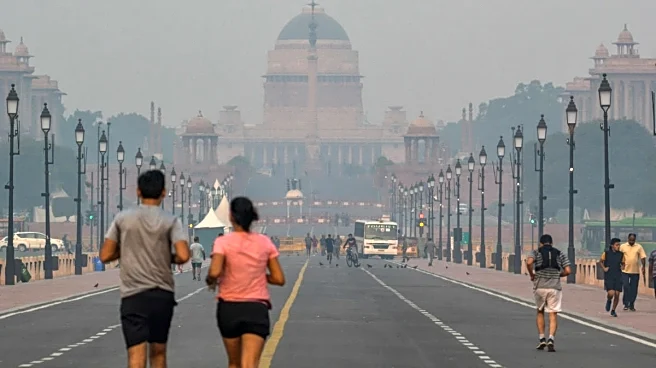

A senior management executive in a pharma company based in Delhi was forced to resign due to rising air pollution in the capital, leading to health issues. Even though many readers wonder if the above
news is correct due to its rarity, they should know that this actually happened, with news spreading on social media resurfacing the heated debate on the accountability of extreme-level air pollution.
Rajkumar Bafna, the President Finance of Akums Drugs & Pharmaceuticals Ltd, in his resignation letter cited the Delhi pollution level as a reason for his resignation from the post. In response, the pharma company accepted his resignation, saying that while it regretted his decision, it would not be able to persuade him to reconsider in view of his health issues.
The resignation of Bafna will become effective from December 31, 2025 as said by the company in the press release.
“…this is to inform you that Mr. Rajkumar Bafna, President – Finance, designated as Senior Management Personnel of the Company has resigned from his position with effect from 31st December, 2025 due to his personal reasons. The Company has accepted his resignation and has relieved him from the duties w.e.f 31st December, 2025,” the company said in the press release.
Akums Drugs and Pharmaceuticals Ltd has a market cap of Rs 7,063 crore as of December 29, 2025 at noon. It offers end-to-end pharma services (R&D, formulations, APIs) for various products like tablets, injectables, cosmetics, and nutraceuticals.
Delhi air quality has been ranging in hardous to severe category for the last two months, since the inception of winter in November.
On Monday, Air quality in Delhi has declined further to 403 leading to term it ‘severe’ according to the Central Pollution Control Board (CPCB’s) categorization system.
When air pollution reaches the severe category, the air is unsafe for everyone, and especially dangerous for people with health problems. Very high levels of fine particles (PM2.5, PM10) can infiltrate in our bloodstream and reach to the lungs, making breathing difficult.
When air quality deteriorates to this level, breathing the air can trigger asthma attacks, worsen chronic lung diseases like COPD, and increase the risk of heart-related complications such as chest pain, heart attacks, or strokes. Elderly people, children, pregnant women, and patients with respiratory or cardiac illnesses are particularly vulnerable.
/images/ppid_a911dc6a-image-177092774715746114.webp)

/images/ppid_a911dc6a-image-177092767520012684.webp)
/images/ppid_a911dc6a-image-177092763347449403.webp)
/images/ppid_a911dc6a-image-177092652580356823.webp)






/images/ppid_a911dc6a-image-177092306157991736.webp)