
Microdrama, a concept we hardly knew about, has now become one of the most talked-about formats. The vertical viewing experience is something no one knew would become so big. Suddenly, all of our feeds are flooded with stories of reincarnation, the poor becoming billionaires, someone getting magical powers, but why do such stories work so well?
“One, it gives you escapism. Second, it also gives you a lot of hope,” says Siddharth, Vice President, KUKU TV.
KUKU TV was among the first ones to bring microdramas to India. When asked how they decided on the themes of the shows, Siddharth explained, “There are 3-4 themes, like there’s a billionaire drama, or it’s called a Rags to Riches story, there’s a revenge drama, there’s a family drama, right? There’s
a love triangle. These were the common themes, which were globally proven. So, we started with what is proven.”
And perhaps that is what makes microdramas so interesting. The stories may seem bizarre at first, but they offer viewers exactly what they are looking for, quick entertainment, escapism and an emotional payoff.
Challenges Of Microdrams
But while the format may look easy to consume, making microdramas comes with its own set of challenges, especially for actors.
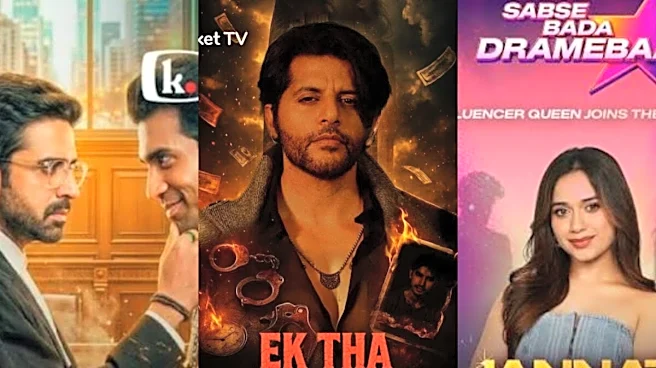
“Micro-drama is a very fast medium, so you get very little time to prepare and understand your character. The pace of shooting is very challenging because to be able to come out with an output of 30-35 minutes of footage in a day is difficult, and at times it even takes a toll on mental and physical health as one hardly gets time to rest,” reveals actor Avinash Sachdeva.
Karanvir Bohra, who has also ventured into the space, agrees that the format comes with its own set of demands. “Every medium has its own set of challenges and its own perks. Microdramas are no different. They come with their own unique challenges, especially because of the pace and the demands of the format, but at the same time, they can be incredibly rewarding.”
While the pace of shooting is a challenge for actors, content providers have another task at hand, understanding what works for India’s diverse audience.
“People’s tastes change every 100 km,” says Siddharth.
And that diversity is perhaps one of the biggest challenges for a format that has already found success in other parts of the world. What works in one market cannot simply be brought to India and expected to work in the same way.
Microdramas Are Here To Stay
Microdramas have become big, no doubt, but it still remains a fairly new venture. Does it carry enough power to challenge TV, OTT or maybe even films? For Siddharth, “India is following the same journey, following the same trajectory, that China and US did 4-5 years ago.” He believes that with Jio coming in and with every other person having and unkiminted mobile data, the stars are in favour.
For actress Jannat Zubair, the answer lies in how addictive the format can be.
“There have been instances with me when I have watched a micro-drama and have been hooked to them, and I downloaded the app, took the subscription and completed the series. So, I know how addictive micro-dramas can be. I think it’s going to become really, really big.”
Avinash believes the format fits perfectly into the way people consume entertainment today.
“I think, with the kind of life that people are living these days, there is very less time for them to get entertained also. People are not willing to give a lot of, investing a lot of time behind entertainment. So, when they have limited time and they want entertainment at the same time, I think micro-dramas are the thing.”
Karanvir, meanwhile, believes the format is part of a larger shift in the way audiences consume entertainment.
“We are entering a new age of viewing patterns, where audiences are looking for instant gratification. Microdramas will continue to adapt and mutate into new formats, but I strongly believe they are here to stay, and they will only continue to grow.”
Are People Subscribing?
But while audiences are clearly watching microdramas, are they willing to pay for them?
KUKU TV’s Vice President, while addressing the question of subscriptions, revealed, “We are over 210 million-plus installs for KUKU TV. That’s by far the largest in the country. Our last disclosed numbers, KUKU had almost over 10 million active paying subscribers. Right? More than 1 crore active paying subscribers. That itself is one of the largest in the country.”
Can Microdramas Work Without Big Stars?
The numbers point towards a growing audience willing to spend money on the format. But another question remains: Can microdramas survive without known faces?
While Avinash believes experienced actors can ace the space more easily because of the demands of the format, Siddharth believes microdramas have the potential to create stars. “It is not necessary to have big faces in micro-drama because they are more story-led rather than cast-led,” says, VP Kuku TV.
And that could be one of the most interesting developments in this new entertainment space. For years, actors needed films, television or theatre to establish themselves. Microdramas are now creating another avenue where actors can reach millions of viewers while simultaneously building their craft and audience.
With established television faces such as Avinash Sachdeva, Karanvir Bohra and Jannat Zubair also entering the space, microdramas are no longer limited to completely unfamiliar faces.
/images/ppid_59c68470-image-178997006651938917.webp)







/images/ppid_59c68470-image-178971252314513373.webp)
/images/ppid_59c68470-image-178975002699010093.webp)