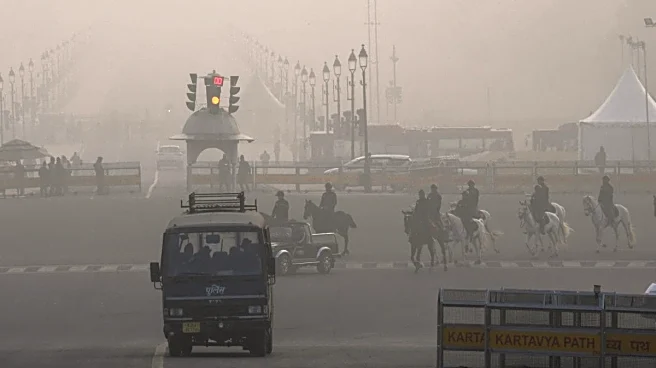

Delhi AQI: Air quality in Delhi worsened significantly on Saturday, edging close to the ‘severe’ category after showing signs of improvement earlier this week.
The city’s 24-hour average AQI stood at 385
at 4 pm, placing it in the ‘very poor’ category, a sharp rise from 332 recorded on Friday, according to data from the Central Pollution Control Board (CPCB). Just two days earlier, on Thursday, the AQI was 234, categorised as ‘poor’, indicating a rapid deterioration in air quality over the past 48 hours.
At least 20 air quality monitoring stations across Delhi reported ‘severe’ pollution levels, with AQI readings above 400. These stations included Shadipur, Vivek Vihar, Ashok Nagar, Bawana, Chandni Chowk, DTU, Dwarka, ITO and Mundka, among others, as per data available on the CPCB’s SAMEER app. Overall, half of the 40 monitoring stations in the capital recorded AQI levels above 400 on Saturday.
The air quality in Delhi had earlier improved to 220 (poor) at 9 am on Friday, with several parts of the capital in the ‘moderate’ category. This came after the Delhi government revoked stage four of the Graded Response Action Plan (GRAP) on Wednesday as the air quality in the capital improved. The decision to revoke GRAP-4 has been taken by the Sub-Committee after reviewing the situation.
According to CPCB categorisation, 0-50 is ‘good’, 51-100 ‘satisfactory’, 101-200 ‘moderate’, 201-300 ‘poor’, 301-400 ‘very poor’, and 401-500 ‘severe’.
Data from the Decision Support System (DSS) for Air Quality Management indicated that vehicular emissions were the single largest contributor to Delhi’s pollution load on Saturday, accounting for 16.2 per cent. Industrial emissions from Delhi and adjoining areas contributed 8.5 per cent, while residential emissions accounted for 4 per cent and biomass burning for 1.6 per cent.
Among National Capital Region (NCR) districts, Jhajjar in Haryana emerged as the biggest external contributor to Delhi’s pollution, with a share of 17.5 per cent. Sonipat and Rohtak followed, contributing 5.8 per cent and 5.6 per cent respectively, the data showed.
According to forecasts, Delhi’s air quality is likely to remain in the ‘very poor’ category over the coming days.
Meanwhile, weather conditions remained relatively stable. The India Meteorological Department (IMD) said Delhi recorded a maximum temperature of 22.2 degrees Celsius on Saturday, about 1.8 degrees above normal, while the minimum temperature settled at 7.8 degrees Celsius, slightly below the seasonal average. Relative humidity stood at 70 per cent at 8.30 am and rose sharply to 100 per cent by 5.30 pm.
For Sunday, the IMD has forecast a minimum temperature of around 8 degrees Celsius and a maximum of 22 degrees Celsius, with shallow to dense fog likely during the morning and evening hours—conditions that could further aggravate pollution levels in the capital.
(With inputs from agencies)