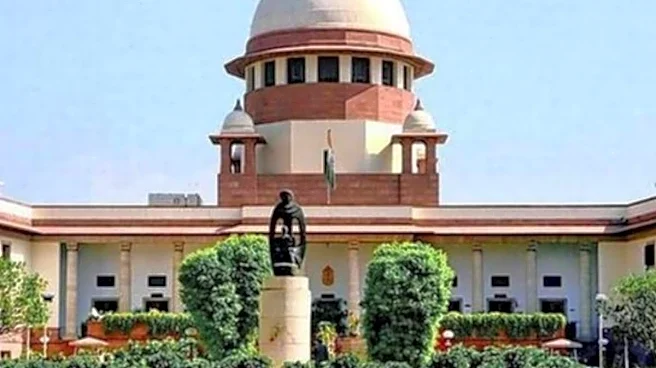




The Supreme Court has reiterated that the State cannot bypass constitutional safeguards merely because a person is accused of a serious offence. In a judgment delivered on Monday, September 21, a bench of Justices Ujjal Bhuyan and Atul Chandurkar held that the grounds of arrest must be communicated to an arrested person in writing and in a language they understand. The court made it clear that the safeguard flows from Article 22(1) of the Constitution and applies irrespective of the nature of the offence.
The ruling came in Jaskaran Jeet Singh Deol v State of Punjab, where the accused had initially been arrested without being supplied written grounds of arrest. The Magistrate subsequently declared the arrest illegal and ordered his release. The Supreme
Court used the case to examine the wider constitutional framework governing arrest, including the circumstances in which a person released following an illegal arrest can be taken into custody again.
The court stressed that informing an arrested person of the reasons for arrest is not a procedural formality. It enables the person to understand the allegations, consult a lawyer, challenge police custody and seek bail. Referring to earlier rulings, the bench said the requirement is a “mandatory binding constitutional safeguard” and cannot be diluted through a restrictive interpretation of Article 22.
Importantly, the judgment also referred to the Supreme Court’s earlier ruling in Prabir Purkayastha v State (NCT of Delhi), a case involving UAPA provisions. The court had held that a person arrested under the UAPA, like an accused under any other criminal law, has a fundamental and statutory right to receive the grounds of arrest in writing. The latest judgment reiterated that a subsequent chargesheet cannot retrospectively cure an unconstitutional arrest.
The Supreme Court also endorsed the procedural safeguards laid down in its earlier Mihir Rajesh Shah ruling. Where written grounds cannot practically be supplied immediately, they may initially be conveyed orally in exceptional circumstances, but the written grounds must follow within a reasonable period and, ordinarily, no later than two hours before the accused is produced before a Magistrate for remand. Failure to comply can render the arrest and subsequent remand illegal.
What Is UAPA?
The Unlawful Activities (Prevention) Act, 1967, or UAPA, is India’s principal anti-terror and national-security law. It allows authorities to deal with activities considered unlawful or connected with terrorism and contains provisions that permit significantly longer investigation and detention periods than those ordinarily available under criminal procedure.
One of its most consequential provisions is Section 43D(2). In appropriate cases, the investigation period can be extended beyond the ordinary 90-day period, up to 180 days, before an accused becomes entitled to statutory or “default” bail for failure to complete the investigation and file the chargesheet. Such an extension, however, is not automatic.
Chargesheet Extensions Under UAPA
The Supreme Court has also repeatedly emphasised that extending the investigation period under UAPA cannot become a routine exercise. In Md Ariz Hasnain v State of Jharkhand, the court dealt with an extension granted without adequate consideration of the accused’s position. It held that extending the investigation period is not a mere formality and requires application of mind by both the Public Prosecutor and the court.
An extension can directly postpone an accused person’s right to default bail. The Supreme Court therefore said that the accused must be produced before the court when an extension is being considered, and the court must examine the progress of the investigation and the reasons why continued detention is necessary. A bald assertion that investigation remains pending is insufficient.
The legal position is rooted in Section 43D(2)(b) of UAPA, which requires the Public Prosecutor’s report to indicate the progress of the investigation and specific reasons for the continued detention. Courts have consequently held that the prosecution cannot seek additional time simply because it has not yet filed the chargesheet.




/images/ppid_59c68470-image-178990503487132880.webp)