
/images/ppid_a911dc6a-image-177107705051568684.webp)
/images/ppid_59c68470-image-177107504779557732.webp)
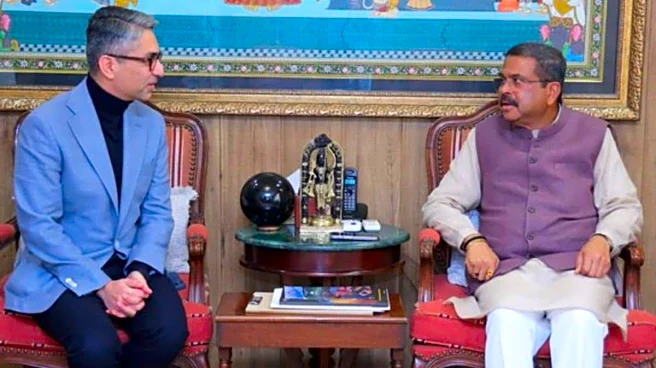
Education Minister Dharmendra Pradhan recently met with Olympic gold medallist Abhinav Bindra to discuss advancing school-level sports excellence. In a post on X, Pradhan expressed his delight in meeting Bindra, noting their productive talks on fostering school sports excellence. They also examined ways to leverage Bindra’s expertise to design sports-based curricula, integrate sports learning, promote mental wellness, and encourage lifelong fitness habits.
A pleasure to meet Olympic gold medallist and national icon Shri @Abhinav_Bindra.
Fruitful conversations on nurturing sporting excellence at the school level. Also, discussed ways we can utilise his expertise for designing sports-based curriculum, imparting sports-integrated… pic.twitter.com/6CQs8hgwCy
— Dharmendra Pradhan (@dpradhanbjp) February 9, 2026
In December, to further India’s goal of becoming a top 10 sporting nation by 2036, the Department of Sports identified the need to enhance sports administration capabilities. As a result, it established a Task Force on Capacity Building of Sports Administrators, chaired by Bindra, to create a framework for strengthening sports administration.
The Task Force recently submitted its report to the Department of Sports, which is available on the Ministry of Youth Affairs & Sports (MoYA&S) website. The report emphasises the need for professional, accountable, and progressive sports administrators to realise this transformative vision, including hosting the Olympic Games, reported ANI.
One of the Task Force’s recommendations is to establish the National Council for Sports Education & Capacity Building (NCSECB) as an autonomous statutory body under the Ministry of Youth Affairs and Sports to regulate, accredit, and certify sports administration training. It also proposed introducing a five-level Capability Maturity Model (CMM) to help SAI, NSFs, and State Departments assess institutional maturity in various areas, facilitating evidence-based monitoring and targeted interventions.
It suggests including sports governance training modules in the induction and advanced training of IAS and State Civil Service officers, linking training to practical application and career progression. It also recommends rotational postings, apprenticeship models, innovation labs, and partnerships with federations, government, and the private sector to ensure administrators can apply their skills and advance professionally.
The Department of Sports is currently evaluating the Task Force’s recommendations to further professionalise India’s sporting ecosystem. It revised assistance norms under the Scheme of Assistance to National Sports Federations (NSFs) in May 2025, allowing NSFs to allocate up to 10% of their funding for administrative manpower. Additionally, expenses for administrative operations, legal services, and hiring specialised professionals or interns are permitted up to 2.5% of the annual budget.
NSFs are now required to have appropriate administrative structures and ensure proper advertisement for staff appointments. These reforms aim to create a globally respected, athlete-focused governance framework, positioning India for long-term sporting success, including the 2036 Olympics. The Government has also laid the foundation for this vision through the enactment of the National Sports Governance Act, 2025.

/images/ppid_59c68470-image-177108005050622563.webp)

/images/ppid_59c68470-image-177108004800829223.webp)


/images/ppid_59c68470-image-177107752663443042.webp)