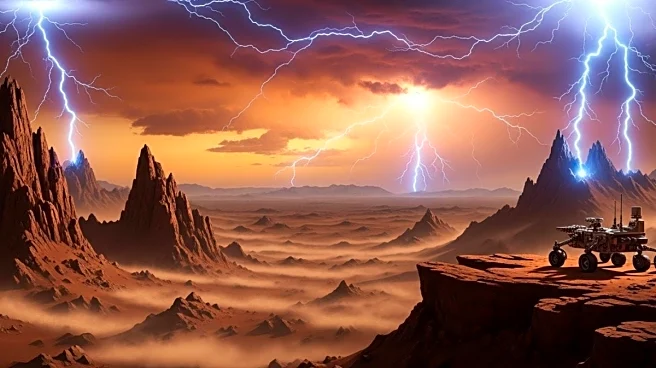

Scientists have, for the first time, claimed to have detected lightning on Mars — a finding that could reshape understanding of the Red Planet’s atmosphere and weather patterns.
NASA’s Perseverance rover,
which landed in Jezero Crater in 2021 to search for traces of ancient biology, captured audio and electromagnetic signals that researchers say point to electrical discharges, described as “mini lightning.” The rover’s SuperCam instrument picked up these short bursts while monitoring dust activity.
For over two Martian years (1,374 Earth days), researchers in France analysed 28 hours of microphone recordings made by Perseverance. They found that the discharges were typically associated with dust devils and moving dust-storm fronts. Dust devils — small whirlwinds created by rising pockets of hot air — appear capable of generating brief electrical arcs through internal particle movements.
“This is a major discovery, with direct implications for Martian atmospheric chemistry, climate, habitability and the future of robotic and human exploration,” lead author Dr Baptiste Chide told Reuters. With this, Mars joins Earth, Saturn and Jupiter as planets known to have atmospheric electrical activity.
The discovery also echoes new findings published in Nature and highlighted by NPR, where scientists described how Perseverance’s microphone accidentally picked up tell-tale acoustic shockwaves from electrical arcs only a few centimetres long. Lightning researcher Daniel Mitchard, who wrote an accompanying commentary for Nature, said the detection fits long-held expectations that Martian dust storms should generate electrical activity. But he cautioned that because the discharges were heard, not seen, some debate will inevitably continue.
Earlier this year, scientists analysing rocks found in Jezero Crater discovered unusual markings — nicknamed “leopard spots” and “poppy seeds” — containing minerals that may have formed through chemical reactions linked to ancient microbial activity. NASA noted these could represent some of the clearest potential signs of past life on Mars, though natural geological processes remain a possibility.
While modern Mars is a cold, arid desert, evidence suggests the planet once had thick atmosphere, liquid water and a climate conducive to life. Perseverance was sent to Jezero Crater for that reason — it bears features of an ancient river delta formed at a time when Mars could sustain flowing water.




/images/ppid_a911dc6a-image-177105322971173172.webp)





/images/ppid_a911dc6a-image-177105253714182198.webp)
/images/ppid_a911dc6a-image-177105248655682778.webp)
/images/ppid_a911dc6a-image-177105245071149153.webp)