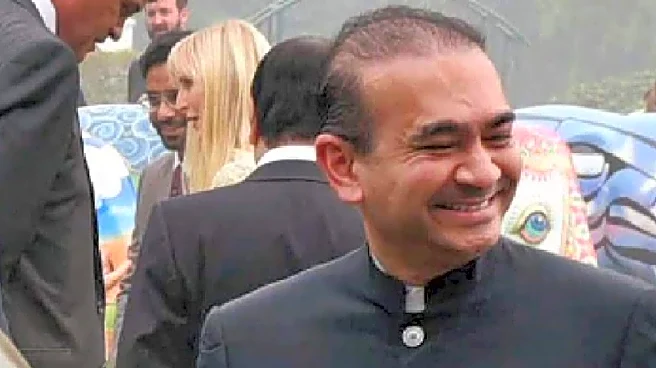

A London court has agreed to defer proceedings in an unpaid loan case against fugitive diamantaire Nirav Modi, allowing his request to postpone the trial until March next year due to delays by UK prison
authorities in providing him access to key legal documents.
Nirav Modi, 54, who is wanted in India on charges of fraud and money laundering in the Rs 13,000-crore Punjab National Bank (PNB) scam, is facing a separate civil case in the UK linked to an $8 million loan extended by the Bank of India.
He has been contesting his extradition to India while lodged in British custody since March 2019.
During an online review hearing on Friday, Justice Simon Tinkler partly accepted Modi’s plea to adjourn the eight-day trial that had been scheduled for January.
The court pushed the matter to March 23, rejecting a longer delay sought by the defence. The judge cited continuing difficulties faced by the accused in accessing essential paperwork following his transfer between prisons in London.
“There must be some doubt as to whether those papers will ever reach Mr Modi if they still exist,” Justice Tinkler observed, adding that the absence of the disclosure bundle so close to trial raised concerns over the fairness of proceeding as scheduled.
“I am not satisfied that the trial would be fair were it to go ahead,” he said, while making it clear that an adjournment until October was unwarranted.
Modi was moved from Thameside Prison in south London to HMP Pentonville in October to enable his appearance before the High Court. However, the transfer has reportedly complicated his ability to prepare his defence.
Representing Modi, barrister James Kinman argued that his client would face a “substantial disadvantage” if the trial were not postponed.
He also suggested that recent Indian media reports failed to reflect the full context of a “confidential process” that has so far prevented Modi’s extradition, widely believed to refer to an asylum-related application.
Kinman claimed that extradition was unlikely before October 2026, though he declined to share further details.
Opposing a prolonged adjournment, Bank of India’s counsel Tom Beasley urged the court to ensure the trial is concluded before any potential extradition.
He said it would be “very hard” to conduct proceedings if Modi were removed from UK jurisdiction, and criticised the defence for relying on an unspecified legal bar without providing details.
The judge also expressed concern over prison authorities failing to meet their obligations, stressing that Modi must be given adequate access to documents to prepare his case.
Modi was not produced for the virtual hearing due to what was described as a communication lapse between the court and prison officials.
The Bank of India case, pursued by law firm RWK Goodman, centres on Modi’s personal guarantee for a loan issued to Firestar Diamond FZE, a Dubai-based entity.
Modi is representing himself in the matter as a “litigant in person” and is now the sole witness, having missed the deadline to submit expert evidence on Indian law.
Currently incarcerated in a Category B prison, Modi is reportedly sharing a cramped cell and is said to be working on his case without basic facilities.
Separately, earlier this week, a bench comprising Lord Justice Jeremy Stuart-Smith and Justice Robert Jay heard Modi’s application to reopen his extradition proceedings, citing the risk of torture if returned to India.
That hearing has also been deferred to March–April 2026 after Indian authorities submitted detailed assurances to counter his claims.
The court was also informed that a “confidential process” believed to relate to an asylum application concluded unsuccessfully in August.
In India, Modi faces three sets of criminal cases: a CBI probe into the PNB fraud, an Enforcement Directorate case for alleged money laundering, and separate proceedings accusing him of interfering with evidence and witnesses.
In April 2021, then UK Home Secretary Priti Patel approved his extradition after a prima facie case was established. Since then, Modi has exhausted multiple appeals and bail pleas, all of which have been rejected.