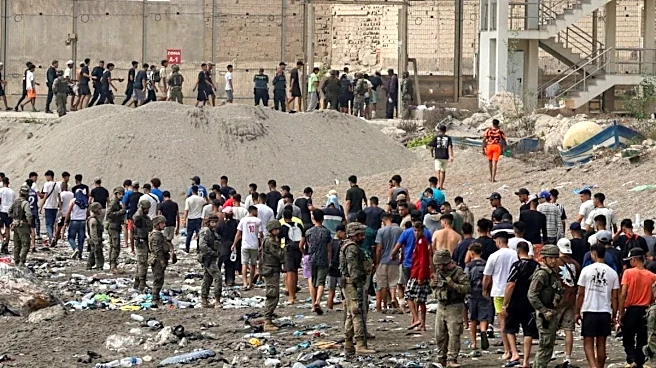




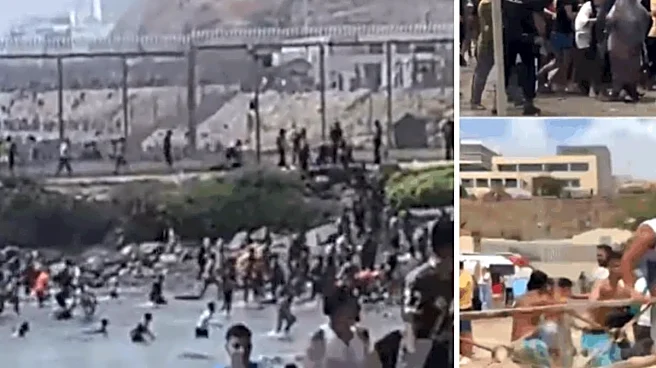
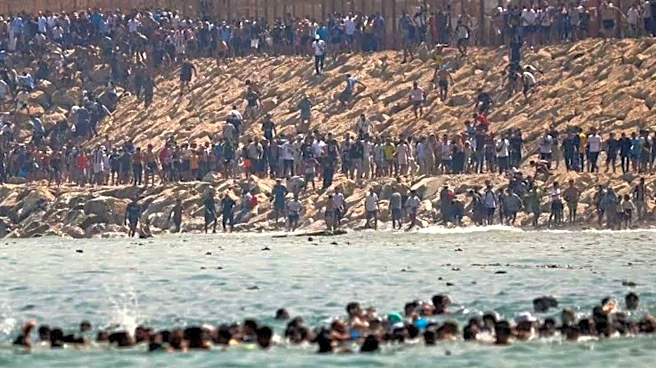
At least 57 people have died trying to reach the Spanish enclave of Ceuta after an unprecedented surge that saw up to 50,000 migrants enter the tiny territory from Morocco within just 24 hours.
Spain’s Prime Minister Pedro Sánchez described the mass crossing as “a violation of Spain’s territorial integrity” as the sudden influx overwhelmed the city of about 85,000 residents and triggered a political crisis in Madrid.
Sánchez, who rushed to Ceuta on Friday, said the government would deploy all available resources to ensure public safety. He blamed “human trafficking mafias” for exploiting a recent Supreme Court ruling that barred authorities from immediately returning migrants intercepted at sea near Ceuta and Melilla.
“That has spread like wildfire
during these last few hours through the networks of mafias that traffic in human beings and has produced an avalanche of the characteristics and dimension that we experienced yesterday,” he said, as reported by The Guardian.
Authorities are now setting up a temporary reception centre to document arrivals and fast-track the expulsion of those without legal grounds to stay. The crisis has also drawn mixed reactions across Europe, with some voices calling for Spain’s suspension from the Schengen free-movement zone.
Why This Is Happening In Ceuta
The chaos has once again drawn global attention to Ceuta, a small but highly sensitive territory where geography and politics collide.
Ceuta is an autonomous Spanish city located on the northern coast of Africa, directly bordering Morocco. Along with Melilla, it forms the European Union’s only land border with the African continent.
Despite being on African soil, both cities are part of Spain and, by extension, the European Union (EU).
Spain has controlled Ceuta since the late 16th century, but Morocco does not recognise it as Spanish territory and considers it occupied land. This long-standing dispute has made the city a recurring flashpoint in relations between the two countries.
With a population of around 85,000, Ceuta is home to a mix of Christian and Muslim communities, including Spanish citizens and Moroccan workers who cross the border daily. Despite this shared social fabric, the border itself remains heavily guarded and politically charged.
Migration As Bargaining Chip
Migration has often been at the centre of tensions. In May 2021, about 8,000 people entered Ceuta within two days after Morocco relaxed border controls in what was widely seen as a diplomatic signal to Spain.
The standoff was eventually resolved after Madrid softened its position on Western Sahara and engaged directly with Moroccan King Mohammed VI.
The latest surge shows how quickly Ceuta can turn from a quiet border city into the epicentre of a wider geopolitical and humanitarian crisis.
Testy History
Ceuta has long been more than a border outpost, it is a hinge between continents, and between eras.
For centuries, much of Spain was under Muslim rule (from 711 to 1492 AD; 781 years), until Christian kingdoms gradually reclaimed it during the Reconquista. By the early 1400s, that struggle had nearly run its course on European soil.
Then it crossed the water.
In 1415, Portugal captured Ceuta, turning a campaign of reconquest into one of expansion. What had been about reclaiming land in Iberia became a push into North Africa, an extension of the same religious and political tensions that had defined the Crusades, now redirected south.
Ceuta became Europe’s first foothold in Africa.
Its location, just across the narrow Strait of Gibraltar, has always made it a gateway. Armies once passed through with imperial ambition.
The Strait of Gibraltar is a narrow waterway between Europe and Africa. Lately, with the war in West Asia and tensions in East between China and Taiwan, the importance of straits has never seen more attention.
Today, migrants approach it with urgency and hope. The direction has changed. The pressure has not.
Where European forces once crossed into Africa, people now attempt the journey in reverse, making Ceuta a place where history doesn’t just echo, but quietly repeats itself in new form.
/images/ppid_59c68470-image-178547752510017987.webp)



/images/ppid_59c68470-image-17855150220023933.webp)
/images/ppid_59c68470-image-178551756099236368.webp)