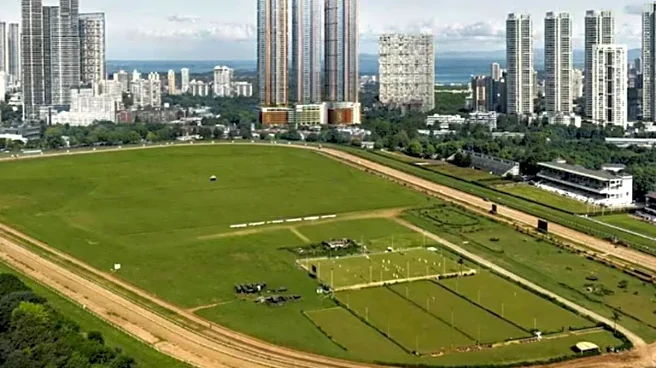

Mumbai is set to get a world-class Central Park combining the open space at Mahalaxmi Racecourse and the Coastal Road area. Spread across 295 acres, the proposed Central Park will combine 125 acres of
the Mahalaxmi Racecourse with 170 acres of land along the Coastal Road, making it the largest urban park in the country.
The proposed project will create a 295-acre green zone that will combine open landscapes, cultural spaces and a large underground sports complex, while keeping the historic racing track and stables intact.
The racecourse, which spans approximately 211-212 acres, is jointly owned by the Brihanmumbai Municipal Corporation (BMC) and the Maharashtra government.
Calling it the biggest gift for Mumbaikars and dubbing it the “oxygen park” for Mumbai, Deputy Chief Minister Eknath Shinde said that a world-class, underground, environment-friendly sports complex will also be developed in 10 lakh square feet beneath the Central Park. The venue will host international-level sports facilities along with traditional Indian sports such as Kho-Kho and Kabaddi.
The proposed master plan of the Central Park was presented to Shinde by Brihanmumbai Municipal Commissioner Bhushan Gagrani on December 15.
“This will be the largest gift ever given to Mumbaikars. There will be no concrete construction on the surface of this park. The Central Park will be directly connected to the Coastal Road through an underground passage. No harm will be caused to the racecourse or its historic heritage,” Shinde said as quoted by news agency PTI.
No Construction On Actual Racecourse
Shinde said that there will be no construction on the actual racecourse. “The racing track and stables will remain untouched. This will be a completely eco-friendly project and will act as an oxygen park for Mumbaikars,” he said.
He said that visitors could even see horses in the park, and the park surface will remain free of any structures except pathways.
Visitors will be able to watch horse racing while walking inside the park. Except for walking paths, there will be no construction on the surface, he said, adding the entire area will remain a green park.
For smooth traffic management, the Central Park will be connected to the Coastal Road via a 1,200-meter-long underground tunnel, for which a Rs 550 crore tender has been issued. He said that This underground connectivity will help manage crowds visiting the Central Park and sports complex. The Coastal Road parking facility will accommodate 1,200 cars and 100 buses.
The DCM said the project will create a 300-acre oxygen park, helping reduce air pollution in Mumbai.
What Will Be There In Central Park?
The project will have a 12-acre city forest to increase oxygen levels and reduce pollution; 77 acres reserved for gardens and open concert grounds; 31 acres for botanical garden, indoor concert arena, and convention centre; lush green botanical landscapes and world-class indoor arenas.
One of the main attractions of the project is a huge underground sports complex spread over nearly 10 lakh square feet. It will have courts and facilities for sports like volleyball, basketball, handball, badminton, squash and kho-kho, along with cricket practice nets, gymnastics areas, skating rinks and an international-level cycling track. Below this complex, a three-storey parking facility for around 5,000 cars is planned to reduce traffic problems in the area.
On the surface, Central Park will have beautifully designed gardens, including a 70-acre topiary garden, a 31-acre botanical garden with medicinal plants, and a 12-acre urban forest. The park will also include a 900-seat amphitheatre, an open lawn for events and several themed gardens.
The project also includes a modern convention centre spread over nine acres inside the park. It will have three large halls, waiting areas and other up-to-date facilities.
The park will be connected to Metro 3’s Nehru Science Centre station via an underground corridor, which will extend along Annie Besant Road to Haji Ali and connect to Coastal Road. Coastal Road parking will have the capacity for 1,200 cars and 100 buses, ensuring proper traffic management.
(With inputs from agencies)
/images/ppid_a911dc6a-image-177080382939031904.webp)

/images/ppid_a911dc6a-image-177080283060312298.webp)
/images/ppid_59c68470-image-177080260455435611.webp)

/images/ppid_59c68470-image-177080263329252397.webp)
/images/ppid_59c68470-image-177080252755837030.webp)
/images/ppid_59c68470-image-177080256500921890.webp)