
birsaDelhi will witness a historic and unique event this month, as tribal communities from across the country gather under the banner of Janjati Sanskritik Samagam (Tribal Cultural Conclave). The Samagam is expected to bring together representatives from over 500 tribal communities across India, with the participation of more than one lakh individuals, making it one of the largest cultural gatherings of its kind in the country. This national-level cultural congregation will be held in New Delhi on May 24–25 to commemorate the 150th birth anniversary of Bhagwan Birsa Munda, a revered figure who is regarded as a symbol of resistance, cultural identity, and community assertion. As part of the programme, a grand cultural procession will be held,
culminating at the Red Fort, followed by a public meeting where community representatives, scholars, and participants will collectively engage in cultural expressions and public dialogue. The central theme of the programme is: “Tu Main Ek Rakt: Vanvasi – Gramvasi – Nagarvasi” (You and I share the same blood: Forest dwellers, villagers, and city dwellers). The idea behind organising this programme is to bring tribal and non-tribal communities closer by offering non-tribals a glimpse into tribal culture. It is expected to help both tribal and non-tribal communities understand their shared civilisational ethos and unity across diverse social and geographical identities. This, in turn, could help bridge the differences between tribals and non-tribals, differences that are often exploited by anti-India forces through an ecosystem comprising urban Naxals masquerading as activists, dubious non-governmental organisations, and certain political parties. Such events become important in this context because they help highlight the rich cultural heritage, knowledge systems, and traditions of tribal communities while fostering a sense of collective identity and national integration.
NO PROTEST OR DEMONSTRATION
Generally, such public gatherings—especially those concerning tribal issues and held in a venue like Delhi—are associated with protests or demonstrations. However, this event, for a change, is neither a protest movement nor a demonstration. It is simply a manifestation of the grand cultural tradition that tribal communities have preserved for thousands of years.
Members of tribal society are travelling from remote forests and mountainous regions to the national capital to express their concern regarding the survival of this culture. It is important to understand that the struggle for the existence of tribal culture and traditions should not remain an issue concerning tribal communities alone; it is a matter of concern for the entire nation. Therefore, tribal communities are arriving in Delhi with the expectation that the entire country will share their concerns and support them.
WHY WE NEED TO PRESERVE TRIBAL CULTURE
The vast forests and mountains where tribal communities reside are the cradle of ancient Indian civilisation. If Indian culture and traditions can still be seen in their purest form anywhere, it is in tribal regions. Tribal communities have protected India’s ancient values for centuries and are the true custodians of Indian culture.
Even before Independence, tribal communities became a primary target of foreign forces and anti-national activities. Christian missionaries, through service activities, attempted religious conversions among tribal communities and allegedly sought to erode the cultural foundations of one of the country’s most deeply rooted societies.
According to many tribal organisations, these efforts continue even today. The consequences of conversions that began more than two centuries ago are now being experienced across tribal society. Many tribal communities have abandoned traditional customs and embraced Christianity. Small tribal villages have become divided along religious lines, affecting social cohesion.
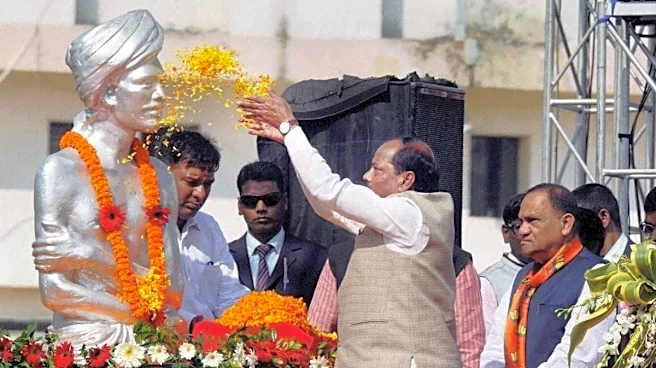
To preserve their ancient traditions, tribal communities have undergone immense struggles. Many warriors and great personalities sacrificed their lives not only for their rights but also for the protection of Dharma and culture. Among such personalities, one prominent name is that of Bhagwan Birsa Munda.
WHO WAS BHAGWAN BIRSA MUNDA?
Whenever the issue of tribal society arises today, the name of Birsa Munda is prominently mentioned. He has emerged as an inspiration and hero of tribal identity. Born on 15 November 1875 in Ulihatu village of Khunti district in present-day Jharkhand, Birsa Munda became revered as a legendary figure by the age of just 25 because of his extraordinary leadership and organisational abilities.
Coincidentally, this year marks the 150th birth anniversary of Bhagwan Birsa Munda. On such a significant occasion, it is natural for tribal communities to gather in such large numbers in the capital city of Delhi.
Across tribal regions of India, there have been many such revolutionaries and great personalities who fought courageously against the British and the Mughals while also protecting their Dharmic traditions and cultural identity. The nation can never forget their contributions. They are a matter of pride for the entire country. This gathering may also be seen as an opportunity to pay tribute to all such heroes and revolutionaries.
In 2021, the Narendra Modi government announced that India would celebrate Janjatiya Gaurav Divas (Tribal Pride Day) every year on 15 November to commemorate the birth anniversary of tribal freedom fighter and anti-colonial icon Birsa Munda.
The very fact that it took more than seven decades for the Indian government to formally recognise the contribution of Bhagwan Birsa Munda is itself revealing of how the importance and contribution of tribal communities had long been neglected. Tribal communities are not at the periphery of Indian civilisation; they are at its core. The Modi government appears to have recognised this reality and has taken several steps in this direction, including the establishment of 11 museums dedicated to highlighting the socio-cultural heritage of tribal communities.
A large section of tribal society that continues to follow its original cultural traditions is still struggling for its rights. At the same time, many tribals who converted to Christianity continue to enjoy the dual benefits of both tribal status and Christian identity.
According to tribal organisations, this situation poses a challenge to the constitutional provisions meant for the protection of tribal traditions and culture. According to tribal organisations, 10% converted Christians have occupied 90% of higher government positions reserved for tribal communities.
Movements carried out in recent years by tribal organisations have reportedly revealed widespread anger within tribal society over this unequal distribution of benefits. Removing reservation benefits from those perceived to be taking “dual benefits” is seen by these groups as a major solution to the issue.
The writer is an author and columnist. His X handle is @ArunAnandLive. Views expressed are personal and solely those of the author, and do not necessarily reflect News18’s views.

/images/ppid_a911dc6a-image-177854824264377509.webp)

/images/ppid_59c68470-image-177843753659056972.webp)

/images/ppid_59c68470-image-177850252985011698.webp)

/images/ppid_59c68470-image-177859503710395327.webp)