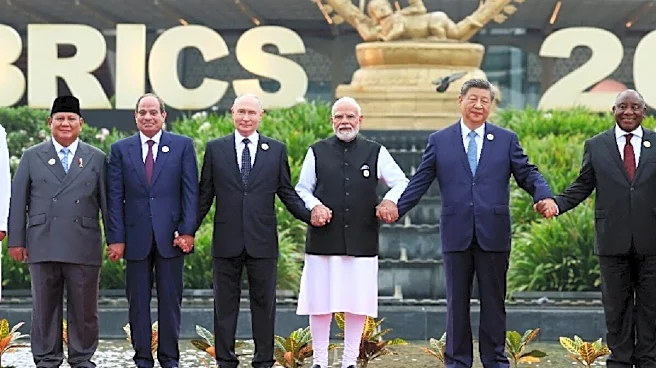



India is currently hosting the two-day BRICS Summit in Delhi’s Bharat Mandapam, which will feature the world’s biggest leaders from 11 countries, including Russian President Vladimir Putin, Chinese President Xi Jinping and Iranian President Masoud Pezeshkian among the key leaders attending.
BRICS currently comprises 11 countries – Brazil, China, Egypt, Ethiopia, India, Indonesia, Iran, Russia, Saudi Arabia, South Africa and the UAE. The bloc represents 49.5% of the global population, 40% of global GDP and 26% of global trade.
This makes BRICS a much larger regional bloc than the G7, which accounts for roughly 10% of the population. One of the biggest advantages of the expanded BRICS bloc is that it comprises a larger pool of younger and working-age
people, while most G7 economies are ageing in their working-age populations.
Explaining The Demographic Advantage
According to official data, more than 50% of the BRICS population is below the age of 35, with India alone contributing 65% of such individuals. Countries like Indonesia, Ethiopia and South Africa also have a large population of younger individuals.
However, this trend is not uniform. For instance, China’s population is ageing rapidly, and Russia’s birth rates fell to a 200-year low in the first quarter of 2026. Despite this, BRICS is positioned to play an important role in driving global innovation, employment and economic growth.
A younger population gives a significant demographic advantage to countries, as more people can enter the workforce, resulting in larger labour supply, greater consumer demand, and potentially faster economic growth. A younger population also means that millions of new consumers can create opportunities for manufacturing, technology, financial services and businesses.
Overall, having a higher percentage of working-age population benefits such countries by driving labour-force growth, consumption and economic expansion. BRICS currently has a larger pool of young workers than the G7, which means the group can accelerate inclusive and youth-led innovation, shape businesses and create employment opportunities.
Why Is It Also Concerning?
However, a younger population by itself is not an economic advantage. Without sufficient jobs in the market and skills, a rapid population growth can lead to widespread unemployment and economic inequality.
According to a UN report, rapid population growth without adequate industrialisation or jobs makes it more difficult for low-income and lower-middle-income countries to afford the increase in public expenditures and ensure universal access to health care, education and other services.
Countries like Ethiopia, Egypt and South Africa are struggling with this problem. They have a rapidly growing population, but limited formal employment and low levels of infrastructure to absorb the young labour force. China is also struggling with a youth employment problem, particularly among university graduates, pushing workers towards informal employment.
In May, BRICS member countries proposed accelerated efforts towards promoting youth employability through expanded apprenticeships, internships, vocational education, entrepreneurship programmes, and targeted initiatives for youth not in education, employment, or training.


