
Krishna Janmashtami is today, and the midnight aarti will be sung in Mathura, Chennai, and across India. It will also be sung in two Gulf cities where temples have become instruments of Indian foreign policy. In Manama stands a Krishna shrine more than a century older than Bahraini oil. In the Abu Dhabi desert stands a mandir finished in 2024.
Narendra Modi presided at both openings, which his government staged and framed as state occasions.
For eleven years India has used Hindu places of worship abroad as tools of statecraft. They serve congregations. They also serve energy supply, remittances, trade targets and election messaging, all at once.
A PLAQUE IN MANAMA, A GIFT IN ABU DHABI
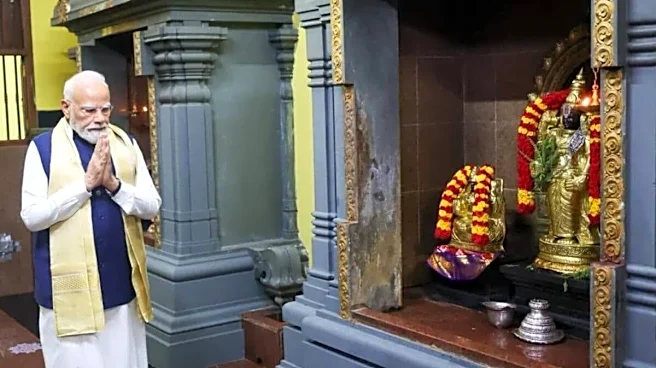
In August 2019, Modi became the first Indian prime minister to visit Bahrain, and he ended the trip
by unveiling a plaque to launch a $4.2 million redevelopment of the Shreenathji temple in Manama. Traders of the Thattai Bhatia community, who had come from Sindh before Partition, built the shrine in 1817. The plan set out a four-floor building of 45,000 square feet on a 16,500 square foot plot, rising to 30 metres, with a knowledge centre and a museum. Modi bought prasad at the temple with a RuPay card, one day after he launched the Indian payments network in the UAE, so the gesture doubled as a sales pitch for India’s financial plumbing abroad. Bahrain pardoned 250 Indians serving sentences there during the same visit. India’s foreign ministry called the temple proof of Bahraini pluralism, a description that suited both governments and cost neither of them anything. The Abu Dhabi project was bigger by every measure. Sheikh Mohamed bin Zayed Al Nahyan, then crown prince, gave 13.5 acres at Abu Mureikha in August 2015, during a Modi visit. The government added another 13.5 acres in January 2019, during the UAE’s Year of Tolerance, which took the campus to 27 acres. The build cost more than 400 million dirhams, roughly $108 million, and the BAPS Swaminarayan Sanstha paid for it rather than the treasury. The design carries seven spires, one for each emirate. Mahant Swami Maharaj consecrated the mandir on 14 February 2024, and it drew more than 2.2 million visitors in its first year. This was Modi’s seventh trip to the UAE in a decade, which makes the country one of the places he visits most. Nine years separated the land grant from the opening, and the government scheduled the opening for an election spring. Emirati enthusiasm followed a policy the UAE has built with care. The Abrahamic Family House opened on Saadiyat Island in 2023, setting a mosque, a church and a synagogue of equal size around a shared forum, drawn from the Document on Human Fraternity that Pope Francis and the Grand Imam of al-Azhar signed in Abu Dhabi in 2019. The state paid for all three buildings, and a Minister of Tolerance and Coexistence opened them. A Hindu stone temple fits the same shelf. The audience for that shelf sits largely in Washington and Brussels, where Gulf governments face steady questions about rights and religious freedom. A temple is cheap and looks good in photographs. It also fits a wider hedge, since Gulf states have spent recent years spreading their strategic and security bets away from the United States alone, towards India, China and Russia. Housing nine million Indians and giving them monumental religious space ties the region’s largest foreign workforce, and its government, more closely in.
NEW DELHI’S INTEREST
More than nine million Indians now live in the six Gulf Cooperation Council states, 3.55 million of them in the UAE and 2.64 million in Saudi Arabia. About two-thirds of all non-resident Indians live in those countries.
What they earn pays for a large part of India’s external account. India received a record $129.1 billion in remittances in 2024, some 14.3 per cent of the world total, and the Gulf states supplied 38 per cent of the Indian figure in 2023-24, down from roughly 47 per cent in 2016-17. That fall tracks skilled migration to the West rather than any weakening of the Gulf route. The World Bank ties strong UAE flows to the February 2023 deal on local-currency settlement and linked payment systems.
Trade has moved the same way. Trade with the UAE crossed $100.06 billion in 2024-25, up 19.6 per cent, and both sides restated a target of $100 billion in non-oil, non-precious-metals trade by 2030. They agreed a further target of $200 billion by 2032 when Sheikh Mohamed visited India earlier this year. Energy still anchors the relationship, and Middle Eastern crude made up close to 54 per cent of India’s imports in January, the highest share in more than two years, with Iraq, Saudi Arabia, the UAE, Kuwait, Oman and Qatar all shipping more.
The temples ease the relationships that generate these numbers, and they give the workers who send the money home a standing that decades of labour alone had not won them.
The opening came weeks after the Ram temple consecration at Ayodhya, and Modi made the link himself, saying the joy felt in Ayodhya had been amplified in Abu Dhabi. A general election followed within months, and he was seeking a third term. The Delhi analyst Asim Ali described a leader who has spent a decade building an image as the “protector of Hinduism”, and who now projects it past India’s borders.
So the same building reads two ways. In the Gulf it shows a host state’s tolerance. At home it shows that Hindu religious assertion has become a national achievement India can export, and that second reading is the one that wins seats. The frame shifts with the audience while the stone stays as it is.
None of this reduces what the mandirs mean to the people. A Sindhi trading community’s shrine from 1817 and a temple that drew 2.2 million visitors in a year are serving congregations, and the recognition they carry was long overdue. The diplomacy stacked on top of them works well.


/images/ppid_59c68470-image-178852267433767177.webp)
