

/images/ppid_a911dc6a-image-177831169715732255.webp)

Does anyone remember KJ Rao? A mastermind behind toppling RJD supremo Lalu Prasad Yadav after 15 years of lawless rule, KJ Rao, as the Election Commission’s observer for the Bihar polls, ensured that goons and intimidators remained behind bars and officers sang the tune of the Election Commission. The result was indeed historic.
The NDA, led by Nitish Kumar, came to power. More than two decades have passed, and there is not only the rule of law in the state, but all the elections have also been violence-free.
History repeated itself in the Bengal polls. The lawlessness and violence which were part of Bengal’s political culture since Left rule continued with even greater vigour under Mamata Banerjee. Almost 50 years passed — from 1977 to 2026 — during
which violence-hit Bengal did not witness any fair polls. This time, the Election Commission was again working on a war footing.
Chief Election Commissioner Gyanesh Kumar was adamant that he would not allow bogus voters and violence to mar democracy in Bengal. Despite all-out attacks from all quarters and being trolled for his decisions, Gyanesh Kumar stood firm. Ably assisted by Manoj Kumar Aggrawal as the Chief Electoral Officer of West Bengal, the team of committed IAS and IPS officers ensured free and fair polls.
This time, a new team was in place in Bengal that was determined to change the political culture of the state and ensure free and fair polls. Manoj Kumar Aggrawal took charge as CEO of Bengal on April 4, 2025.
After the announcement of elections, two officers were also appointed as special observers to assist the CEO. The two observers were Subrato Gupta, a retired IAS officer, and NK Mishra, an IPS officer. Subrato had worked with former Left CM Buddhadev Bhattacharya and was targeted by Mamata Banerjee after the Singur incident. Both these officers knew the nitty-gritty of Bengal’s electoral politics and Mamata’s gimmicks. They ensured that the entire team and machinery of the Election Commission remained integrated and that people’s fear subsided slowly.
On April 4, 2026, Manoj Kumar Aggarwal set up his integrated office, and he asked Odisha-cadre IPS officer and IG Sambalpur Himanshu Kumar Lal to join him as special police observer. Himanshu Lal looked after all operations, law and order management, intelligence inputs, the control room and every grievance of the public and political parties.
Shalabh Mathur, an IPS officer from the UP cadre, coordinated the movement of Central paramilitary forces. Mitul Kumar, Special DG of the CRPF, was also stationed in Kolkata. Sources said around 125 IPS officers were summoned from across the country.
Around 294 IAS officers were deployed across all constituencies in Bengal. Apart from this, 15 IPS officers with expertise in dealing with violence and known as tough administrators were called to Bengal. They were given charge of prominent violence-prone districts. They were invisible forces reporting directly to the war room.
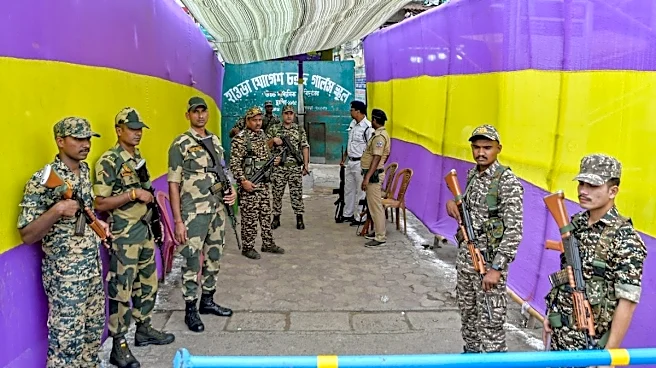
For every seat, there was one zonal observer and, for every two to three Assembly seats, one zonal and one police observer were appointed. For Bengal’s 294 Assembly seats, around 500 observers were appointed. These officers came from all states. A total of 2,500 companies of Central Armed Police Forces were deployed across the state.
Considering that one company has 100 jawans, around 2,50,000 paramilitary personnel were deployed. The district force coordinators and CAPF coordinators were all integrated and directly connected to the CEO’s war room.
The 24/7 functioning of the war room became the backbone of the entire polling process during the elections. The Bengal Election Commission’s first action was to remove the state police team from active polling duties. A few telephone numbers were widely circulated to ensure that anyone from even the remotest areas could connect with Manoj Aggarwal’s war room. All grievances from district election officers or the CEO office came to this war room.
Sources from the war room claimed that all grievances were sent to QRTs, or Quick Reaction Teams, or police observers, and were resolved within half an hour. Himanshu Kumar Lal, in the integrated control room, ensured that issues were resolved quickly and action-taken reports were sent to the CEO.
Manoj Aggarwal, who analysed polling booth and other election-related CCTV footage, understood the games of the powers that be. He came up with another formula. He instructed that CCTV cameras be installed on every vehicle used by officers and Quick Reaction Teams, from booth level to the control room, giving live pictures to the war room.
Sources in the war room admitted that common people were hesitant to come forward with complaints, but the minimum involvement of the state police and the impartial functioning of the Election Commission ensured that complaints started pouring in.
Sources said that the war room identified all the big goons, criminals and intimidators, and raids were conducted at their dens, thereby allaying fears among the masses that they were invincible. Before polling day, motorcycle movement was banned. Motorcycles had become an identity of criminals and were used by intimidators. According to sources, from April 22 to 29, more than 4,500 criminals were put behind bars and the rest were warned.
This gave confidence to the people and ensured that 15 per cent more voters came out to vote compared to the previous polls. Violence, which was a trademark of Left rule, was taken to another level by Mamata Banerjee’s TMC. The forces ensured that fear subsided and people came out to vote. The message is loud and clear in Bengal — gone are the days of gundaraj. Democracy always prevails.

/images/ppid_a911dc6a-image-177850408042741065.webp)


/images/ppid_a911dc6a-image-177849103370441920.webp)
/images/ppid_a911dc6a-image-177837142561233092.webp)
/images/ppid_a911dc6a-image-177840530208348941.webp)

/images/ppid_a911dc6a-image-177850923450937934.webp)