
Sonia Gandhi’s extraordinary political and personal journey is well known, although no biographer or journalist has had the gumption or occasion to speak to her about it directly. She has only edited books about her in-laws and husband, never about herself. A few stray comments to the few journalists who have access to her are the only crumbs that people have got from her in the past 35 years. So, tremendous pent-up interest from the reading public goes without saying.
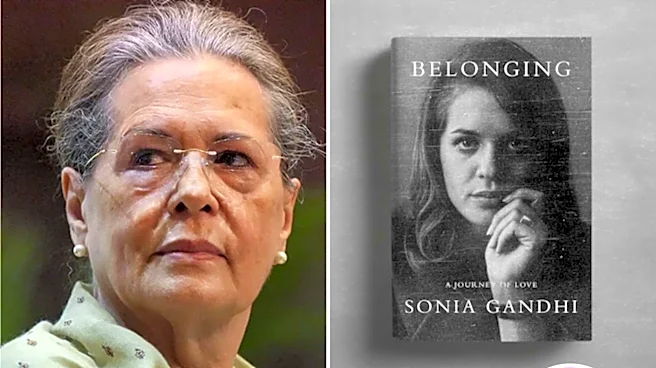
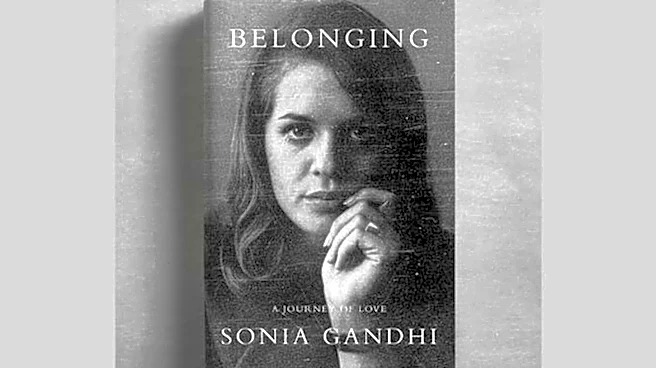
No wonder the US publisher Alfred Knopf has announced a 1 lakh-copy initial print run for Sonia Gandhi’s Belonging: A Journey of Love. A pretty working-class Italian girl from an obscure village married the handsomest scion of India’s most famous political dynasty and, after double
tragedies, reluctantly entered the tumultuous political arena herself and then inducted both her children. There is no doubt her memoir will sell exceedingly well both in India and abroad.
Janet Jagan, the American-born nurse (called “blue-eyed bhowgee”) who became President of Guyana in 1997 upon the death of her husband, Dr Cheddi Jagan, is the only other foreign wife with a journey comparable to Sonia Gandhi’s, albeit an even more active one right from when she arrived in her adoptive country. Jagan’s authorised biography, Janet, by Patricia Mohammed came out in 2024, but the life of an Italian ‘brown-eyed bhowgee’ in India will have a wider appeal.
The journalist Rasheed Kidwai wrote an “unauthorised” biography simply titled Sonia in 2003 that went into several editions. The bestselling Spanish author Javier Moro also wrote a racy one called The Red Sari in 2008, which was released abroad but got stonewalled by the Congress Party and prevented from being published in India for many years. It was finally published in India in 2015—only after the Congress lost the elections in 2014 and the government changed.
Now, ironically, there are sotto voce insinuations that official pressure is behind the Indian publisher—the same one that did Kidwai’s biography of Sonia—pulling out of her own memoir. Penguin Random House India apparently wanted some changes in the manuscript that Sonia Gandhi refused to accept. Given that the US publisher is part of the same company, the Indian branch crying off on its own is quite strange. Its notice “denying” that is anything but clarificatory too!
What then does the 544-page memoir contain that the Indian arm of PRH was concerned about? Congress circles allege online that Sonia Gandhi’s observations on Prime Minister Narendra Modi and the RSS (among others) were the sticking points, not any comment on contemporary political events. But a publisher cannot question an author’s take on people or events, as opinions are central to memoirs, as compared with biographies. So why back out on this untenable ground?
Moreover, if a gaggle of Indian publishers are reportedly only too happy to step up to publish what Penguin Random House would or could not, then the contents surely cannot be all that iffy, whether from a political or legal angle. What controversies and bans do, however, is whet appetites, whether about a book or a movie or indeed any bit of suppressed information, thereby increasing its reach. That even has a name: the Streisand Effect. Does that apply to this book?
Arguably, the Gandhis do not need to resort to stoking public interest, as they have never been short of it. Despite having been in “public life” for five generations now, they have remained media-averse. They have been even less accessible than the British royal family, who at least have had a clutch of biographies—authorised and not so—portraying them warts and all. But Sonia Gandhi’s book will be the first one by a member of the clan, so the anticipation is understandable.
Neither Jawaharlal Nehru nor Indira Gandhi nor her sons left any memoirs of their years in power. Nehru’s An Autobiography only deals with his life well before Independence rather than his years as Prime Minister. He and Indira Gandhi only oversaw the publication of their speeches and letters. Unfortunately, both Rajiv Gandhi and his younger brother Sanjay passed away before they probably even reached the stage of contemplating any autobiographies.
Sonia Gandhi published a pictorial memoir of her husband a year after his tragic demise, but that is not quite the same. And while some may want to read what Rahul Gandhi makes of his three decades as an MP and Prime-Minister-in-Waiting, it may be premature to expect one from him just yet. Thus, Sonia Gandhi’s memoir will be the only personal peek into the dynasty that the world can expect in the near future. Why would any publisher not jump at it?
It is certain to be a bestseller, but a bit of controversy also has a salutary effect on sales. To that extent, the memoir has hardly hit a roadblock with the so-called pull-out by the Indian publisher. Whispers of official annoyance will rouse curiosity and also rally the troops, so to speak, for the Congress Party, with the UP elections round the corner. The crucial state, after all, has been that family’s karmabhoomi for generations, though none of them have lived there for over a century.
This December, Sonia Gandhi will turn 80. She is already the longest-lived Gandhi family member, barring Nehru’s sister Vijayalakshmi Pandit, who passed away at the ripe old age of 90 in 1990. Nehru died at 74, Indira Gandhi at 66, Rajiv Gandhi at just 46 and Sanjay Gandhi at 33. In her nearly 60 years as a Gandhi bahu, she has seen the family pass through its glory years, downfall, revival, tragedy, eclipse and reinvention. These events, described in her own words, will be invaluable.
The author is a freelance writer. Views expressed in the above piece are personal and solely those of the author. They do not necessarily reflect News18’s views.

/images/ppid_59c68470-image-178816252400392880.webp)