
/images/ppid_59c68470-image-177061758044051537.webp)
/images/ppid_59c68470-image-177061752503670543.webp)
/images/ppid_59c68470-image-177061755522237761.webp)
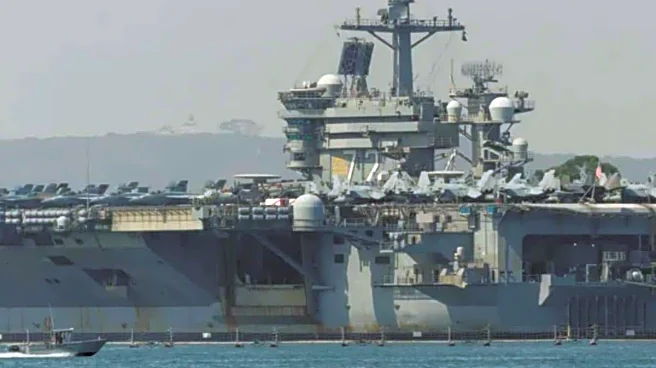
As a formidable US naval presence, spearheaded by the USS Abraham Lincoln carrier strike group, takes up positions in the Middle East, the spectre of a direct military confrontation between Washington and Tehran has reached its highest point in years. President Donald Trump has repeatedly warned that “time is running out” for the Iranian leadership, threatening “speed and violence” if the Islamic Republic does not halt its nuclear enrichment and cease its violent suppression of domestic protests. While the White House describes the deployment of this “massive armada” as a tool for stability and deterrence, regional observers fear that the confluence of external pressure and internal Iranian instability has created a powder keg.
A Regime Under Siege
Tehran enters
January 2026 in an arguably more precarious position than at any point since the 1979 Revolution. Historically, the regime’s deterrence was built on two pillars: its “Axis of Resistance” proxy network and its domestic security apparatus. However, both have been severely compromised. Following the “Twelve-Day War” in June 2025, Israeli and US airstrikes decimated much of Iran’s sophisticated air defences, including Russian-made S-300 systems, and damaged critical drone and missile production facilities.
Simultaneously, the collapse of the Bashar al-Assad regime in Syria and the systematic weakening of Hezbollah and Hamas have left Iran without its traditional regional buffers. Domestically, the situation is equally dire. Since December 28, 2025, a nationwide uprising sparked by the collapse of the rial has evolved into a demand for total regime change. Reports from human rights monitors suggest a brutal crackdown has resulted in thousands of deaths and a near-total internet blackout, further isolating the clerical leadership from the global stage.
The Retaliatory Arsenal
Despite these setbacks, it would be a strategic miscalculation to view Iran as “defenceless”. While its air force consists of ageing airframes and its radar coverage is “practically naked” in some sectors, Tehran retains a formidable asymmetry in firepower. Its arsenal of thousands of ballistic and low-flying cruise missiles remains the largest in the Middle East. Experts note that many of these assets are stored in “missile cities”—deeply buried underground silos designed to survive a first-strike scenario.
The concern for US planners is that a regime facing an existential threat—both from the skies and its own streets—may no longer adhere to the “measured retaliation” seen in previous decades. Historically, Iran’s responses, such as the 2020 strikes on Al Asad airbase, were calibrated to avoid a total war. However, in 2026, the Islamic Republic may calculate that it has “nothing left to lose.” Potential retaliatory strikes could target:
Global Energy Chokepoints: Iran possesses the capability to harass civilian shipping in the Strait of Hormuz or launch drone swarms against Saudi and Emirati oil infrastructure, which could spike global energy prices overnight.
Regional US Bases: Numerous American facilities in Qatar, Bahrain, and the UAE are within easy reach of Iranian medium-range missiles.
Cyber Warfare: Tehran has invested heavily in offensive cyber capabilities designed to disrupt financial markets and critical infrastructure in the West.
The Doctrine of Anticipatory Defence
Adding to the tension is a recent shift in Iranian military doctrine. In early January 2026, Tehran’s Defence Council signalled that it may no longer wait to be attacked before responding. By adopting a posture of “anticipatory defence,” the regime has widened its trigger threshold, suggesting it could strike if it perceives “objective signs of threat”.
With the US armada now in striking distance and President Trump’s rhetoric remaining uncompromising, the region is trapped in a classic security dilemma. While the US seeks to force Tehran to the negotiating table through a show of overwhelming force, the very presence of that force may compel a cornered Iranian leadership to lash out in a desperate bid for survival.
/images/ppid_a911dc6a-image-177061852520461579.webp)

/images/ppid_a911dc6a-image-177061825419274749.webp)
/images/ppid_a911dc6a-image-177061828450475546.webp)
/images/ppid_a911dc6a-image-177061822453038648.webp)