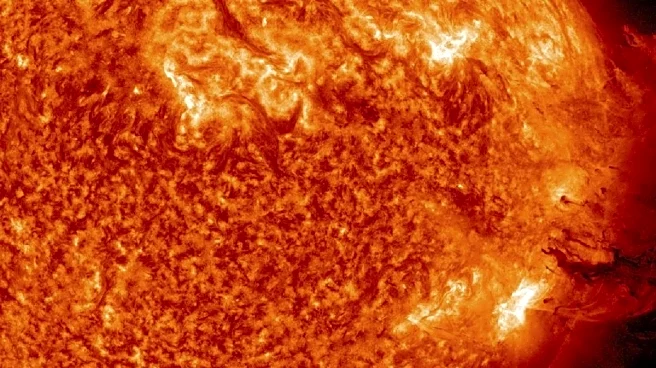




A rare and powerful solar radiation storm — the strongest in more than two decades — is currently impacting Earth, US space weather officials said, triggering severe geomagnetic storm conditions and raising the possibility of vivid aurora displays across large parts of the United States.
The US National Oceanic and Atmospheric Administration’s Space Weather Prediction Center (SWPC) said an S4-level severe solar radiation storm is now in progress, marking the most intense event of its kind since October 2003.
“This is the largest solar radiation storm in over 20 years,” the SWPC said in an update, noting that the last time S4 conditions were recorded was during the powerful solar storms of October 2003.
Solar radiation storms occur when high-energy
particles from the Sun accelerate toward Earth, potentially affecting satellite operations, space missions and aviation at high latitudes. According to NOAA, the primary impacts of the current storm are expected to remain largely limited to space-based and aviation systems.
Shortly after the radiation storm intensified, severe geomagnetic storm conditions were also recorded. The SWPC confirmed that G4-level geomagnetic storm conditions were first reached at 2:38 pm EST following the arrival of a coronal mass ejection (CME) shock.
An S4 severe solar radiation storm is now in progress – this is the largest solar radiation storm in over 20 years. The last time S4 levels were observed was in October, 2003. Potential effects are mainly limited to space launch, aviation, and satellite operations. pic.twitter.com/kCjHj4XYzB
— NOAA Space Weather Prediction Center (@NWSSWPC) January 19, 2026
Calling the event “historic”, space physics researcher and aurora photographer Vincent Ledvina said the storm had crossed a significant threshold. “We have now officially crossed the S4 severe radiation storm boundary,” Ledvina said, noting that the last comparable event occurred just days before the infamous Halloween solar storms of 2003.
We have now officially crossed the S4 / SEVERE radiation storm boundary! The last S4 radiation storm occured on October 29, 2003 before the infamous G5 Halloween storms. This is a historic event. https://t.co/Lq88TKoh7S pic.twitter.com/pDg1fxb6RP
— Vincent Ledvina (@Vincent_Ledvina) January 19, 2026
Meteorologist Max Velocity warned that the geomagnetic storm could lead to widespread aurora visibility. “A major geomagnetic storm is coming tonight,” he said, adding that northern lights could potentially be visible as far south as Florida if conditions align.
MAJOR GEOMAGNETIC STORM is coming TONIGHT! 😲
Tonight has the potential to be a big show of Northern Lights. A G4 Geomagnetic storm is possible, which is the 2nd strongest storm possible. Northern Lights could be visible as far south as FLORIDA! Get those cameras ready! pic.twitter.com/1OVlxRRzA1
— Max Velocity (@MaxVelocityWX) January 19, 2026
NOAA said that during severe geomagnetic storms, disturbances in Earth’s magnetic field can fluctuate between moderate and severe levels over the course of the event. Infrastructure operators and satellite controllers have been notified to take precautionary measures.
Possible effects include temporary voltage regulation issues, increased chances of satellite anomalies, and longer or more frequent GPS signal degradation, NOAA said, adding that most impacts are manageable with mitigation steps.
For the general public, NOAA advised staying informed through official updates and, where skies are clear and nighttime conditions permit, watching for auroras. If G4 conditions persist or intensify, the auroral oval could expand farther south across much of the central United States, reaching northern California.
The Space Weather Prediction Center, based in Boulder, Colorado, said it would continue to monitor the storm closely and issue updates as conditions evolve.