

/images/ppid_59c68470-image-176968270118370248.webp)
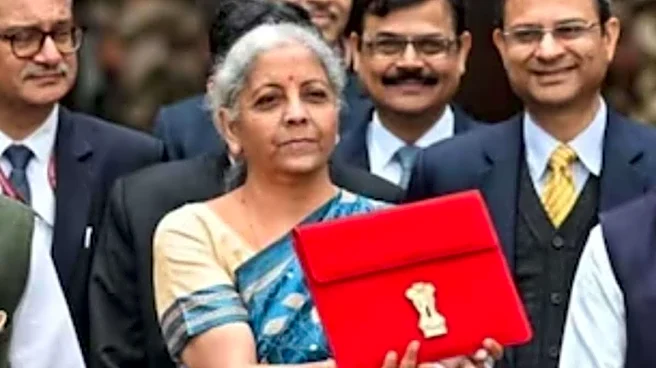
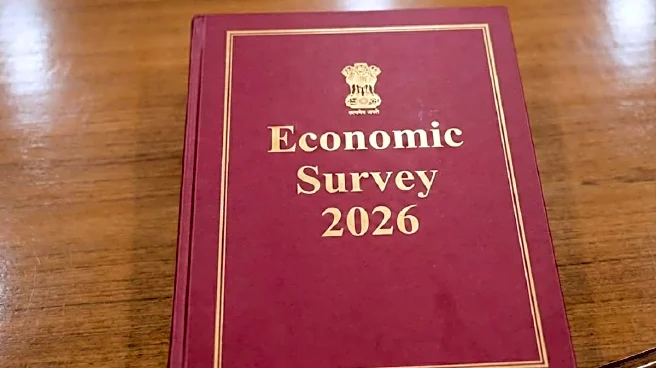
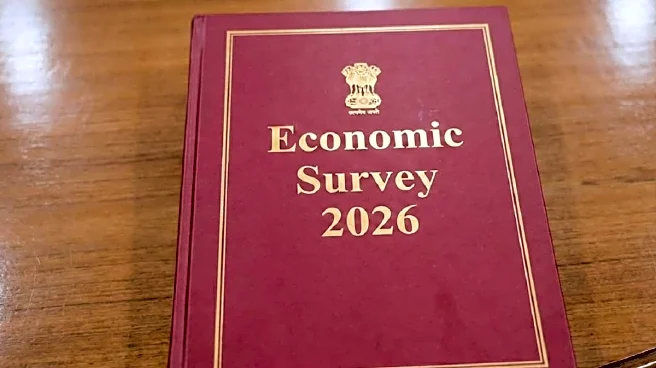
India rarely gets an Economic Survey that reads like both a diagnostic report and a field manual for nation-building. The Economic Survey 2025–26 does exactly that. It is confident about India’s fundamentals, clear-eyed about a harsher world, and unapologetic about the scale of effort required to reach Viksit Bharat.
At its core, the Survey makes a simple argument: India is doing many things right—but the world has changed—and so the Indian state must evolve faster than ever. The headline is not triumphalism; it is preparedness.
India’s Strong Position: Fundamentals That Deserve Confidence
The Survey opens with a review of India’s recent resilience and policy momentum. It notes strong growth through the post-COVID period and a continued improvement across quarters, alongside a more supportive monetary stance.
It also flags measurable progress on fiscal consolidation: the Union fiscal deficit at 4.8% of GDP (below the budgeted 4.9%) and a target of 4.4% for FY26, continuing the path promised from the 9.2% deficit of FY21.
The Survey also records a significant reputational milestone: credit rating upgrades from three agencies in 2025, including an S&P upgrade that it describes as India’s first from a major agency in nearly two decades.
And then comes a paragraph that, in many ways, is the Survey’s “India in one breath” snapshot: “Growth is good; the outlook remains favourable; inflation is contained… banks are healthy… corporate balance sheets are strong…”
That’s not chest-thumping. It’s a baseline for ambition: India has the macroeconomic and institutional foundations to aim higher—if it upgrades its execution capacity.
The Paradox: Macro Success No Longer Buys Insulation
Here is the Survey’s latest warning: the global system is no longer a friendly rewards programme for good macro behaviour.
“The paradox of 2025 is that India’s strongest macroeconomic performance in decades has collided with a global system that no longer rewards macroeconomic success with currency stability, capital inflows, or strategic insulation.”
Geopolitics, trade coercion, fragmented supply chains, and volatile capital flows now shape outcomes. The Survey lays out three global scenarios for 2026, ranging from “managed disorder” to a riskier multipolar breakdown, to a lower-probability but high-impact “systemic shock cascade.” The message: even if India is “relatively better off,” it is not automatically insulated.
The Strategy: Resilience Without Losing Speed
This is where the Survey gives India an operating doctrine for the next phase:
“The appropriate stance for 2026 is therefore one of strategic sobriety rather than defensive pessimism.”
And its most memorable line—destined to be quoted in boardrooms and policy notes alike: “India must run a marathon and sprint simultaneously, or run a marathon as if it were a sprint.”
In practice, that means India must maximise domestic growth while also building buffers—redundancy in supply, diversified routes and payment systems, and liquidity cushions—because volatility may be an enduring feature, not a one-off event.
The Governance Shift: From Regulation To Capability
The Survey is blunt that India’s next leap depends less on new slogans and more on state capacity—especially process capacity. It makes a crucial distinction: “Policy reforms do matter. Process reforms arguably more so.”
Why? Because processes determine the daily interface between the government and the governed. When those processes become predictable, time-bound, and enabling, they turn into growth accelerators. The Survey points to encouraging signs in deregulation and smart regulation initiatives by states, signalling a shift “from regulation and control to enabling.”
The Big Idea: The Entrepreneurial State
Perhaps the Survey’s most powerful concept is its call for a state that can act decisively in uncertainty—not wait for perfect information.
“A deeper shift towards entrepreneurial policy making under uncertainty: a state that can act before certainty emerges, structures risk rather than avoids it, learns systematically from experimentation, and corrects course without paralysis.”
It clarifies what this means in practice: a state that can structure risk, learn through experimentation, and correct course without paralysis. It cites early examples already underway—mission-mode platforms (like semiconductors and green hydrogen), procurement reforms that enable first-of-a-kind domestic innovation, and deregulation compacts that replace inspection-heavy control with trust-based compliance.
This is exactly the kind of governance architecture a $30+ trillion ambition demands: strategic direction + competitive markets + enabling regulation + societal legitimacy.
Manufacturing, Exports & Cost Of Capital: The Hard Constraints
The Survey is equally candid about the macro-structural constraints that can quietly cap India’s rise.
It argues that India’s high cost of capital is not just a banking spread story; it is linked to a macro reality: persistent current account deficits and reliance on foreign savings imply a risk premium. Hence its broader goal: India must “transform itself into a surplus-generating economy.”
It returns repeatedly to a truth many Indians intuitively understand: service excellence is valuable, but manufacturing ecosystems anchor durable currency stability and broad-based capability upgrades. The Survey notes that in recent years, services exports have outpaced goods exports, and stresses that services cannot substitute for goods-based export ecosystems that underpin long-term external stability.
Why This Matters For Viksit Bharat
The Survey does something rare: it connects macroeconomic outcomes to national character and time preference. It invokes the distinction between Śhreya (enduring good) and Preya (fleeting comfort), and argues for “delayed gratification” as a civic and policy posture. The concluding counsel is crisp: in a world being reshaped for years, India must build resilience, innovate relentlessly, and stay the course toward Viksit Bharat, rather than chase quick fixes.
The Survey even raises India’s estimated potential growth to 7.0%, up from 6.5% three years ago, signalling that sustained reforms and public investment are lifting the underlying frontier.
The Takeaway
Read as a whole, the Economic Survey 2025–26 is not merely optimistic—it is demanding. It says: India has earned the right to dream bigger because its fundamentals are strong; but India must also earn the future through execution—through process reforms, deregulation that enables scale, a manufacturing-export push that strengthens external resilience, and a state that can act boldly under uncertainty.
If Viksit Bharat is the destination, the Survey tells us what kind of vehicle we need: not a heavier state, but a smarter, faster, more learning-oriented state—and a society willing to choose the long-term good over short-term comfort.
And that may be the Survey’s most meaningful conclusion of all: the evidence suggests we will choose well.
The author is an angel investor and startup mentor for the Atal Innovation Mission, Government of India, and the Atal Incubation Centre-Rambhau Mhalgi Prabhodhini. He is presently the Convenor (Western Maharashtra) of the BJP Intellectual Cell and has recently co-edited the book Modi’s North East Story. Views expressed in the above piece are personal and solely those of the author. They do not necessarily reflect News18’s views.