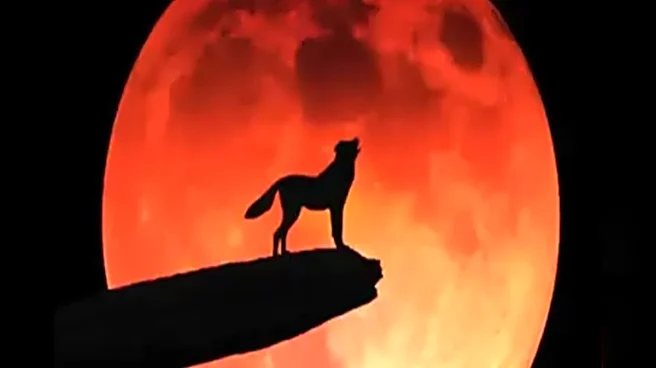




The start of 2026 will be anything but quiet, as the year opens with a stunning astronomical event. On January 3, 2026, the first full moon of the year, known as the ‘Wolf Moon’, will light up the night sky as a supermoon.
This is not just the first full moon of 2026, but also one of the biggest and brightest full moons of the year. On this day, the Moon will be at perigee, its closest point to Earth, making it appear about 14% larger and nearly 30% brighter than an average full moon.
Exact Timing Of The Full Moon
The Moon will reach peak fullness at 10:03 am GMT, which corresponds to 3:33 pm IST in India, on January 3. However, the most breathtaking views will occur after sunset, when the Moon rises into the evening sky.
On the evenings of January 2 and January 3, the Moon
will appear unusually low on the eastern horizon. This positioning creates the famous ‘moon illusion’, an effect that makes the Moon look larger, more golden, and dramatically closer as it rises.
In India, the supermoon will become visible between 6 and 7 pm and will remain bright throughout the night. For the best experience, observers are advised to watch from open fields, rooftops, or rural areas, away from city lights and pollution.
Why Is It Called The ‘Wolf Moon’?
The name ‘Wolf Moon’ comes from ancient Native American and European traditions.
January was a time of harsh cold, long nights, and food scarcity. During this period, wolves were often heard howling outside villages in search of food, giving the January full moon its evocative name.
What Exactly Is A Supermoon?
A supermoon occurs when a full moon coincides with perigee, the Moon’s closest approach to Earth. In January 2026, the Moon will be just 356,800 kilometres away, roughly 10 per cent closer than its average distance. This proximity makes the Moon appear larger, brighter, and especially photogenic.
Astronomers say this Wolf Moon supermoon will be the first of three to four supermoons expected in 2026, making it an exciting start for skywatchers.
Visibility Across India
The spectacle will be visible across the country, including cities such as Delhi, Mumbai, Kolkata, Chennai, and Bengaluru, provided the skies are clear.
In North India, cold winter air and clearer skies are likely to enhance the view, while in South India, the Moon will still appear impressively large as it rises in the eastern sky during the evening.
/images/ppid_a911dc6a-image-17710654257455666.webp)










/images/ppid_a911dc6a-image-177106302538573741.webp)