
/images/ppid_59c68470-image-177063256546745294.webp)
/images/ppid_59c68470-image-17706325339595308.webp)
/images/ppid_59c68470-image-177063260024959924.webp)
Preparations are underway for the annual Ganga Sagar Mela, and this year the West Bengal government is set to initiate a long-pending road connectivity project to Sagar Island. Chief Minister Mamata Banerjee is scheduled to lay the foundation stone of the proposed Ganga Sagar Bridge during her visit on January 5, when she will also review the final arrangements for the mela.
Long-Pending Demand for Direct Road Connectivity
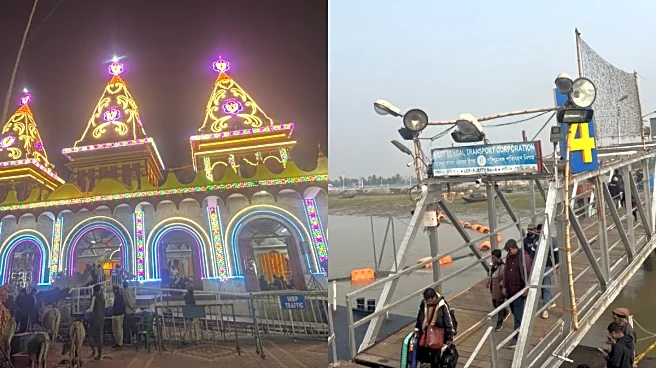
There has been a longstanding demand for a direct road link between Kakdwip and Sagar Island. The proposed bridge will be constructed over the Muriganga (also known as the Buri Ganga) river and will connect Kakdwip with Sagar Island. At present, vehicles can travel by road only up to Kakdwip, after which passengers and vehicles must cross the river by ferry or trawler. The ferry crossing
takes around 45 minutes one way and is often disrupted due to fog, tidal conditions, and siltation, leading to frequent inconvenience for pilgrims during the mela.
Once the bridge is completed, the travel time for the same stretch is expected to reduce to approximately five to seven minutes.
Project Cost, Timeline, and Land Acquisition
The approved cost of the Ganga Sagar Bridge project is Rs 1,670 crore. However, the construction tender has been awarded to a private company at Rs 1,567 crore. The bridge is planned as a four-lane structure with a total length of 4.757 kilometres and is scheduled to be completed within four years.
For the construction of the bridge, 12.92239 acres of land have already been acquired—7.85349 acres on the Kakdwip side and 5.0689 acres on the Kachuberia side of Sagar Island. The remaining land acquisition process is expected to be completed within the next 15 days. Sources in the Public Works Department said the tender process has been finalised and construction work will begin immediately after the foundation stone-laying ceremony.
Chief Minister Mamata Banerjee has on several occasions stated that the state government had repeatedly requested the Centre to build a bridge over the Muriganga river to connect Sagar Island.
Expected Benefits of the Bridge
The bridge is expected to benefit not only the lakhs of pilgrims who visit during the Ganga Sagar Mela each year but also nearly four lakh residents of Sagar Island. Given the island’s vulnerability to cyclones, the bridge is expected to significantly improve connectivity, facilitate faster post-cyclone rescue and relief operations, and strengthen disaster response mechanisms. The project is also expected to improve the transportation of agricultural and industrial products from the island and create potential for the development of a river port in the future.
Extensive Arrangements for Ganga Sagar Mela
A large influx of pilgrims is expected during this year’s Ganga Sagar Mela. To manage the movement of devotees, more than 2,500 buses will be deployed to transport pilgrims between Ganga Sagar, railway stations, and the airport.
A total of 21 jetties, including 11 temporary ones, will be made operational during the mela. In addition, 13 barges—up from just one in the previous year—with an average carrying capacity of 1,000 to 2,500 persons each will be deployed. Around 45 vessels and 100 launches will operate from Lot-8 and Namkhana for ferrying pilgrims between the mainland and Sagar Island.
All vessels and launches operating between the mainland and the island will be fitted with advanced GPS devices integrated with specialised software. These will be monitored in real time from the Mega Control Room at Sagar.
Crowd Control and Technology-Driven Monitoring
For Ganga Sagar Mela 2026, the district administration will deploy NavIC (Navigation with Indian Constellation) technology developed by ISRO. This satellite-based navigation system will be used to monitor all vessels and buses carrying pilgrims, providing accurate location data and precise timing information. Automated alerts will be generated at the Mega Control Room if any vessel deviates from its designated route, enabling real-time tracking and rapid response.
To regulate crowd movement, approximately 54 kilometres of metal and temporary barricading is being installed. Directional signage will be placed along all major roads, mela locations, and pilgrim facilities. Roads will also be illuminated with different colours to enable easy identification of designated pilgrim routes.











/images/ppid_a911dc6a-image-177063322874071402.webp)