
/images/ppid_a911dc6a-image-177100572282276854.webp)
Uttarayan, celebrated as Makar Sankranti across many parts of India, is one of the most revered festivals in India. Kite flying remains the heart of the festival which draws people of all ages outdoors to celebrate. But beneath the festive cheer, a hidden danger returns every year: sharp kite strings or manjha.
Glass-coated and chemical-laced manjha, often used to gain an edge in kite battles, poses a serious threat to pedestrians, birds and especially two-wheeler riders. In Surat, one man’s personal loss has transformed into a long-standing public safety mission.
Surat Man’s Thoughtful Initiative On Uttarayan
Brijesh Verma, who lives in Surat’s Adajan area, knows this danger far too well. Around two decades ago, his close friend stepped out during
Uttarayan without any protective gear. A stray kite string suddenly struck his neck that left him critically injured. He died during treatment.
The incident shocked Brijesh and in order to save others from the same fate, he began working toward spreading awareness about kite-string safety.
Turning Loss Into Public Awareness
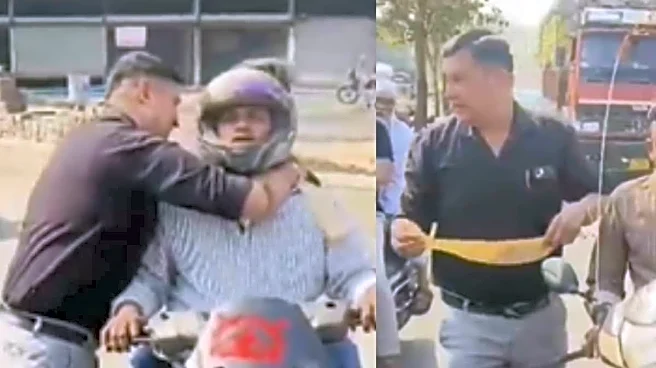
For the past 15 years, Brijesh has been actively involved in road safety initiatives aimed at reducing kite-related injuries. As the president of a local road safety council, he started distributing protective neck safety belts to two-wheeler riders during Uttarayan.
Every year, volunteers at four major roads across the city offer these neck guards free of cost. The aim is straightforward: protect riders from potentially deadly cuts caused by flying or dangling manjha.
Here’s how you can celebrate safely:
What Protective Gear Should You Use?
Make sure you wear gloves, full-sleeved clothes and closed shoes while flying kites.
Motorcyclists should opt for full-face helmets.
Use neck guards or collars designed to block sharp strings.
Sunglasses or caps can help shield eyes and face from stray threads.
Where To Fly Kites?
Opt for open grounds or parks which are away from traffic and power lines.
If flying from terraces, keep distance from edges and remove obstacles.
Avoid rooftops without railings or safety barriers.
Stay clear of electrical wires to prevent serious accidents.
Avoid using glass-coated manjha to reduce overall risk. Instead opt for cotton threads.
How Should Children Be Supervised?
Always keep an eye on children during kite flying.
Stop them from running on slippery terraces or leaning over edges.
Do not allow kids to chase fallen kites onto roads or unsafe areas.
Limit the number of people on rooftops to avoid overcrowding.
What Road Precautions Should Be Taken?
Ride or drive slowly in kite-flying zones.
Pedestrians should also cover their neck.
Watch out for hanging or loose strings on roads.
Dispose of used strings properly to protect birds and animals.
What Should You Do If Someone Gets Injured?
Clean minor cuts immediately using a basic first-aid kit.
Seek medical help right away for deep wounds especially near the neck or eyes.
Inform local animal rescue teams if birds are injured by strings.
What Safety Gear Do Two-Wheeler Riders Need Most?
Full-face helmets to protect the face and eyes.
Neck collars made with layered material like rexine, metal chains or aluminium.
Wear gloves and full-sleeved jackets for added protection.
What Type Of Bike Attachments Can Help Prevent Injuries?
Install U-shaped metal rods or wire guards near handlebars. These attachments help catch and divert stray strings.
Many safety drives distribute these guards free during Uttarayan.
Even simple homemade versions can offer some protection.
What Extra Precautions Can Riders Take?
Wrap a scarf or muffler around the neck under the collar.
Avoid elevated roads and high-speed riding during peak kite hours.
Stay alert and slow down in crowded festival areas.
Encourage the use of cotton threads instead of dangerous manjha.
How Effective Are Neck Collars Really?
Properly designed neck guards can prevent up to 90 per cent of serious injuries.
Multi-layered collars with metal or aluminium inserts work best.
Gujarat Police and civic bodies actively promote their use during Uttarayan.
What Helmet Features Matter Most?
Choose full-face helmets with anti-fog, UV-protected polycarbonate visors.
Ensure the visor is shatter-resistant and locks securely.
Always fasten the chin strap properly.
Prioritise safety standards over style or convenience.
Which Helmets Are Best for Uttarayan?
Arai Corsair-X: It features a multi-layered shell and VAS visor system for maximum protection.
HJC RPHA 12: Lightweight carbon build with anti-fog visors.
STUDDS Full-Face Helmets: An ISI-certified company that provides numerous helmet options that are reliable.


/images/ppid_a911dc6a-image-177101752951095973.webp)


/images/ppid_a911dc6a-image-177101403147018469.webp)
/images/ppid_a911dc6a-image-177101053501199609.webp)
/images/ppid_59c68470-image-177101003680064644.webp)