



In any state, the Secretariat is a seat of governance. Ministers may come and go, governments may change, but the building has traditionally remained the permanent address of governance.
But not in Tamil Nadu.
Here, the Secretariat has often been a political football, with Chief Ministers changing its location, perhaps in the name of it being “cramped and needing refurbishment”, but always with something more at play.
When Jayalalithaa proposed building a new Secretariat at Queen Mary’s, the government faced protests. Even the Kotturpuram project did not take off. But it was DMK supremo M. Karunanidhi who refused to work out of the place where Jayalalithaa had exercised power and built the Omandurar complex.
That did not last long. Soon after the
DMK fell out of power, Jayalalithaa returned and not only converted the Secretariat into a multi-speciality hospital, but also went right back to Fort St George to function.
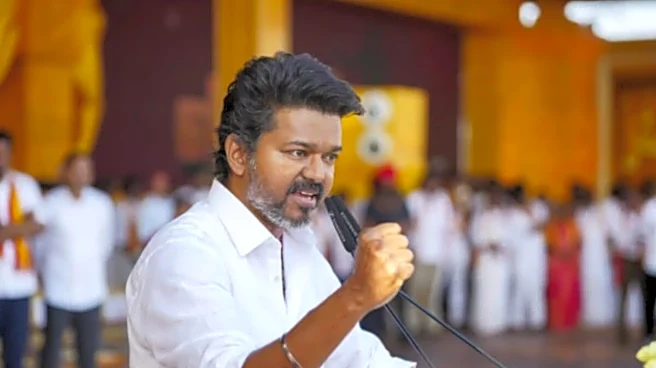
And now comes the next change — CM Vijay’s plan for a new Rs 1,200-crore Secretariat and Assembly complex at Foreshore Estate, or Pattinapakkam. The government has identified 21.76 acres of land for the project.
While this plan may still be on paper, many are questioning the reasons. The proposed site is along the Marina beach coastline. One question being raised is: when the unfortunate tsunami hit, were all these places along the coast affected? Is it right to put the entire Secretariat, MLAs and government offices along the very same coastline?
In Tamil Nadu, the address of power has never been just an address.
A Secretariat is, technically, where files move, ministers meet, bureaucrats work and governments function. In political terms, however, the building from which a Chief Minister rules can become something far more loaded — a symbol of who owns the moment, whose legacy is being embraced and whose is being quietly packed into boxes.
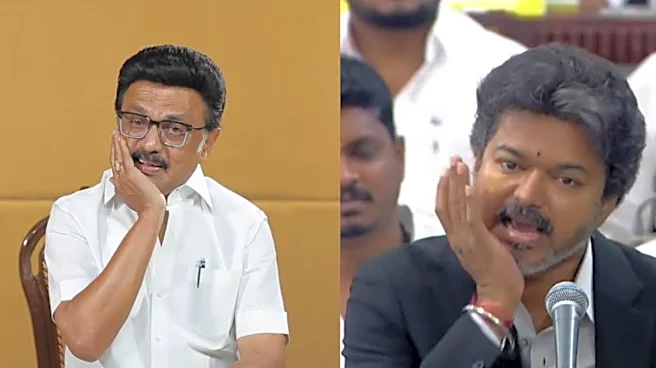
Present TN Chief Minister C. Joseph Vijay is looking at shifting his office, along with some key departments, to the tenth floor of Namakkal Kavignar Maligai within the Fort complex — effectively beginning the administrative exit from the historic seat of government even before the new complex is built.
And there is the delicious political irony: Fort St George may finally be too cramped for modern government, but it has never been too small to contain Tamil Nadu’s political history.
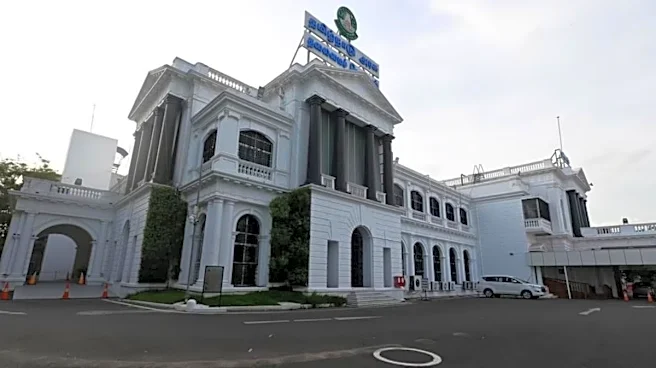
The British began building Fort St George in 1639. It became the seat of the Madras Presidency and, after Independence, the administrative headquarters of Tamil Nadu.
But the interesting story is not that successive governments have wanted to leave it. It is why they wanted to leave — and what happened when they did.
The first serious attempt came under MG Ramachandran in 1983. Space constraints were cited as the reason to look beyond the Fort. The idea, however, never became a reality.
Then the AIADMK, under its supremo Jayalalithaa, came to power.
In 2003, J Jayalalithaa wanted to do what politicians often like to do when they come to power: redraw the roadmap and, in the process, perhaps redraw the memory of power.
Her government considered moving the Secretariat and Assembly out of Fort St George and spoke of creating an administrative city near Sholinganallur. But because building an entire administrative township would take years, a more immediate solution was proposed — a new Secretariat on the Marina beachfront, which meant the premises of Queen Mary’s College.
The proposal to demolish the historic women’s college on the Marina turned into a major protest, with students, staff, alumni, heritage activists and political opponents rallying against the plan. Thousands protested. The government eventually had to back away.
Jayalalithaa’s next idea was Kotturpuram, on land where the Anna Centenary Library would eventually come up. There was even a bhoomi pooja in 2003, attended by her ministers. But that Secretariat never materialised either.
Then the political wheel turned.
DMK supremo M Karunanidhi returned to power and did what his predecessor had struggled to do: he actually built a new Assembly-Secretariat complex.
This was the Omandurar Government Estate complex on Anna Salai, which was inaugurated in 2010. It was modern, imposing and meant to become the new nerve centre of Tamil Nadu’s government.
Karunanidhi’s decision, DMK insiders say, to build the Omandurar Secretariat was driven by a very real administrative problem — Fort St George could no longer comfortably accommodate an expanding government. The heritage complex had severe space constraints, and government departments were scattered across different buildings.
The idea behind Omandurar was to bring the Assembly, the Chief Minister, ministers and the administrative machinery under one roof.
But in Tamil Nadu politics, it would be very naive to pretend that the building was only about administration.
It was Karunanidhi versus Jayalalithaa — two political adversaries for whom even buildings could become markers of political identity.
The new Secretariat was very much Karunanidhi’s project. He chose the site, pushed the construction and saw the Assembly move there in 2010. It was inaugurated by Prime Minister Manmohan Singh, and the complex was presented as a modern, state-of-the-art, green administrative centre.
But there was a problem.
The person who might next occupy that seat of power was Jayalalithaa. And Jayalalithaa had made her position abundantly clear even before the 2011 election. She had criticised the new complex and said that if she returned to power, her government would function from Fort St George.
The elections happened. Jayalalithaa won. And one of the first things her government did was move the Secretariat and Assembly back to Fort St George.
That is where the story stops being merely about architecture.
Jayalalithaa insisted that the decision was administrative, not political. Her argument was that the Omandurar complex had been opened before it was fully ready, with ministers and some departments operating there while other departments remained at Fort St George.
That, she argued, meant the government machinery was split between two locations and was inefficient.
Her critics saw something else: a newly elected government deliberately abandoning the most visible administrative monument of its political rival.
And the symbolism was hard to miss.
Karunanidhi had built a new Secretariat. Jayalalithaa refused to rule from it. The building Karunanidhi had created as the new centre of political power was eventually converted into the Tamil Nadu Government Multi Super Speciality Hospital and stands as a stark reminder of Tamil Nadu politics of space.
That is why the current move by the TVK deserves to be watched politically, even if the government’s reasons are entirely administrative.
There are perfectly legitimate arguments for moving out. The Fort is a heritage precinct. There are restrictions on new construction. Offices are cramped. Parking and modern infrastructure are difficult. Government employees have complained that some departments are operating in severely congested spaces.
But in Tamil Nadu, buildings acquire political meanings whether governments intend them to or not.
A new Secretariat is never merely a new Secretariat. It becomes the Secretariat of that government.
Now comes Vijay’s government.
His government has announced a ₹1,200-crore complex and says Fort St George will ultimately be conserved as a heritage structure for future generations.
That is, on paper, a sensible decision, say many: move the machinery of government into a purpose-built modern complex and preserve the old Fort as history.
But Tamil Nadu politics has taught us one thing about Secretariats: the files may move, but the politics follows them.
Because the real question is not merely where the next Secretariat will be. It is what the new address will come to represent.
It is the fact that, in Tamil Nadu, even a change of address can become a change of political inheritance.
The irony is that every Chief Minister who has tried to move the Secretariat has had to negotiate with the same invisible tenant: political history.
Fort St George has survived empires, governments, Chief Ministers and political rivalries.
This is yet another piece of history it will stand to see.